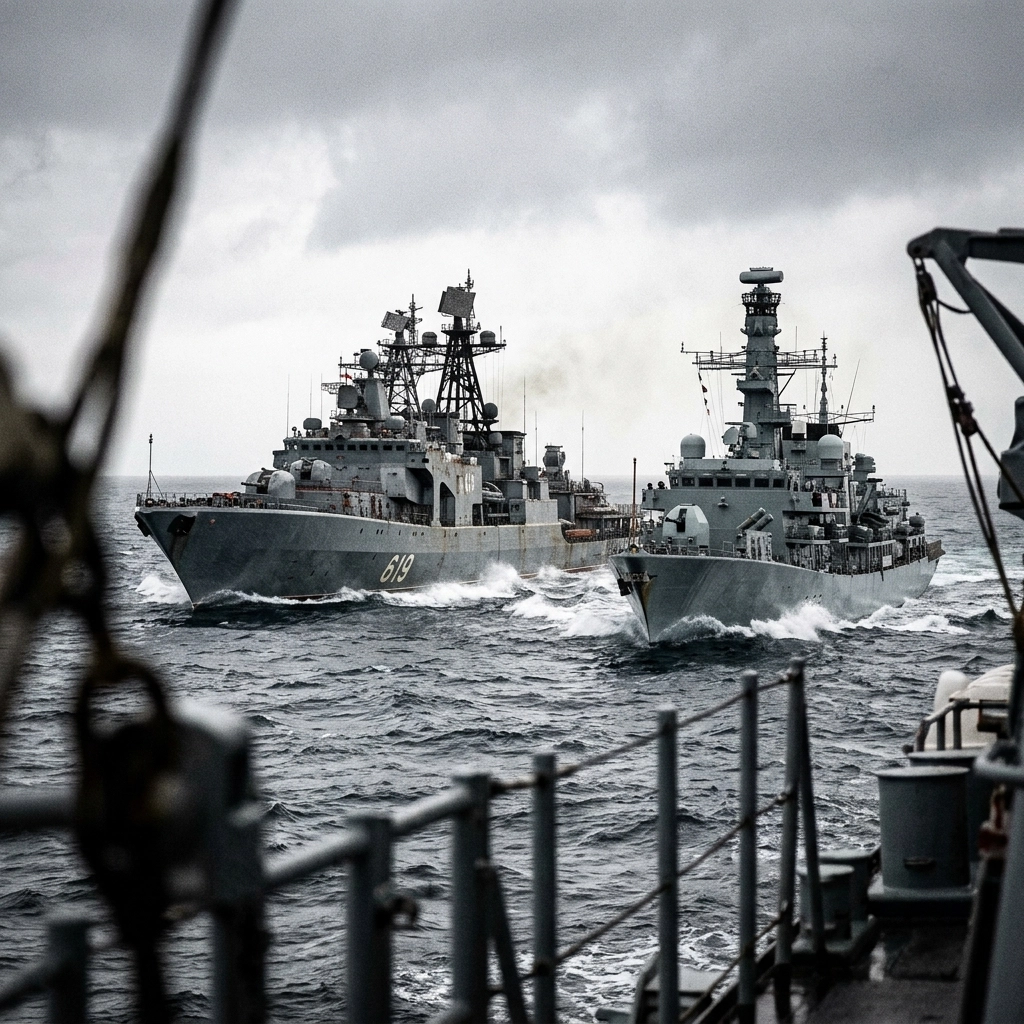
While most of the headlines regarding global conflict focus on land-based movements and traditional air strikes, there is a much quieter, more shadow-filled battle taking place just off our shores. For those of us following independent news UK, it is becoming increasingly clear that the deep blue is no longer just a highway for trade; it is a complex chessboard. This secret sea war involves high-stakes interceptions, advanced surveillance, and a constant game of cat and mouse between the Royal Navy and Russian vessels. It is a struggle that rarely makes the evening news in full detail, but it represents one of the most significant challenges to our national security and the stability of the global economy.
The reality of this maritime friction is often hidden in plain sight. Every few weeks, a brief report might surface about a British frigate escorting a Russian destroyer through the English Channel. To the casual observer, it looks like a routine bit of naval etiquette. However, look closer and you will find the untold stories of crews working around the clock to monitor "shadow fleets" and research vessels that seem far more interested in the seabed than in marine biology. This is the new normal: a persistent state of high-alert surveillance that defines the current maritime strategy of the United Kingdom and its NATO allies.
The Invisible Frontline in British Waters
The waters surrounding the British Isles are some of the busiest and most strategically important in the world. They are also the primary playground for a sophisticated game of UK vs Russia maritime chicken. In recent years, the frequency of Russian ships entering the UK’s "area of interest" has surged. These are not always warships in the traditional sense. Often, they are intelligence-gathering vessels disguised as tugs or scientific research ships. Their goal is simple: to test response times, map vulnerabilities, and remind the West that the Russian Navy still has a reach that extends far beyond the Black Sea.
This "grey-zone" activity is designed to sit just below the threshold of open conflict. By constantly nudging the boundaries, Russia forces the Royal Navy to burn through resources and personnel. Every time a Russian vessel lingers near a sensitive site: be it an offshore wind farm or a naval base: the UK must respond. This isn't just about showing force; it’s about data. When a British ship intercepts a Russian one, both sides are busy recording electronic signatures, testing radar capabilities, and seeing how the other side reacts under pressure. It is a live-action training exercise with real-world consequences.
The stakes were raised significantly following the events of 2022. The sinking of the cruiser Moskva and the subsequent naval battles in the Black Sea proved that even a massive naval force is vulnerable to modern technology. This has made the Russian Navy more cautious but also more creative. They have shifted their focus to areas where they can exert influence without engaging in direct combat, making the North Sea and the Atlantic the new primary theatres for their covert operations. For the sailors on our side, this means long deployments and the constant mental strain of knowing that a single mistake could escalate into a diplomatic crisis.
Safeguarding the Arteries of Global Communication
If you want to understand why this secret sea war matters to the average person, you don't need to look at warships; you need to look at your internet connection. Buried deep on the ocean floor is a sprawling network of fibre-optic cables that carry over 95% of the world’s international data. These cables are the literal arteries of the global economy, facilitating trillions of pounds in financial transactions every day and keeping the world’s communication systems humming. They are also incredibly vulnerable.
There has been a worrying increase in reports of Russian vessels "loitering" directly above these critical cables. This isn't a coincidence. Part of Russia’s broader maritime strategy involves the capability to disrupt these communications in the event of a wider conflict. We’ve already seen the impact of undersea sabotage with the Nord Stream pipeline incidents, and the fear is that data cables could be next. NATO has responded by launching missions like "Baltic Sentry," specifically designed to protect undersea infrastructure. This mission uses a combination of surface ships and advanced sonar to keep a constant eye on anything moving near these vital links.
The technology being used in this fight is straight out of a spy novel. Russia has invested heavily in a secret Arctic network of underwater sensors and specialized submarines designed for deep-sea "engineering": a polite term for cable tapping or cutting. In response, the UK and its allies are deploying their own underwater drones. We’ve seen the effectiveness of these systems in the Black Sea, where Ukraine’s "Sea Baby" drones have successfully targeted Russian submarines. Bringing this level of tech to the North Atlantic is the next logical step. It’s a silent, submerged arms race where the winner is whoever can see the other person first without being seen themselves.
Beyond the Horizon: A New Era of Naval Chess
As we look toward the future, the nature of UK vs Russia tensions at sea is likely to become even more digital and autonomous. The move toward uncrewed surface vessels (USVs) and submersible drones is changing the geometry of naval warfare. You no longer need a billion-pound destroyer to pose a threat; a small, low-cost drone packed with explosives or surveillance equipment can do the job just as well, if not better. This levels the playing field in some ways, but it also makes the ocean a much more unpredictable place.
The geopolitical implications of this sea war extend far beyond the immediate tactical wins. It’s about the freedom of navigation and the integrity of international borders. If the UK allows its waters to be mapped and monitored without a challenge, it signals a weakness that can be exploited in other areas, such as trade or diplomacy. This is why the maritime strategy must be proactive rather than reactive. It’s not enough to simply escort a ship out of our waters; we have to be able to predict where they will go next and why.
The untold stories of this conflict are also about international cooperation. The UK doesn't do this alone. Working alongside NATO partners, the Royal Navy forms part of a continuous chain of surveillance that stretches from the high Arctic down to the Mediterranean. This collective defence is the only way to counter a nation that has spent decades perfecting the art of maritime deception. As technology continues to evolve, the "secret" part of this war might become harder to maintain. With satellite imagery and open-source intelligence becoming more accessible, the public is starting to get a glimpse behind the curtain.
Ultimately, the goal of this ongoing maritime struggle is to ensure that the "grey-zone" never turns into a "red-zone." By maintaining a constant, visible presence and investing in the latest underwater defence technology, the UK aims to deter aggression before it ever reaches our coastlines. It’s a job that requires patience, precision, and an unwavering focus on the long game. While the ships might be silent and the battles may be bloodless for now, the outcome of this secret sea war will determine the safety of our digital and physical world for years to come.
In the grand scheme of things, the sea remains the ultimate frontier. It is vast, unforgiving, and essential to our way of life. Understanding the hidden dynamics of the UK vs Russia struggle is the first step in appreciating the sheer scale of the effort required to keep our island nation secure. As we continue to monitor these developments through the lens of independent news UK, we remain mindful of the men and women at sea who are the first and last line of defence in a war that most people don't even know is happening.