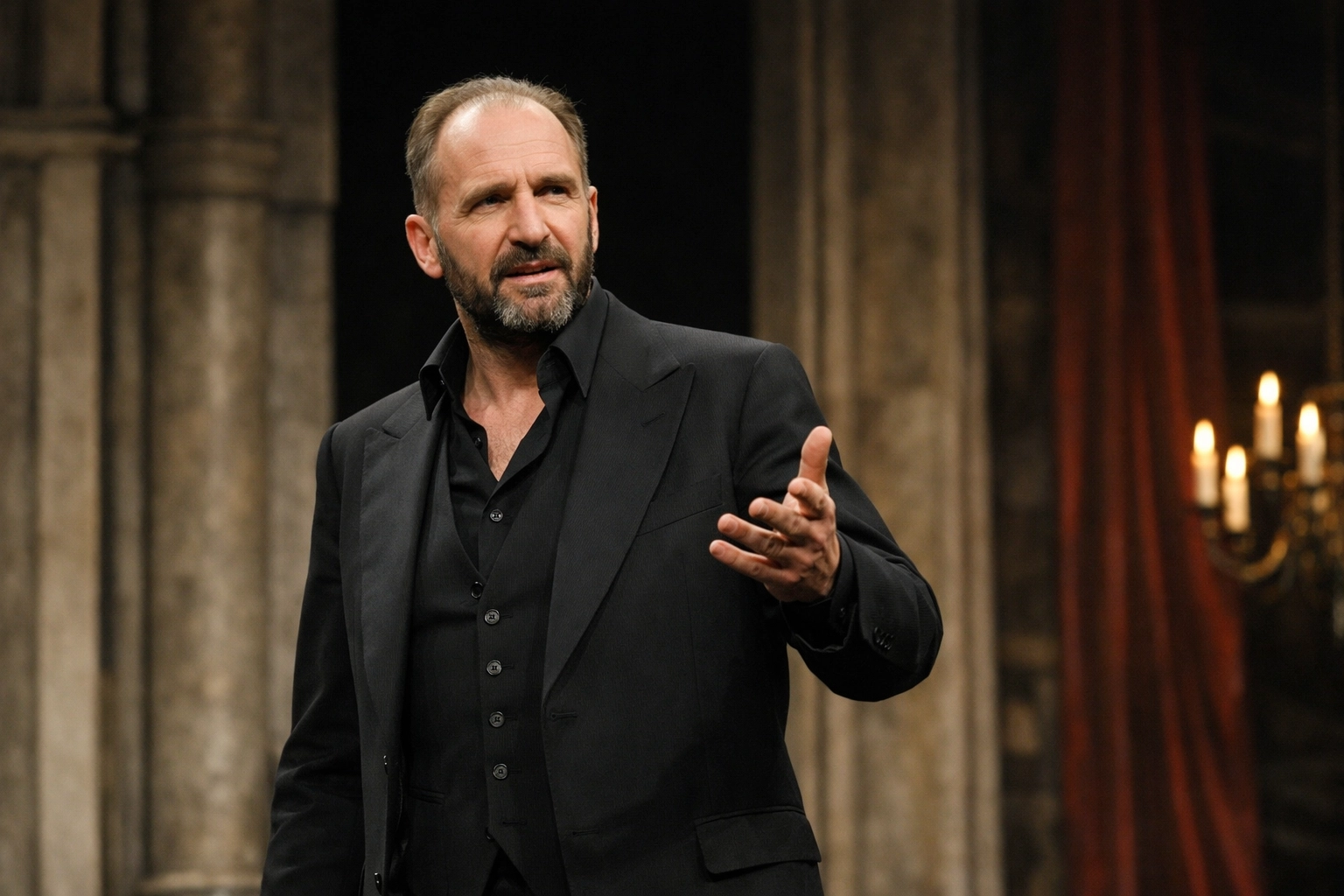
Ralph Fiennes is set to return to the London stage this spring, leading a high-profile West End transfer of David Hare’s latest play, "Grace Pervades." The production, which will take up residency at the Theatre Royal Haymarket, marks a significant moment for the 2026 theatrical season. Opening on April 24 and running through July 11, the play arrives in the capital following a critically acclaimed and sold-out premiere at the Theatre Royal Bath last year.
The production sees Fiennes reuniting with director Jeremy Herrin to portray one of the most influential figures in the history of British performance: Sir Henry Irving. Appearing alongside Fiennes is Miranda Raison, who reprises her role as Ellen Terry, Irving’s long-term professional partner and the leading lady of the Victorian era. The play explores the complex intersection of public triumph and private struggle within the walls of the Lyceum Theatre during the late 19th century.
Industry analysts suggest the transfer provides a needed boost to the West End’s spring schedule, bringing a combination of star power and historical gravitas to the Haymarket. The Theatre Royal Haymarket, itself a landmark of Victorian theatrical architecture, provides a fitting backdrop for a narrative centered on the very figures who defined that era’s dramatic standards.
The Historical Weight of the Lyceum Legends
At the heart of "Grace Pervades" is the meticulously researched portrayal of Sir Henry Irving, a man whose impact on the acting profession remains a cornerstone of modern theatre. Irving was the first actor in British history to be awarded a knighthood, a distinction that signaled a shift in the social standing of performers from vagabonds to respected members of the cultural elite. Fiennes, known for his ability to navigate the psychological depths of complex historical figures, inhabits the role of an actor-manager whose obsession with perfection and legacy often came at a significant personal cost.
The narrative focuses heavily on the professional and platonic partnership between Irving and Ellen Terry. Terry was arguably the most celebrated actress of her generation, known for her luminous stage presence and her ability to humanize the often-rigid tropes of Victorian drama. Miranda Raison’s performance captures the intelligence and autonomy of Terry, a woman who maintained a distinct identity despite the overshadowing presence of Irving’s formidable "Governor" persona at the Lyceum.
David Hare’s script does not merely function as a biographical retrospective. Instead, it examines the transition of British theatre from the melodramatic spectacles of the Victorian age toward the burgeoning modernist movement. This shift is represented through the inclusion of Terry’s children, Edith Craig and Edward Gordon Craig. Both figures would go on to revolutionize theatre production, with Gordon Craig becoming a world-renowned pioneer in stage design and Edith Craig emerging as a vital director and campaigner for women’s suffrage. The play highlights the generational friction between Irving’s traditionalism and the radical new ideas proposed by the younger Craigs.
A Legacy Reprised from the Bath Premiere
The West End transfer carries with it much of the original ensemble that secured the play's success during its initial run in Bath. Ruby Ashbourne Serkis and Jordan Metcalfe return to their roles as Edith and Edward Gordon Craig, respectively. Their performances have been noted for providing a vital counterweight to the veteran leads, illustrating the tension between the established order of the Lyceum and the avant-garde future of the arts.
The supporting cast for the London run includes a broad array of established stage talent. Youness Bouzinab, Giulia Innocenti, Tom Kanji, and Harriet Leitch join the company, alongside Guy Paul, Chris Porter, Maggie Service, Saskia Strallen, and Kathryn Wilder. This large-scale ensemble is a rarity in contemporary non-musical drama, reflecting the ambition of the production and the scale of the historical world Hare has sought to recreate.
Jeremy Herrin’s direction is characterized by a focus on the rhythmic precision of Hare’s dialogue while managing the logistical complexity of a period drama. Herrin, whose previous credits include "Wolf Hall" and "People, Places and Things," has a reputation for handling large-scale historical narratives without losing sight of the intimate human conflicts at their core. His collaboration with Fiennes has been described by production insiders as a rigorous exploration of Irving’s psyche, moving beyond the caricatures often associated with 19th-century acting styles.
The decision to move the production to the Theatre Royal Haymarket was confirmed following intense speculation within the industry. The venue, which has a capacity of nearly 900, is expected to see high demand for tickets, particularly given Fiennes' recent successes in solo performances and major cinematic roles. The limited eleven-week run emphasizes the exclusive nature of the event, positioning it as a cornerstone of the 2026 arts calendar.
Technical Craft and West End Prospects
To bring the world of the 1890s Lyceum to life, the production utilizes an award-winning creative team. Bob Crowley, a frequent collaborator with the National Theatre and the Royal Shakespeare Company, serves as the set designer. His task is to evoke the grandeur of the Victorian stage while allowing for the fluid scene transitions required by Hare’s non-linear narrative structure. The visual identity of the play is further bolstered by costume design from Fotini Dimou, whose work must bridge the gap between the ornate stage costumes of the period and the everyday attire of the Victorian intellectual class.
Lighting design is handled by Peter Mumford, with sound design by Elizabeth Purnell and video design by Akhila Krishnan. The integration of video design is particularly notable, as it is used to simulate the atmospheric "limelight" and early stage effects that Irving pioneered during his tenure as a manager. This technical authenticity is paired with a musical score by composer Paul Englishby and movement direction by Lucy Cullingford, ensuring that the physical language of the play matches the heightened reality of the Victorian theatre.
As rehearsals begin for the April opening, the production faces the high expectations that accompany any David Hare world premiere. Hare, a playwright known for his "state-of-the-nation" plays, has turned his gaze inward toward the history of his own craft. In doing so, he provides a commentary on the enduring nature of the acting profession and the sacrifices required to maintain a position at the pinnacle of the arts.
The return of Ralph Fiennes to the Haymarket is more than a celebrity vehicle; it is a calculated effort to celebrate the lineage of British acting. By portraying Henry Irving, Fiennes pays homage to the man who quite literally paved the way for the modern stage actor. For the West End, "Grace Pervades" represents a commitment to high-budget, serious drama at a time when the commercial theatre landscape is increasingly dominated by musical revivals and screen-to-stage adaptations.
Tickets for the engagement are scheduled to go on sale shortly, with previews beginning on April 24. The production concludes its run on July 11, after which Fiennes is expected to return to film commitments. For now, the focus of the theatrical world remains firmly on the Haymarket, where the ghosts of the Lyceum are set to be brought vividly back to life.