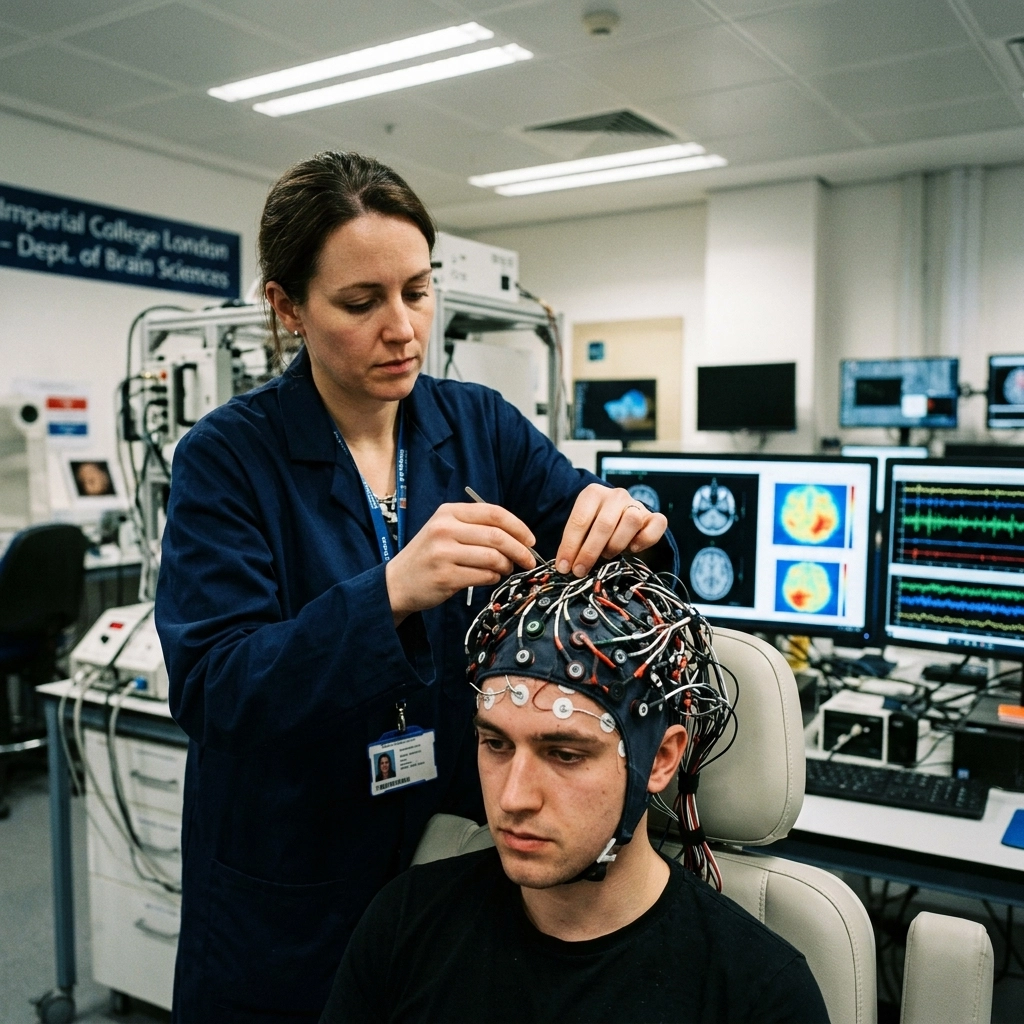
The human brain has long been described as the final frontier of biological science. With 86 billion neurons firing in a chaotic, beautiful symphony, trying to understand it has been like trying to map the Atlantic Ocean with a teaspoon. However, as of April 2026, the team at Imperial College London has just been handed a much larger shovel: or rather, a very expensive set of lights.
With a fresh injection of £3.92 million from the Advanced Research + Invention Agency (ARIA), a team of researchers is set to develop what they call an "Optical Oscilloscope." If that sounds like something pulled straight out of a late-night sci-fi marathon, you aren't far off. This is high-stakes, high-reward territory that promises to turn the lights on in the darkest corners of the human mind.
As an outlet dedicated to independent news uk, we’re diving into the untold stories of British innovation that usually get buried under headlines about political bickering or the latest celebrity scandal. This isn't just about a grant; it’s about a fundamental shift in how we see ourselves, literally.
Q: Let’s get straight to the point. What exactly is an "Optical Oscilloscope"?
A: Think of your brain as a massive, hyper-complex electrical grid. Traditionally, if scientists wanted to see what was happening in there, they had two options: either look from the outside with an MRI (which is like trying to watch a football match through a thick fog) or stick electrodes directly into the tissue (which is effective but, understandably, quite invasive).
The Optical Oscilloscope is the "third way." It’s a technology that uses light-field microscopy to capture the electrical activity of neurons in real-time and in 3D. Instead of measuring one or two points, it allows researchers to see entire neural circuits pulsing with activity. It’s the difference between hearing a single note and seeing the entire orchestra in high definition.
Q: Why did it take nearly £4 million to make this happen?
A: Because building a 3D IMAX camera for the subconscious isn't cheap. The £3.92 million grant is part of ARIA’s Precision Neurotechnologies programme. ARIA is the UK’s answer to the US’s DARPA: it’s designed to fund "bold" and "high-risk" projects that might fail but will change the world if they succeed.
The money isn't just for the kit; it’s for the minds. This project brings together heavyweights from Imperial College, Newcastle University, and the UK Dementia Research Institute (UK DRI). They are tackling the "silicon ceiling": the limit of how much data we can actually pull out of biological tissue without damaging it.
Lighting Up the Neural Labyrinth
Q: The team mentions "light-field microscopy." Is that just a fancy way of saying "a better microscope"?
A: It’s significantly more than that. Standard microscopy focuses on a single plane: it’s 2D. But the brain doesn't work in 2D. Neurons are stacked, layered, and interconnected in every direction. Light-field microscopy captures the direction of light rays, not just their intensity. This allows the researchers to reconstruct a 3D volume from a single snapshot.
When you apply this to the brain, you can suddenly see how a signal travels from the surface down into the deeper structures, like the substantia nigra. This is the area of the brain that’s hit hardest by Parkinson’s disease. By using light instead of physical probes, the team can map these circuits with a level of precision that was previously considered impossible.
Q: How does this help the average person? Is this just for lab experiments?
A: It starts in the lab, but the goal is the clinic. Right now, our treatments for brain disorders like Alzheimer’s or Parkinson’s are a bit like trying to fix a Swiss watch with a hammer. We use drugs that affect the whole brain or stimulation that’s relatively blunt.
If we can map exactly which circuit is failing, we can design "precision neurotechnologies." Imagine a treatment that only targets the specific group of neurons responsible for a tremor, leaving the rest of the brain untouched. This £4 million investment is the foundation for a future where brain surgery might not even require a scalpel, and where "incurable" neurodegenerative diseases are managed with the flick of a light switch.
Q: You mentioned "untold stories." Why aren’t we hearing more about this?
A: Scientific breakthroughs often lack the "instant gratification" of a tech product launch or a political scandal. Mapping neural circuits takes years of painstaking work. However, in the world of independent news uk, we believe these are the stories that actually define our future. The work being done at Imperial today will likely be the reason your grandchildren don't fear an Alzheimer’s diagnosis.
Breaking the Silicon Ceiling
Q: Is there a risk involved here? ARIA sounds like they enjoy a gamble.
A: Absolutely. That’s the whole point of ARIA. If there was a 100% chance of success, a private corporation would have funded it already. The risk here is technical. Getting light to penetrate deep into brain tissue and bounce back with enough information to create a 3D map is incredibly difficult. The brain is basically a dense, wet sponge that scatters light everywhere.
The team, led by Dr Nir Grossman and his colleagues, is betting that they can use advanced algorithms and specialised sensors to "un-scatter" that light. It’s a high-wire act of physics and biology. If they fail, we’ve lost some money. If they win, we’ve unlocked the operating system of the human species.
Q: Is this part of a wider trend in the UK tech scene?
A: Very much so. While the US often dominates the software side of things, the UK has quietly become a global powerhouse for neurotechnology and life sciences. Between Imperial’s work, the startup MintNeuro securing millions for neural semiconductors, and the UK DRI’s massive footprint, London is becoming the "Brain Valley" of the 2020s.
This isn't just about one project; it’s about an ecosystem. We’re seeing a shift where the "hard sciences": physics, engineering, and biology: are merging. The Optical Oscilloscope is the poster child for this merger. It’s not just biology; it’s high-speed data processing and optical engineering.
Q: What’s the timeline for seeing this in action?
A: The ARIA grant covers a four-year window. We are currently in the early stages of proof-of-concept. Over the next two years, expect to see the first 3D "movies" of neural circuits in animal models. If the data holds up, the transition to human-compatible systems could begin by the end of the decade.
A New Vision for Brain Health
Q: Some people are worried about "brain tech" and privacy. Should we be?
A: It’s a valid question. Whenever we talk about "mapping the mind," people naturally think of "reading thoughts" or "mind control." But the Imperial team is focused on health, not surveillance. The Optical Oscilloscope is designed to see the health of a circuit, not the content of a thought.
Furthermore, because this technology is being developed in a university setting with public (ARIA) funding, it is subject to the UK’s rigorous ethical standards. Unlike a private tech giant that might want to monetise your neural data, this research is aimed squarely at solving the crisis of an ageing population.
Q: What is the most exciting part of this for the researchers?
A: If you ask the team, they’ll tell you it’s the "unknown unknowns." Every time we get a better "microscope" for the human body, we discover things we didn't even know were there. When we first looked at cells, we didn't know about DNA. When we first looked at DNA, we didn't know about epigenetics.
By seeing the brain's electricity in 3D for the first time, we might discover entirely new types of neural communication. We might find that the "gap" between a healthy brain and a diseased one is much smaller: and easier to bridge: than we ever thought.
The £3.92 million grant to Imperial College London marks a significant milestone in the UK's commitment to frontier science. By funding the development of the Optical Oscilloscope, the Advanced Research + Invention Agency is betting on a future where the complexities of the human brain are no longer a mystery. While the technical challenges remain substantial, the potential rewards for global health and our understanding of human biology are unparalleled. As this project progresses, it stands as a testament to the power of high-risk, high-reward research in the heart of London's scientific community.