The universe just got a little bit heavier, and we have a group of brilliant British minds to thank for it. In what is being hailed as a landmark moment for independent news UK, scientists working at CERN have confirmed the existence of a brand-new subatomic particle. It isn't just any old speck of matter; it’s a "heavy proton" that has been dodging detection for decades. Known officially as the Ξcc⁺ (Xi cc plus), this discovery is less about finding a needle in a haystack and more about finding a very specific, slightly different needle in a field of a billion identical ones.
This isn't just a win for the textbooks; it’s a massive flex for the UK’s scientific community. Teams from Birmingham, Bristol, Cambridge, and Manchester have been at the heart of this discovery, proving that when it comes to the untold stories of the subatomic world, the UK is still leading the pack.
Here is everything you need to know about our new, chonky subatomic friend and why this changes the game for particle physics.
The Anatomy of a Heavyweight Subatomic Champion
To understand why this discovery is making waves, we first have to look at what makes up a standard proton. Most of us remember from school that protons are the building blocks of atoms, but they aren't solid balls. They are made of smaller bits called quarks. A normal, garden-variety proton has two "up" quarks and one "down" quark. The new Ξcc⁺ particle, however, decided to go for a much more exotic internal wardrobe.
- The Quark Cocktail: Unlike your standard proton, the Ξcc⁺ is comprised of two "charm" quarks and one "down" quark. If the "up" quark is a light snack, the "charm" quark is a full Sunday roast.
- The Weight Class: Because charm quarks are significantly heavier than up quarks, this new particle is approximately four times heavier than a regular proton. Imagine a house cat suddenly being the size of a mountain lion, and you’ll get the idea of the scale change.
- A Brief Appearance: You won't find these heavy protons floating around in your tea. They are incredibly unstable and exist for only a fraction of a second before decaying into lighter particles.
- The 7-Sigma Significance: In the world of physics, you can’t just say "I think I saw something." You need proof. The discovery was observed with a statistical significance of 7 sigma. In plain English, that means the chances of this being a fluke are about one in hundreds of billions.
- Quantum Chromodynamics: This discovery is a massive boost for the theory of the strong force: the "glue" that holds quarks together. By seeing how two heavy charm quarks interact with a single down quark, scientists can test if their math actually holds up in the real world.
- Technological Marvels: The discovery was made using the upgraded LHCb detector at CERN. This piece of ai-technology and precision engineering is designed specifically to hunt for particles containing charm and beauty quarks.
How UK Brainpower Decoded the Quantum Chaos
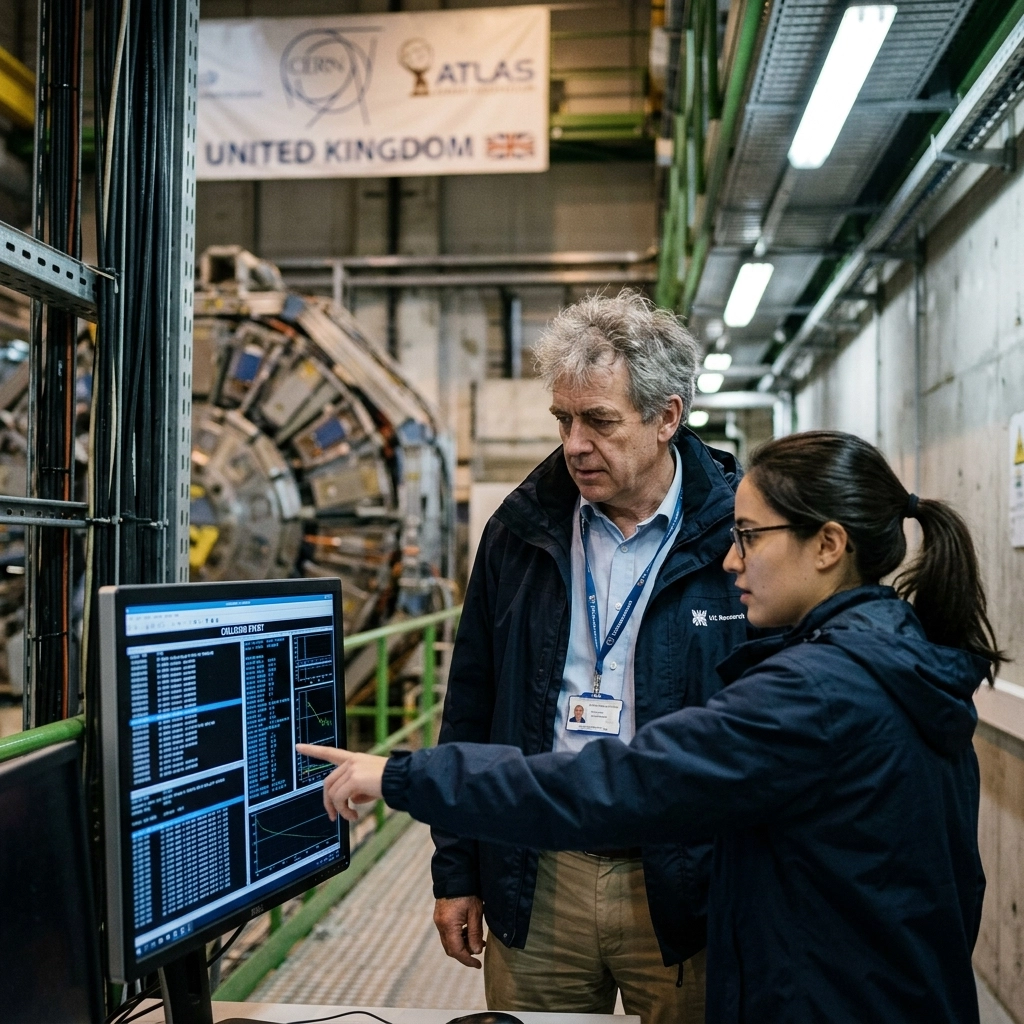
While CERN is located in Switzerland, the heart of this discovery beats in British laboratories. This is one of those untold stories where the heavy lifting happens in university basements in Manchester and Bristol before the glory hits the headlines in Geneva.
- The Manchester Connection: Professor Chris Parkes and his team at the University of Manchester were instrumental. They didn’t just look at the data; they built the eyes that saw it. The Manchester team led the design and construction of the silicon pixel detector modules.
- The Silicon Pixel Detectors: Think of these as ultra-high-resolution cameras. To find the Ξcc⁺, you need to see exactly where a particle was born and where it decayed, down to a few microns. Without the UK-built sensors, the particle would have remained a blur.
- A National Effort: It wasn't just Manchester. Scientists from Birmingham, Bristol, and Cambridge were deeply embedded in the LHCb collaboration. This represents a massive return on investment for the UK's Science and Technology Facilities Council (STFC).
- Data Crunching in 2024: The discovery didn't happen overnight. It was the result of analysing mountain-sized piles of data recorded during proton-proton collisions in 2024. This was the first full year of operation for the upgraded LHCb experiment, and it’s already paying dividends.
- The Human Factor: Over 1,000 scientists from 20 countries were involved, but the UK’s leadership in the silicon detector upgrades placed British researchers in the driver's seat during the analysis phase.
- Independent Research: This isn't just about following the lead of others. The UK teams spearheaded the specific search for this "doubly charmed" baryon, driven by a desire to solve a mystery that had been lingering for over two decades.
Settling Scores and Rewriting Physics History
The discovery of the Ξcc⁺ isn't just about adding a new name to a chart; it’s about settling a long-standing scientific grudge. About 20 years ago, a US-based experiment claimed to have seen this particle, but the result was so messy that no one else could confirm it. For two decades, the "heavy proton" was the Bigfoot of particle physics: rumoured to exist but never caught on camera.
- The SELEX Mystery: The US experiment, known as SELEX, reported a mass for the particle that didn't quite sit right with theoretical physicists. It was like someone claiming they saw a five-legged horse; possible, but unlikely.
- The Correction: The new data from CERN shows that the particle's mass is actually quite different from the SELEX claim. It perfectly matches the predictions of modern theory, effectively closing the book on the 20-year-old debate.
- The First of Many: The Ξcc⁺ is the first particle discovered using the newly upgraded LHCb detector. This suggests that we are entering a "golden age" of discovery where more exotic particles will be dragged out into the light.
- Why We Should Care: You might ask why we need a heavy proton that disappears in a blink. The answer is fundamental. Everything we see: from the stars to your smartphone: is held together by the strong nuclear force. Understanding how that force works in "extreme" conditions (like inside a heavy proton) helps us understand the fabric of reality.
- The Future of the LHC: With the LHC running at higher energies and with better detectors, we are looking at a period where action-needed to support further funding is crucial. The UK’s role in these discoveries ensures we have a seat at the table when the next big breakthrough: like Dark Matter or New Physics: finally happens.
- A Win for Independent News UK: Stories like this often get buried under political noise or celebrity gossip. But the untold stories of British scientists pushing the boundaries of human knowledge are the ones that define our era.
This discovery is a reminder that the world is far more complex and interesting than it appears on the surface. While the Ξcc⁺ might be tiny, the implications of its discovery are massive. The UK scientific community has proven once again that it can punch well above its weight class, delivering a "charmed" result that will be talked about in physics departments for the next fifty years.
The Large Hadron Collider continues to be the most powerful tool ever built by humanity, and with the UK at the helm of its most sensitive instruments, the secrets of the subatomic world are finally being revealed, one heavy proton at a time. The discovery of the Ξcc⁺ confirms that our understanding of the universe is on the right track, even if the universe is a lot heavier than we initially thought.