There is something inherently haunting about a decommissioned power station. For decades, the Ratcliffe-on-Soar site was a titan of the British landscape, its eight massive cooling towers puffing out steam like the breath of a slumbering giant. But as of late, the fires have gone out, and the silence left behind is heavy. That was until a few days ago, when The Institute Collective decided that a 114-metre-tall concrete hyperbola was the perfect place to drop a few bars.
Forget traditional concert halls with their velvet curtains and overpriced interval drinks. In the world of untold stories, we are seeing a shift toward the industrial, the raw, and the slightly damp. Recording charity songs inside a disused cooling tower isn't just a gimmick; it is an acoustic experiment that has produced some of the most spine-tingling audio of 2026. This is independent news uk at its most creative, proving that even the relics of our fossil-fuel past can be repurposed for something beautiful.
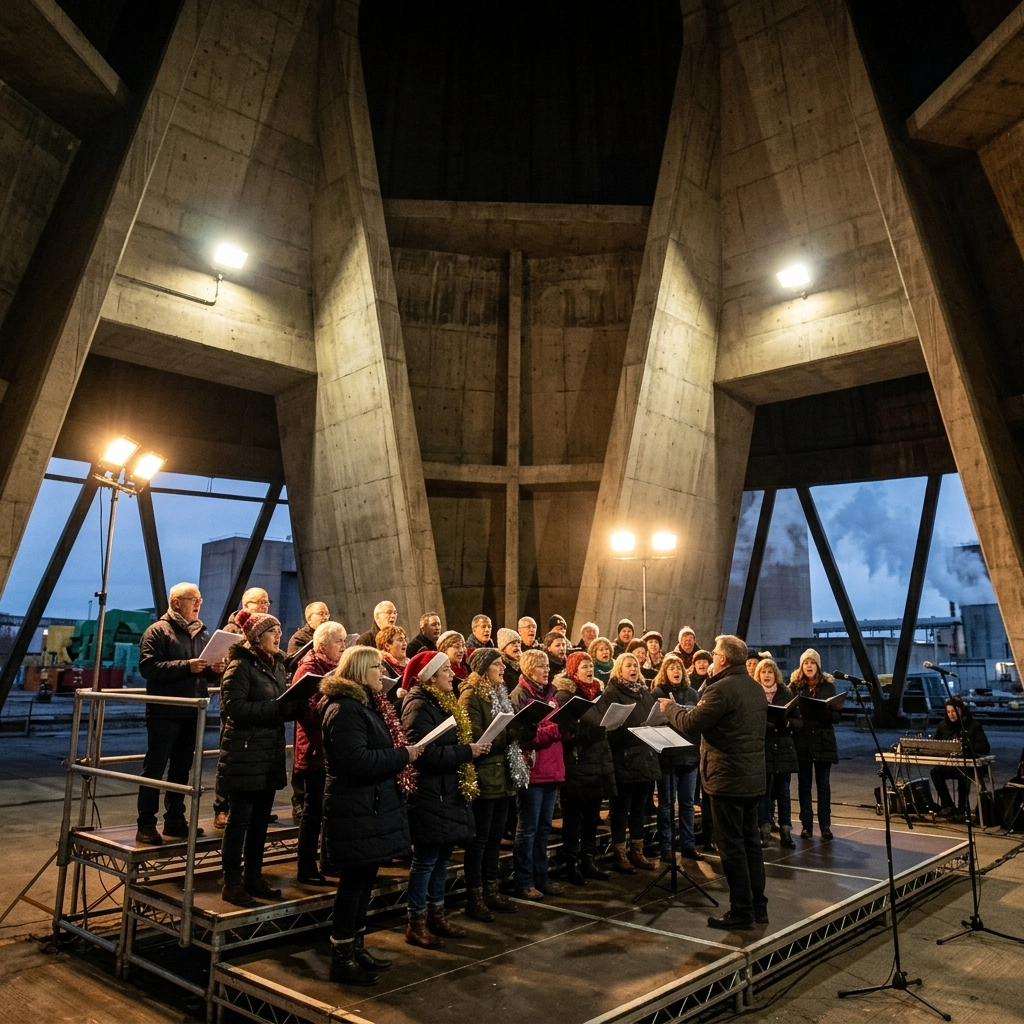
The Institute Collective, a choir known for pushing boundaries and blending genres, didn't just show up with a pitch pipe and a dream. They brought a full recording rig into the heart of the Ratcliffe-on-Soar complex. The goal? To raise money for Rainbows Hospice, a local legend in its own right that provides vital care for children and young people with life-limiting conditions. The result? A series of "Cooling Tower Carols" that sound less like a Sunday service and more like a celestial transmission from another dimension.
Walking into the base of a cooling tower is a humbling experience. The scale is impossible to capture on a smartphone camera. You are standing in a space that could comfortably house a cathedral, yet the walls are nothing but rough, weathered concrete. There is a specific scent, a mix of old rain, mineral dust, and the lingering ghost of heavy industry. When the choir took their positions, the air was still. Then, the first note hit, and the building began to speak back.
The acoustics of a concrete giant are unmatched by any studio
If you have ever hummed in the shower and thought you sounded like a pro, imagine that effect multiplied by a factor of ten thousand. The geometry of a cooling tower is designed for airflow, but it turns out it’s also perfectly shaped for vocal resonance. When The Institute Collective began their set, the sound didn't just travel; it spiralled. The natural reverb in a space this large lasts for several seconds, creating a layer of sound that acts as its own backing track.
Standard recording studios spend millions of pounds trying to emulate this kind of depth with digital plugins and acoustic tiling. Here, nature and engineering did the work for free. The choir had to actually slow down their tempo to accommodate the "bounce" of the sound. If they sang too fast, the notes would crash into each other in a chaotic muddle of harmony. It required a level of discipline and vocal control that most performers never have to consider.
Every breath was magnified. Every minor chord hung in the air like a fog. For the sound engineers on site, it was a nightmare and a dream all at once. Balancing the sheer volume of a full choir against the echoing walls meant placing microphones in positions that seemed counter-intuitive. But the final tracks possess a quality that is impossible to replicate. It’s an authentic, raw sound that reminds us why independent news uk outlets are so obsessed with these untold stories, there is a truth in the echo of a dead power station that you just can't find in a polished pop studio in London.
It provides a final, soulful tribute to the UK’s coal-fired history
There is a certain irony in singing songs of hope and charity inside a monument to the carbon age. Ratcliffe-on-Soar was the last coal-fired power station in the UK, a final holdout of an era that defined the British economy for over a century. Its closure marked a massive milestone in our transition to greener energy. While we are all happy to breathe cleaner air, there is no denying the cultural impact these structures have had on the Midlands skyline.
By choosing this venue, The Institute Collective wasn't just looking for a cool reverb; they were performing a sonic exorcism. They were taking a site associated with soot, smoke, and hard manual labour and filling it with something ethereal and light. It’s a bold way to say goodbye to an old friend. For the former workers of the plant, seeing the towers used for a Rainbows Hospice fundraiser provides a sense of closure that a simple demolition wouldn't achieve.
These towers are slated for eventual removal, but for one afternoon in April 2026, they were the most important cultural venue in the country. This isn't just about music; it’s about heritage. We often talk about repurposing old warehouses into luxury flats or turning docks into shopping centres, but turning a cooling tower into a musical instrument is a stroke of genius. It captures the imagination and reminds us that our industrial past doesn't have to be forgotten: it can be sung into the history books.
Every echo serves a greater purpose for Rainbows Hospice
At the heart of this "industrial goth" aesthetic is a very real, very human cause. Rainbows Hospice for Children and Young People is a charity that deals with the hardest of realities. They provide a "rainbow" of services for those facing the shortest of lives. It is a place of immense love, but like all charities in 2026, they are feeling the squeeze of a changing economy.
The choice to record "Cooling Tower Carols" was a strategic one. In a world saturated with digital content, you need something bold to grab attention. The "wow" factor of seeing a choir dwarfed by the massive internal structure of Ratcliffe-on-Soar is what drives clicks, and clicks drive donations. But beyond the marketing, there is a symbolic resonance here. The contrast between the cold, hard, unyielding concrete of the tower and the soft, vulnerable beauty of the human voice mirrors the work done at Rainbows: finding light and melody in the most difficult of environments.
The project has already gained traction across social media, with snippets of the recordings going viral for their "haunted cathedral" vibes. The full album, set to be released digitally, will see 100% of the proceeds headed straight to the hospice. It’s a reminder that art doesn't need a fancy stage to be effective. Sometimes, it just needs a big enough room and a clear enough purpose. The Institute Collective has proved that you can take the most utilitarian structure imaginable and, with a bit of vocal talent and a lot of heart, turn it into a vessel for charity.
As the sun set over the East Midlands on the day of the recording, the final notes of the session faded out. The choir packed up their gear, the engineers wound up their cables, and the cooling towers returned to their silent vigil. But the air felt different. For a few hours, the last bastion of the coal age wasn't a relic of the past; it was a beacon for the future.
The "Cooling Tower Carols" project stands as a testament to the power of creative thinking in the face of industrial decline. It highlights the importance of supporting local charities like Rainbows Hospice and proves that the UK’s landscape is full of hidden stages waiting for the right voice. Whether you’re a fan of choral music or just someone who appreciates a bit of architectural audacity, this story is a win for the Midlands and a win for the arts.
In the end, the towers at Ratcliffe-on-Soar might eventually crumble or be pulled down to make way for new tech hubs and green energy parks. But for those who heard the music, the memory of those harmonies soaring toward the open sky will remain. It is a story of transition, a story of sound, and most importantly, a story of help for those who need it most. When the history of 2026 is written, the day the choir hit the power station will surely be one of its most harmonious chapters.