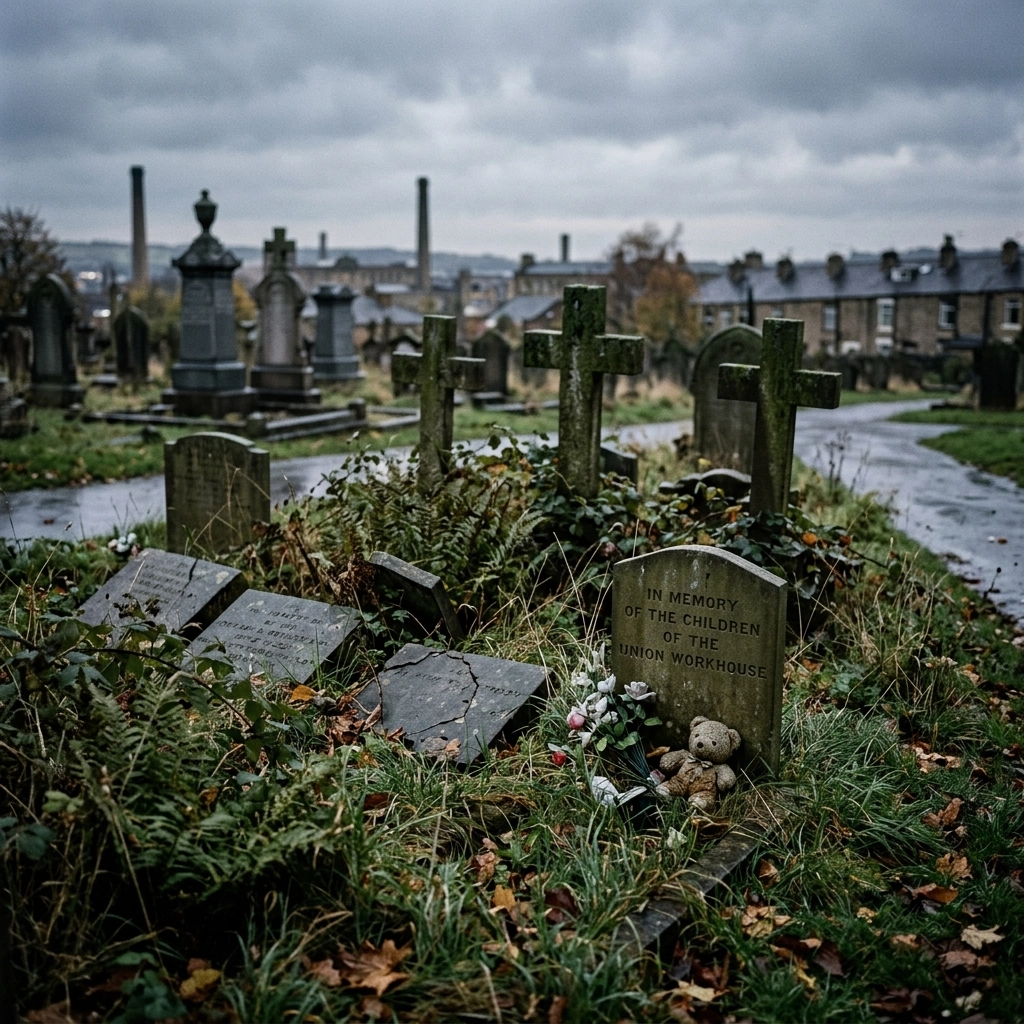
Bradford’s Undercliffe Cemetery is, by all accounts, a masterpiece of Victorian vanity. Perched on a hillside overlooking the city, it is a place where the mill owners and industrial barons of the 19th century went to spend their final days: or rather, where they went to be remembered in the most ostentatious way possible. Giant obelisks, weeping angels, and grand masonry compete for attention, each monument shouting about the wealth and status of the person resting beneath it. It is a skyline of ego carved in stone.
But if you wander away from the grand avenues of the wealthy, you will find a different story. For decades, a quiet, grassy patch of land at Undercliffe held a secret that the city’s grand history books seemed to have conveniently misplaced. This wasn't a site of grand monuments, but a mass grave. Specifically, it was the final resting place for the "Little Incurables": dozens of children who died in the care of Barnardo’s homes, forgotten by a society that prioritised the "worthy" poor over the "unfit."
The discovery and subsequent restoration of this site is more than just a bit of local archaeology. It is a bold reminder that history is often written by the people who can afford the most expensive headstones. For the first time in over a century, the names of these children are being spoken again, and the "Incurables" are finally getting the recognition they were denied in life.
A Victorian Secret Unearthed in Yorkshire
To understand why these children were buried in such a way, you have to understand the Victorian obsession with categorisation. In the 1800s, poverty wasn't just a financial state; it was seen as a moral failing. There were the "deserving poor," who worked hard and kept their heads down, and then there were the "undeserving." At the bottom of this social pile were the children with chronic illnesses, physical disabilities, or terminal conditions. They were the "incurables," and in many ways, they were seen as a lost cause from the moment they were born.
The grave site at Undercliffe, which has recently been the focus of intense restoration work, was used primarily between the late 19th century and the early 20th century. While the rest of the cemetery was busy being a pageant of Victorian success, this patch of ground was quietly accumulating the bodies of children who had passed away at the nearby Barnardo’s homes. In those days, if a child died and their family couldn't afford a burial: or if they had no family left to claim them: they were placed in what was essentially a pauper’s grave.
For years, this area looked like nothing more than an empty field. No stones, no names, no markers. It was as if the city had collectively decided that these children didn't exist. It took the dedicated efforts of historians and the modern Barnardo’s organisation to peel back the layers of neglect. What they found was a staggering list of names. These weren't just statistics; they were toddlers, infants, and teenagers who had succumbed to diseases that we now consider easily treatable, but which were death sentences in the cramped, soot-stained streets of industrial Bradford.
The "Little Incurables" were often those who had been sent north for "cleaner air" or better care in specialised homes. Ironically, many of them ended up in the very soil that had been polluted by the industry that made the city’s elite so rich. It’s a bit of a grim irony that isn’t lost on those who have spent the last few years trying to restore dignity to the site.
From Forgotten Shadows to Barnardo’s Legacy
The restoration of the "Grave of the Incurables" has been a significant undertaking, led by Barnardo’s in partnership with the Undercliffe Cemetery Charity. The goal was simple but profound: to give these children back their identity. We often talk about "untold stories" in a metaphorical sense, but here, the stories were literally buried.
Barnardo’s history in Bradford is deep. The organisation, founded by Thomas Barnardo, was a pioneer in child welfare, but it also operated within the constraints of its time. The homes they ran were often the only thing standing between a child and the workhouse. However, when those children died, the funds for a proper burial simply weren't there. The mass grave at Undercliffe was a pragmatic, if cold, solution to a mounting problem.
During the restoration project, researchers went through old ledgers and burial records, cross-referencing names with the location of the plot. They discovered that many of the children died from tuberculosis, rickets, and respiratory failures. These were the "lost children" of the industrial revolution: the collateral damage of a world that was moving too fast to care for its most vulnerable members.
The work hasn't just been about clearing weeds and planting flowers. A new memorial now stands at the site, listing the names of the children buried there. It is a bold, modern addition to an old Victorian space. It doesn't try to blend in with the grand obelisks of the mill owners. Instead, it stands as a stark, honest acknowledgment of the past. It tells the visitor that these lives mattered, regardless of their economic value or their physical health. It’s a shift from the Victorian view of "charity" as a cold obligation to a modern view of human rights and dignity.
Witnessing the names being etched into the memorial is a powerful experience. For over a hundred years, these children were anonymous numbers in a ledger. Now, families who are researching their genealogy are finding long-lost relatives in a corner of Bradford they never knew existed. It’s a reclamation of history that is as much about the present as it is about the past.
Why These Untold Stories Still Matter Today
It is easy to look at a story like this and think of it as a historical curiosity: a sad tale from a darker time. But the story of the "Little Incurables" resonates deeply with modern issues. How we treat our most vulnerable, how we remember the poor, and how we handle the "inconvenient" members of society are questions that haven't gone away. They’ve just changed their appearance.
This is why independent news in the UK is so vital. While mainstream outlets often focus on the grand narratives of politics and macro-economics, the untold stories are found in the quiet corners of places like Undercliffe. These stories challenge the "official" version of history. They remind us that for every grand Victorian success story, there were dozens of people whose lives were cut short by the system that created that success.
The restoration work in Bradford is a call to look closer at our own surroundings. Every city has these forgotten spaces. Every community has its "lost children." By bringing these narratives to light, we aren't just doing a service to the dead; we are educating ourselves. We are learning to see the human cost of progress and the importance of empathy over ego.
The Grave of the Incurables is no longer a secret. It is now a place of reflection and education. It serves as a reminder that even the most "incurable" life has value. The work done by Barnardo’s and the local community ensures that the next generation of Bradfordians won't walk past that grassy patch and see nothing. They will see the names. They will hear the stories. And perhaps, they will learn that a city’s true greatness isn't measured by the height of its monuments, but by how it cares for those who have nothing to give in return.
As the restoration project concludes this year, the site stands as a testament to the power of memory. The children of the mass grave are no longer lost. They have been found, named, and finally laid to rest with the dignity they were denied a century ago. It is a small victory for the "untold stories" of Yorkshire, but a significant one for the history of the UK.
The restoration of the grave site at Undercliffe Cemetery marks a pivotal moment in the preservation of Bradford’s social history. By identifying and memorialising the children once categorised as "incurables," the project has bridged a significant gap in the local historical record. The collaboration between Barnardo’s and the Undercliffe Cemetery Charity provides a template for how other municipalities might approach the reclamation of pauper burial sites. This work ensures that the systemic neglect of the past is acknowledged, offering a more comprehensive understanding of the Victorian era's social complexities.