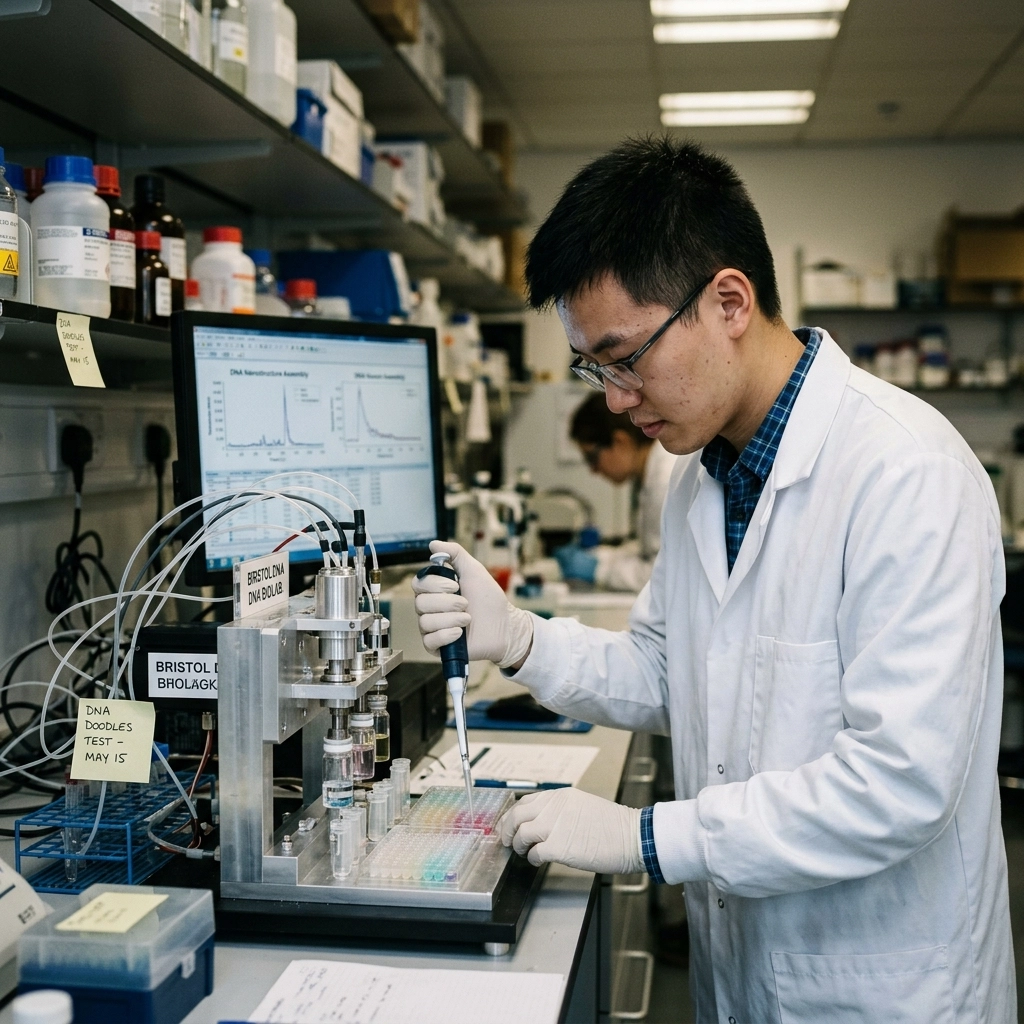
Scientists at the University of Bristol have just discovered that nature has a secret hobby. It turns out that the molecular machinery inside our cells, the stuff we thought was strictly "copy-paste," actually likes to go off-script. In a revelation that feels like finding out your office photocopier spends its weekends painting abstract watercolours, researchers have found that DNA polymerases can be "steered" to write entirely new genetic sequences from scratch. They’re calling it "DNA doodling," and it is about to flip the script on how we build the future of biology.
For decades, we’ve viewed DNA polymerases as the ultimate biological clerks. Their entire job description was simple: find a template, read it, and make an exact copy. If life is a book, these enzymes were the printing press. But the team at Bristol, led by Professor Thomas Gorochowski, has shown that if you nudge these enzymes the right way: change the temperature or restrict their "ink" (the chemical building blocks): they stop copying and start improvising. This isn't just a quirky lab observation; it’s a massive win for independent news uk readers who want the real dirt on how synthetic biology is evolving beyond the headlines.
This is one of those untold stories that rarely makes it to the front page of the broadsheets, yet it holds the key to how we might eventually store the entirety of the internet in a vial of liquid or grow bespoke medicines in a matter of hours.
From Photocopier to Jazz Improviser: The Science of Doodling
To understand why this is a big deal, we have to look at how we currently "write" DNA. Right now, if a scientist wants to create a specific strand of DNA, they have to rely on chemical synthesis. It’s a slow, painstaking process. Imagine trying to build a LEGO castle but you can only add one brick every hour, and if you get to 200 bricks, the whole thing might just collapse. That is essentially the state of modern DNA writing: limited, expensive, and frustratingly short.
The Bristol discovery, published in Nature Communications, changes the game by tapping into the raw power of enzymes. These polymerases aren't limited to a few hundred bases. In their "doodling" phase, they can churn out sequences exceeding 85,000 bases. That’s not just a small improvement; it’s an exponential leap. The researchers used nanopore sequencing: a high-tech way of "reading" DNA as it passes through a tiny hole: to watch these enzymes work in real-time. What they saw was a variety of patterns, from simple two-base repeats to incredibly complex eight-base motifs.
The "witty" part of nature is that it’s been doing this since the 1960s, but we just weren't looking closely enough. We assumed the "junk" DNA created in these reactions was just a mistake: a biological "oops." Instead, it turns out the enzymes were just waiting for a conductor. By controlling the environment, the Bristol team proved they could steer these doodles, effectively turning a random scribble into a structured, useful sequence. It’s the difference between a toddler with a crayon and a master architect with a blueprint.
Three Ways DNA ‘Doodling’ Changes Everything
When we look at the implications of this breakthrough, it becomes clear that we are entering a new era of biomanufacturing. This isn't just about lab experiments; it's about shifting the paradigm of how we interact with the building blocks of life. Here are the three most significant ways this discovery is set to change the world as we know it.
1. The End of the "Short-Strand" Bottleneck
As mentioned, current methods are stuck in the "short-strand" era. If you want a long piece of DNA, you have to write lots of little pieces and then try to stitch them together like a biological Frankenstein’s monster. It’s prone to error and incredibly slow. DNA doodling allows for the creation of massive, continuous strands in a single reaction. This means we could produce the instructions for complex proteins or even entire synthetic genomes far faster than ever before. For those following the offbeat side of science, this is like moving from dial-up internet to fibre-optic overnight.
2. AI-Powered Biological Design
The Bristol team didn't just find the doodle; they found the steering wheel. By combining this enzymatic process with AI-powered protein design, we can begin to "programme" these enzymes to write exactly what we want. Imagine an AI that knows exactly which temperature shift will cause a polymerase to write a specific sequence needed for a new vaccine. We are moving away from "copying" nature and towards "collaborating" with it. The enzymes do the heavy lifting, and our algorithms provide the direction.
3. Revolutionising Data Storage
Silicon has its limits. We are producing more data than we have chips to store it on. DNA, however, is the most compact and durable storage medium in the universe. You could theoretically store all the world's data in a few grams of DNA, and it would last for thousands of years. The main barrier has been the cost and speed of writing that data into DNA. Doodling offers a path to high-speed, long-form DNA writing that could make DNA data centres a reality within our lifetime. This is the kind of breakthrough that highlights why we focus on untold stories: it’s the stuff that actually changes the long-term trajectory of human civilisation.
Steering the Unsteerable: The Future of Biomanufacturing
So, where do we go from here? The discovery at Bristol University isn't the finish line; it’s the starting gun. The next phase involves refining the "steering" mechanisms. If we can achieve 100% precision in what these enzymes doodle, we effectively have a high-speed biological printer that runs on simple chemicals and heat. This would decentralise biomanufacturing. Instead of massive chemical plants, you might have a small desktop "DNA printer" in every hospital or research lab.
There are, of course, ethical and safety considerations whenever we talk about making it easier to write the code of life. At NowPWR, we take our editorial standards seriously, and it’s important to note that while this technology is revolutionary, it also requires robust oversight. The ability to write 85,000 bases of DNA quickly is a tool, and like any tool, its impact depends on the hand that holds it. However, the potential for good: in curing diseases, fixing the climate, and storing knowledge: is staggering.
The beauty of this breakthrough lies in its simplicity. We aren't inventing a new machine; we are just learning how to talk to the machines that have lived inside our cells for billions of years. We’ve stopped telling them to just copy the manual and started asking them to write something new. It turns out, they have a lot to say.
The research at Bristol reminds us that even in a world where we think we’ve mapped every corner of biology, there are still deep mysteries hidden in plain sight. Nature isn't just a static template; it's a dynamic, creative force. By learning to "doodle" alongside it, we are opening a door to a future where biology is as programmable and versatile as computer code. This is the essence of independent news uk: finding the stories that matter before they become the status quo.
The "printer" is warmed up, the ink is ready, and for the first time, we are the ones holding the pen. The next chapter of human history might just be written in DNA.
The implications of the Bristol University discovery suggest a shift towards more sustainable and efficient biotechnological processes. By leveraging natural enzymes rather than harsh chemical synthesis, the field of synthetic biology could significantly reduce its environmental footprint while increasing its output. As researchers continue to refine the methods for steering DNA polymerases, the transition from experimental "doodling" to precise biological engineering appears increasingly inevitable. This advancement stands as a testament to the potential of interdisciplinary research in addressing some of the most complex challenges in modern science.