If you’ve ever walked past a blooming meadow or a busy hive, you’ve heard the hum. To most of us, it’s just the soundtrack of a British summer. To a bee, however, that vibration is a complex stream of information. And now, thanks to a groundbreaking study at Wakehurst, Kew’s wild botanical garden in Sussex, we are finally starting to understand what they are saying. This isn’t just some quirky science project; it is a high-tech eavesdropping operation that could change the future of food security and environmental conservation.
The reality for our buzzing friends has been fairly grim lately. Pollinator populations have been taking a hit from every possible angle: habitat loss, climate shifts, and those pesky pesticides. Traditionally, checking on a hive meant a beekeeper had to physically crack the thing open, puff some smoke in, and poke around. It’s invasive, it’s stressful for the bees, and it only provides a snapshot in time. But what if we didn’t have to disturb them? What if we could just listen?
Enter the world of bioacoustics and artificial intelligence. By using sensitive microphones and sophisticated algorithms, researchers are now "untold stories" hunters, digging into the acoustic signatures of the hive to monitor health, stress levels, and even the threat of disease before a single bee drops. It’s a bold new frontier for independent news uk readers who are tired of the same old doom-and-gloom climate reports and want to see how tech is actually fixing things.
Decoding the Hive’s Secret Language
Bees don’t just buzz for the sake of it. Every vibration, every wing-beat, and every "toot" or "quack" (yes, queen bees actually make those noises) carries data. The AI models being trained at Wakehurst and other research centres are learning to distinguish between the contented hum of a healthy colony and the frantic frequency of a hive under stress. It turns out that a hive exposed to sublethal doses of pesticides actually sounds different. It’s subtle: too subtle for the human ear: but for a machine-learning algorithm, it’s as clear as a siren.
This technology allows scientists to monitor thousands of bees simultaneously without ever lifting a lid. The AI looks for patterns in the "vibroacoustics." Think of it as a fingerprint or a voiceprint for the entire colony. By using Hidden Markov Models: the same kind of tech that helps your phone recognise your voice: researchers can translate sound waves into a diagnostic dashboard. If the bees are hungry, the AI knows. If the queen is missing, the AI knows. If the temperature is fluctuating due to a sudden cold snap in the Sussex countryside, the AI is already sending an alert.
This shift toward non-invasive monitoring is a game-changer. In the past, by the time a beekeeper noticed a colony was failing, it was often too late to do anything about it. Now, we are looking at a future where we can intervene with precision. It’s a bit like having a 24/7 doctor for every hive, one that doesn’t need a coffee break and never gets stung.
The Bee Whispering Tech
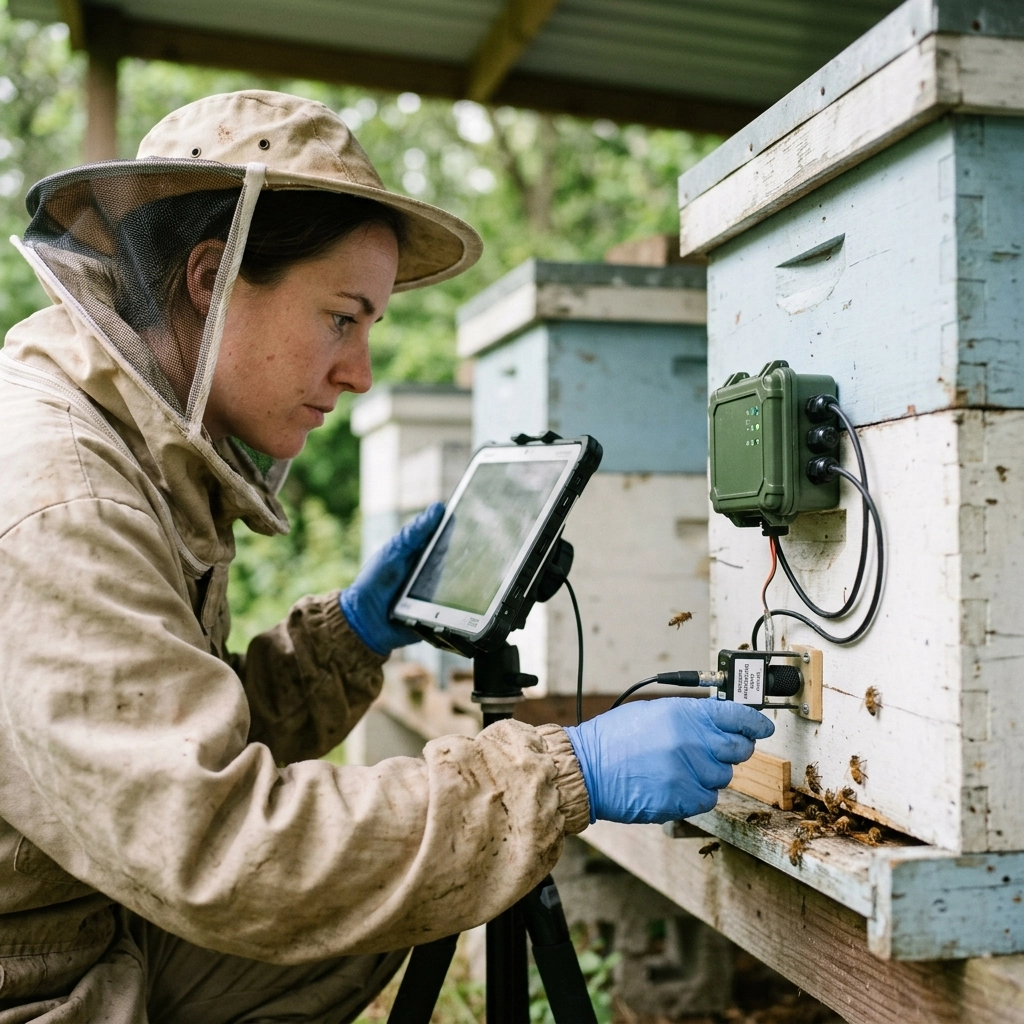
The hardware behind this "bee whispering" is surprisingly elegant. It’s a mix of rugged outdoor sensors and high-powered cloud computing. Because the study at Wakehurst focuses on wild and managed populations in varied landscapes, the tech has to be tough enough to handle the British weather while being sensitive enough to pick up the movement of a single leg against a honeycomb.
Here is how the Bee Whispering Tech actually functions on the ground:
- Acoustic Sensors: High-fidelity microphones are placed inside or near the hive entrance to capture the full spectrum of bee communications and mechanical vibrations.
- IoT Connectivity: Data is beamed via low-power networks (like LoRaWAN) or mobile signals to central servers, meaning researchers don't have to keep trekking out to remote fields to collect SD cards.
- Machine Learning Algorithms: The heavy lifting happens in the cloud, where AI compares the live audio feed against a massive library of "healthy" and "unhealthy" hive sounds.
- Environmental Integration: Many of these setups also include sensors for humidity, temperature, and even "bee counters" at the entrance to track foraging activity throughout the day.
- Automated Alerts: If the AI detects a signature associated with "swarming" or a varroa mite infestation, it sends a real-time notification to the land manager's smartphone.
What makes this particularly exciting is that these hives essentially become tiny environmental stations. By eavesdropping on the bees, we aren't just learning about the insects themselves; we are learning about the health of the entire ecosystem. If the bees aren't bringing back enough pollen, or if their activity levels drop unexpectedly, it tells us something is wrong with the local flora or air quality. It’s an "untold story" of the landscape, narrated by the creatures that know it best.
Why Listening Is the Key to Conservation
We often talk about AI in terms of robots or deepfakes, but its application in the natural world is perhaps its most noble calling. At Wakehurst, the goal isn't just to produce honey; it’s to understand how we can boost pollinator populations across the UK. With one out of every three bites of food we eat depending on pollinators, the stakes are remarkably high. If the bees go quiet, our supermarkets go empty.
The beauty of this AI-driven approach is its scalability. Once the models are perfected, they can be deployed globally. A farmer in Kent or a conservationist in the Highlands could use the same tech to protect their local populations. It democratises conservation. You don’t need a PhD in entomology to know your bees are in trouble if your phone tells you the hive's "stress frequency" has spiked by 20% overnight.
Moreover, this research challenges the way we view "wild" spaces. By integrating tech into the heart of the forest or the meadow, we aren't "taming" nature; we are finally paying attention to it. This is the kind of independent news uk coverage that highlights the intersection of British innovation and ecological necessity. We are moving away from the era of guessing and into the era of knowing.
The Wakehurst study is a testament to what happens when we stop trying to control nature and start trying to listen to it. The bees have been telling us their secrets for millions of years; we just finally built the ears to hear them. As this technology matures, expect to see it expanded to other species. From tracking bird migrations to monitoring the health of coral reefs through underwater acoustics, AI is becoming the ultimate translator for the natural world.
The hum of the hive is no longer just background noise. It is a data-rich narrative of survival, and thanks to a bit of clever code and some very sensitive microphones, we’re finally part of the conversation. The future of the British countryside might just depend on our ability to keep eavesdropping.
The integration of artificial intelligence into beekeeping and environmental monitoring marks a significant step forward in our efforts to preserve biodiversity. By using bioacoustics to monitor hive health, researchers at Wakehurst and beyond are providing a blueprint for non-invasive, high-tech conservation. This approach not only protects vital pollinator populations but also offers a deeper understanding of the ecological shifts occurring in the UK landscape. As these technologies continue to evolve, they will undoubtedly play a crucial role in securing the future of our natural world and the food systems that depend on it.