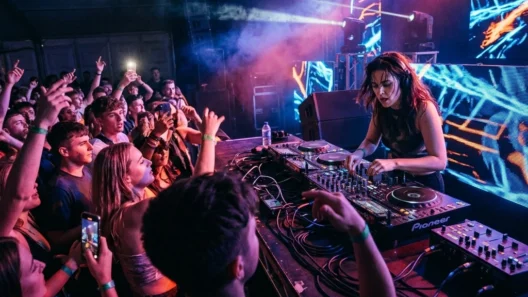









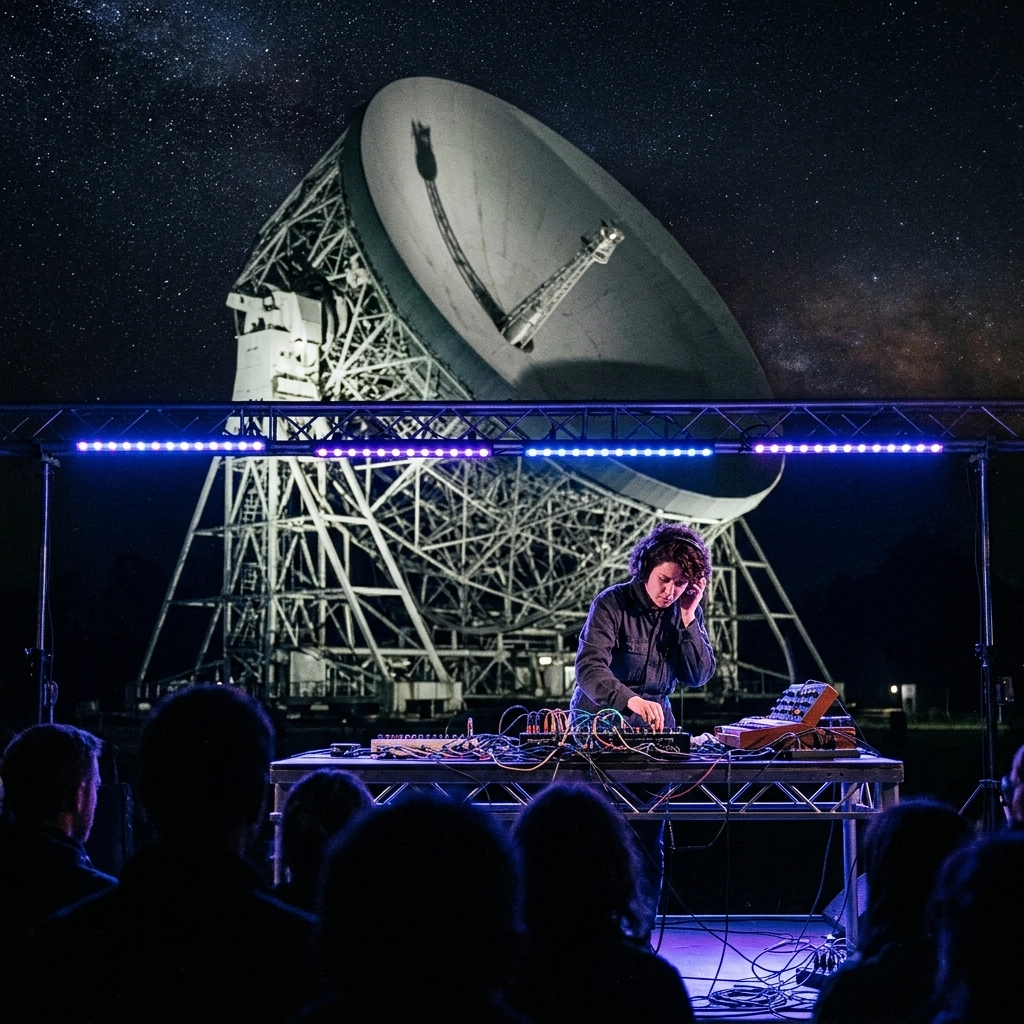
There is something inherently absurd about standing in a damp Cheshire field, clutching a lukewarm plastic cup of craft ale, while a seventy-six-metre-wide radio telescope looms over you like a silent, celestial sentinel. This is Jodrell Bank, the home of the Lovell Telescope, a structure that has spent decades eavesdropping on the whispers of the universe. But tonight, the universe isn’t the only thing making noise. We are at Bluedot, and the intersection of deep space and deep bass is about to get very, very loud.
It’s easy to forget, amidst the glitter-painted faces and the smell of gourmet halloumi fries, that Jodrell Bank is a place of serious, world-altering science. This is where we tracked Sputnik, where we mapped the invisible architecture of the cosmos, and where we continue to hunt for signals that might: just might: tell us we aren’t alone. But for a few days every year, the lab coats are traded for neon windbreakers, and the silent data streams are replaced by the soaring, oscillating frequencies of the world’s most iconic synthesizers. It is a collision of worlds that shouldn't work, yet somehow, under the shadow of that massive white dish, it feels like the only thing that makes sense.
At NowPWR, we’re always looking for the untold stories, the ones that slip through the cracks of the mainstream cycle. While the big outlets might focus on the logistics of festival mud or the price of a weekend ticket, we’re more interested in why we feel the need to blast electronic music at the stars in the first place. This is independent news UK style: unfiltered, a bit cheeky, and always looking for the heartbeat beneath the hype.
Cosmic Chords and Silicon Dreams
The headline act for this particular celestial gathering is none other than Jean Michel Jarre. If you were to build a human out of synthesizers and Gallic flair, you’d get Jarre. He is the undisputed architect of the "spectacle," the man who turned the concept of a concert into a multi-sensory assault on the senses. Seeing him at Jodrell Bank isn't just a gig; it's a cosmic alignment. As the sun dips below the horizon, painting the Cheshire sky in bruised purples and burnt oranges, the Lovell Telescope becomes a canvas.
Jarre’s music has always felt like it was composed in a vacuum and then beamed down to Earth. When those first iconic notes of Oxygène ripple through the air, you can almost feel the photons reacting. He doesn't just play music; he manipulates light and sound with a precision that would make the resident astrophysicists nod in approval. His famous laser harp: a series of green beams that he "plucks" to trigger notes: looks like something pulled straight out of a 1970s sci-fi fever dream. Against the backdrop of the telescope, it’s a reminder that our obsession with the future has always been tied to the tools we use to imagine it.
The crowd is a glorious mix of the "old guard" of electronic music: blokes in vintage Moog t-shirts who can tell you the difference between a sawtooth and a square wave from fifty paces: and a younger generation who just want to vibrate at the same frequency as a superstar. There’s no pretension here. When the bass kicks in, and the telescope dish is bathed in a rhythmic pulse of strobes, the collective realization hits: we are tiny, the universe is massive, and Jean Michel Jarre has some really, really expensive speakers. It’s a bold, unapologetic celebration of human ingenuity, both in the way we listen to the stars and the way we make our own noise.
Hunting Pulsars in a Sea of Neon
While the main stage thumps with the sound of Jarre’s silicon dreams, the real untold story of Jodrell Bank is happening in the quieter corners of the site. Away from the flashing lights, there’s a different kind of rhythm being explored. We’re talking about pulsars. For the uninitiated, pulsars are highly magnetized, rotating neutron stars that emit beams of electromagnetic radiation. They are the cosmic metronomes of the universe, spinning hundreds of times per second and ticking with a precision that puts Swiss watches to shame.
At Bluedot, the festival-goers are invited to participate in "pulsar hunts." It’s an interactive experience where the line between scientist and spectator blurs into nothingness. You’re not just looking at a screen; you’re listening to the heartbeat of a dead star. When the data from the telescope is converted into sound, it’s haunting. It sounds like a glitchy, organic techno beat: a rapid-fire thump-thump-thump that has been travelling through the void for thousands of years just to reach a pair of headphones in a field in Macclesfield.
This is the intersection where the festival truly finds its soul. You have artists like Hannah Peel, who has famously collaborated with the sounds of Jodrell Bank, blending the mechanical "clicks" of these stars with orchestral arrangements and modular synths. It’s a reminder that music isn't just something we create; it’s something we discover. The universe is already playing a symphony; we’re just finally getting the EQ right. There’s a certain wit in the fact that we spend millions on telescopes to hear these stars, only to realise they’ve been dropping better beats than most Ibiza DJs since the beginning of time. It’s science as art, and art as a form of cosmic archaeology.
The Independent Heartbeat of the Cheshire Plain
As the night winds down and the last echoes of the synthesizers fade into the night air, you’re left with the quiet hum of the telescope once again. The Lovell dish doesn't stop working just because the party is over. It pivots, silently tracking a distant galaxy or a mysterious burst of energy from across the light-years. The juxtaposition is staggering. One moment we’re dancing to a French man playing a laser harp, and the next we’re reminded of our infinitesimal place in the grand scheme of things.
Why does this matter? Because in a world that often feels increasingly fractured and cynical, events like this offer a rare moment of genuine wonder. They remind us that curiosity is a powerful, unifying force. Whether you’re a PhD student studying gravitational waves or a teenager who just likes the way the bass feels in their chest, you’re both looking at the same sky. At NowPWR, we believe these are the stories that define us: the moments where we stop arguing about the mundane and start staring at the magnificent.
The Bluedot festival at Jodrell Bank isn't just another entry on the summer calendar. It’s a statement of intent. It’s a declaration that we can be both incredibly smart and incredibly silly at the same time. It’s about the audacity to build a giant metal ear to listen to the heavens and then decide to throw a rave underneath it. As the lights go out and the crowd drifts back to their tents, the telescope remains, pointed upwards, waiting for the next signal. And who knows? Maybe the next one will have a melody we can finally dance to.
The intersection of deep space and deep bass isn't just a clever marketing slogan; it’s a fundamental truth about being human. We want to know where we came from, and we want a good soundtrack for the journey. As far as untold stories go, the one being written in the Cheshire mud every year is one of our favourites. It’s weird, it’s loud, and it’s perfectly independent. Just the way we like it.