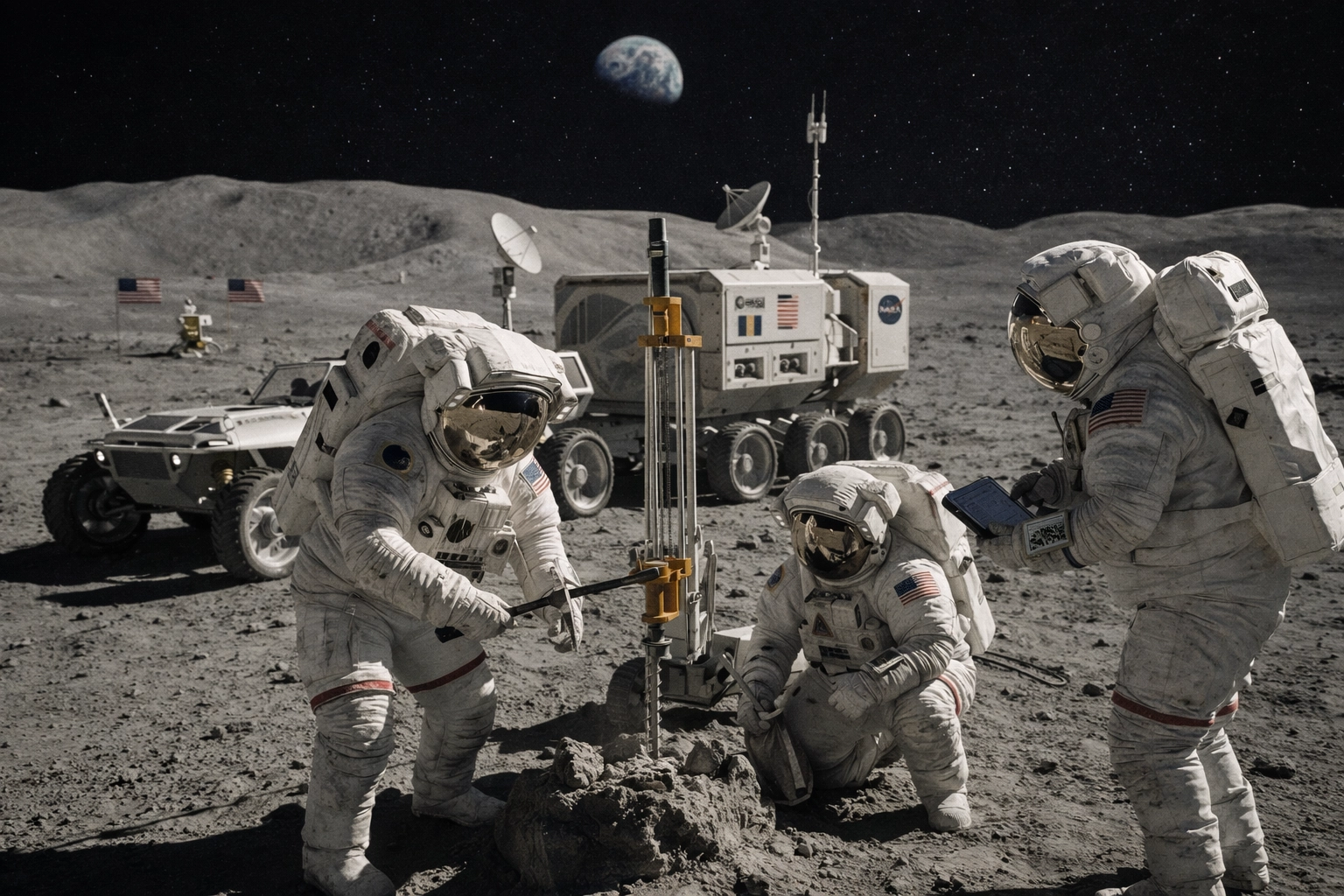
The human fascination with the silver orb in our sky has never truly faded, but for decades it felt like a chapter of history that had been firmly closed. That changed on 1 April 2026. As the Artemis II mission continues its historic journey, we are seeing the first time in more than fifty years that human beings have ventured into the deep space surrounding the Moon. This is not just a nostalgic return. It is a high-stakes, technically advanced mission that is helping lay the groundwork for a lasting human presence beyond Earth.
As we follow these major global stories, the significance of the Artemis programme becomes clearer. It marks a real shift in how space exploration is being approached. This mission, involving the Orion crew capsule appropriately named Integrity, has already seen four astronauts — three Americans and one Canadian — travel further from Earth than any human in history. Reaching a distance of more than 406,000 kilometres from home, the crew has officially surpassed the record set by the Apollo 13 mission in 1970.
At the heart of this effort is a commitment to uncovering the untold stories of our solar system’s history. While the mission does not include a lunar landing, the crew’s slingshot around the lunar far side offers a view no human has had in generations. They are currently flying 7,600 kilometres beyond the far side of the Moon, using lunar gravity to carry them back towards Earth. This 10-day journey is a crucial stress test for the life support and environmental control systems that could one day sustain crews for months at a time on the lunar surface.
Breaking Records in Deep Space
The technical achievements of Artemis II are remarkable. When the Integrity capsule reached its furthest point from Earth, it marked a milestone not only for one agency but for human spaceflight as a whole. The mission is a vital bridge between low-Earth orbit operations and the deeper-space ambitions of the 2030s. By testing how far humans can safely travel, the Artemis programme is showing that the hardware and software built in the 2020s may be ready for the harsher conditions beyond Earth orbit.
For readers following independent news uk coverage of the space race, the key question is often simple: why return now? The answer is in the science and the systems being tested. The Moon’s far side, which the crew is now observing, holds clues about the early formation of our solar system and remains shielded from Earth’s radio interference. The astronauts are not there simply to set records. They are there to prove that the Integrity capsule can keep a crew safe and well while exposed to higher radiation levels and the extreme temperatures of deep space.
The mission is also a strong example of international cooperation. Having a Canadian astronaut on board underlines that the return to the Moon is not a solo effort. It is a collaborative project involving multiple nations and private companies. That broad involvement helps ensure the lessons from Artemis II are shared across the scientific community. The data gathered during the lunar flyby will help shape the timeline for Artemis IV, which is currently scheduled to return humans to the surface in 2028.
A Sustainable Return to the Lunar Surface
The biggest difference between the 1960s and today is the thinking behind the mission. The Apollo era was a sprint shaped by Cold War rivalry, where the aim was to land, plant a flag and return safely. Artemis is different. It is being treated more like a marathon. The goal is sustainability. NASA and its partners are not focused on flags and footprints alone. They are planning a Gateway space station in lunar orbit and, eventually, a base camp at the lunar South Pole, where water ice is believed to sit in permanently shadowed craters.
This shift is being driven in part by the growth of the commercial space sector. Unlike the Apollo rockets, which were fully government-owned and used once, the Artemis programme makes use of commercially developed reusable technology. That helps lower the cost of getting mass into orbit and makes a longer-term presence more realistic. It is a move from exploration towards habitation. By involving private industry, the programme is trying to turn space travel from a rare state-led event into something more routine within the global economy.
The environmental implications are also being considered carefully. Understanding the Moon’s geology may offer useful insights into Earth’s own history and climate patterns. It could also help researchers learn more about how to survive in tightly controlled environments where every resource matters. In that sense, the Moon may become a testing ground for systems that recycle water, air and energy efficiently, with lessons that could matter back on Earth too.
The Geopolitical High Ground
While the spirit of Artemis is collaborative, the geopolitical competition around the Moon is impossible to ignore. The new race for lunar access has become part of today’s biggest global stories, with several nations pushing to expand their influence. China in particular has moved quickly. After returning samples from the lunar far side through its Chang'e 6 mission, it is planning its own crewed landing by 2030 and hopes to build a joint lunar station with Russia by 2035.
That competition has raised concerns about access to valuable lunar regions. If one nation gains an early advantage over areas rich in resources — such as the peaks of eternal light, where solar energy is more reliable, or the craters believed to hold ice — there are worries that legal grey areas could be used to limit others. This is one reason the Artemis Accords matter. They are designed to support a peaceful and transparent framework for how countries operate beyond Earth.
For anyone interested in untold stories at the point where science, diplomacy and power meet, the Moon is becoming one of the most important arenas to watch. The issue is not just who builds the fastest rocket. It is also who helps shape the rules for the decades ahead. As the Integrity capsule begins its journey back to Earth, the success of this flyby sends a clear message: the Moon is no longer a distant dream, but a realistic destination. The safe return of the Artemis II crew will be the final major hurdle before another human landing is attempted, and the data they bring home could shape the next era of exploration.