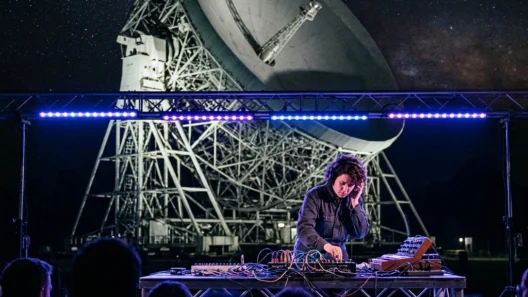
Q: So, I’ve heard rumors that the hottest new techno venue isn't in Berlin or London, but in… Rotherham? Please tell me this is a prank.
A: No prank here. While everyone else is queuing for twelve hours in the rain to get into a concrete basement in Kreuzberg, the real pioneers are heading to South Yorkshire. Specifically, they are heading to a place called the Particle Shrine. It’s part art installation, part scientific laboratory, and entirely a vibe. We’re talking about music that is literally "out of this world." This is the ultimate peak into the untold stories of the British North, where high-energy physics meets a thumping bassline. It turns out the universe has a better rhythm than most of the DJs you’ll find on a Saturday night in Shoreditch.
Q: "Music from space" sounds like something a bloke in a tin-foil hat would tell me at 3 AM. What are we actually talking about here?
A: It’s significantly more sophisticated than tin-foil hat territory, though the wonder of it might make you feel a bit giddy. The Particle Shrine is an installation that detects cosmic rays: subatomic particles that have travelled across the galaxy at nearly the speed of light: and converts them into light and sound in real-time. Imagine a high-energy particle, born from a supernova or a black hole millions of light-years away, smashing into our atmosphere, raining down on Rotherham, and then immediately being turned into a synth pad or a drum hit. It’s the ultimate independent news uk story: a local town hosting a universal concert.
Q: How do you even "catch" a cosmic ray? Is there a giant butterfly net involved?
A: Not quite. The tech involved is actually quite brilliant. It uses things called spark chambers and water Cherenkov detectors. When these invisible particles: mostly muons, which are like the heavier, cooler cousins of electrons: pass through the detectors, they trigger a signal. In the Particle Shrine, that signal is mapped to specific musical notes or visual flashes. It’s essentially a cosmic MIDI controller. The universe is the performer, and the installation is the instrument. Because cosmic ray arrivals are random, the music is generative and ever-changing. You will never hear the same "song" twice, which is more than you can say for the Top 40.
The Galactic DJ in the Room
Q: Does this actually sound like techno, or is it just a bunch of random beeps and boops?
A: That’s the beauty of the "shrine" aspect. The artists and scientists involved haven't just hooked up a Geiger counter to a buzzer and called it a day. They’ve carefully curated the sounds so that the incoming data creates a cohesive, atmospheric soundscape. It has that deep, driving, minimalist feel that characterizes the best underground techno. Sometimes it’s a low, resonant drone; other times, a flurry of particles creates a frantic, high-tempo glitch section. It’s unpredictable, raw, and deeply immersive. If you’re looking for a melody you can whistle on the bus, you’re in the wrong place. But if you want to feel the literal pulse of the cosmos, Rotherham is the place to be.
Q: Why Rotherham, though? It feels like an odd choice for a cosmic gateway.
A: That’s exactly why it’s one of the best untold stories we’ve come across. Rotherham has a massive industrial heritage, and there’s something poetic about repurposed industrial spaces hosting cutting-edge science and art. It challenges the "London-centric" narrative of the UK arts scene. You don't need a posh gallery in Mayfair to explore the mysteries of the universe. Sometimes, all you need is a dark room in South Yorkshire and a very sensitive particle detector. It’s a testament to the fact that innovation happens everywhere, often in the places you’d least expect.
Q: Is there a deeper meaning to all this, or is it just a cool way to make noises?
A: There’s a massive philosophical undercurrent. Most of the time, we walk around completely oblivious to the fact that we are being bombarded by billions of particles from deep space every second. We think of "space" as something far away, something we see through a telescope. The Particle Shrine forces you to realise that we are in space. The universe is literally passing through your body right now. By turning these invisible events into sound, the installation makes the abstract tangible. It’s a way of connecting humans to the vast, cold, and beautiful reality of the quantum world. It’s science communication, sure, but it’s also a form of secular spirituality.
Rotherham: The Interstellar Dance Floor
Q: Can I actually dance to it? I don't want to stand there stroking my chin for two hours.
A: You absolutely can. In fact, the physical reaction to the sound is part of the point. The frequencies used are often low and guttural, the kind of sub-bass that you feel in your chest. When a particularly dense shower of cosmic rays hits, the room lights up and the sound intensifies. It’s an organic rave. You aren't dancing to a pre-recorded track; you’re dancing to the death throes of a star that exploded before humans even existed. If that doesn't get your feet moving, I don't know what will. It’s the ultimate "offbeat" experience for anyone tired of the same old club circuit.
Q: Who are the people behind this? Are they mad scientists or just very bored artists?
A: It’s a collaboration between several brilliant minds, including artists like Anne-Marie Culhane and scientists who spend their days thinking about things like dark matter and cloud chambers. It takes a specific kind of person to look at a muon detector and think, "I bet this would sound great through a reverb pedal." These are the people creating the untold stories of the 21st century: merging disciplines that usually stay in their own lanes. It’s this kind of cross-pollination that leads to the most exciting cultural shifts.
Q: Is this the future of music? Are we going to see "Cosmic Ray" festivals replacing Glastonbury?
A: Probably not next year, but there is a growing movement toward generative and data-driven music. As we get better at capturing the "noise" of the natural world, artists are finding ways to turn that noise into something beautiful. Whether it’s the movement of trees, the shifting of tectonic plates, or the arrival of cosmic rays, there’s a desire to listen to the world around us in a new way. The Particle Shrine is a pioneer in this space. It’s a reminder that there is music everywhere if you have the right equipment to hear it.
Why Your Spotify Wrapped is Boring
Q: Speaking of music, how does this compare to what we usually listen to?
A: Look, we all love a good pop hook, but your Spotify Wrapped is likely a feedback loop of things you already know you like. The cosmic ray "techno" scene is the literal opposite of an algorithm. It is pure, unadulterated randomness. It’s the sound of the universe not caring about your preferences. There’s something incredibly refreshing about that. In a world where everything is curated, polished, and targeted toward our specific demographics, the Particle Shrine offers something that is genuinely "other." It’s a reminder that we are small, and the universe is loud.
Q: How do I get involved? Do I need a PhD in astrophysics to enjoy it?
A: Not at all. That’s the beauty of it. You can walk in knowing absolutely nothing about physics and still be blown away by the sensory experience. The installation is designed to be accessible. You don't need to understand what a muon is to feel the impact of its arrival. Of course, once you’re there, you’ll probably find yourself getting curious. You’ll start asking questions about where these particles come from and how they got here. That’s the "hidden" education aspect of the whole thing. It’s a gateway drug to science, disguised as a very cool light show.
Q: What’s the "Untold Story" here that I should tell my friends at the pub?
A: The story is that while the world is looking at big flashy tech launches and billionaire space races, there is a quiet, beautiful, and slightly loud revolution happening in Rotherham. It’s the story of how we are finally learning to listen to the secret music that has been playing around us since the beginning of time. It’s about finding wonder in the invisible and realizing that the most "independent" news you can find is the news being broadcast from the other side of the galaxy, straight into a converted industrial space in Northern England.
The Particle Shrine represents a unique intersection of local culture and universal phenomena. By transforming the invisible rain of cosmic particles into a tangible sensory experience, it challenges our perceptions of both art and science. This installation serves as a reminder that the most profound stories are often happening right above our heads, waiting for the right moment: and the right town: to be heard. It is a celebration of the unpredictable, the local, and the cosmic, proving that even in the most familiar settings, the universe still has plenty of surprises in store.