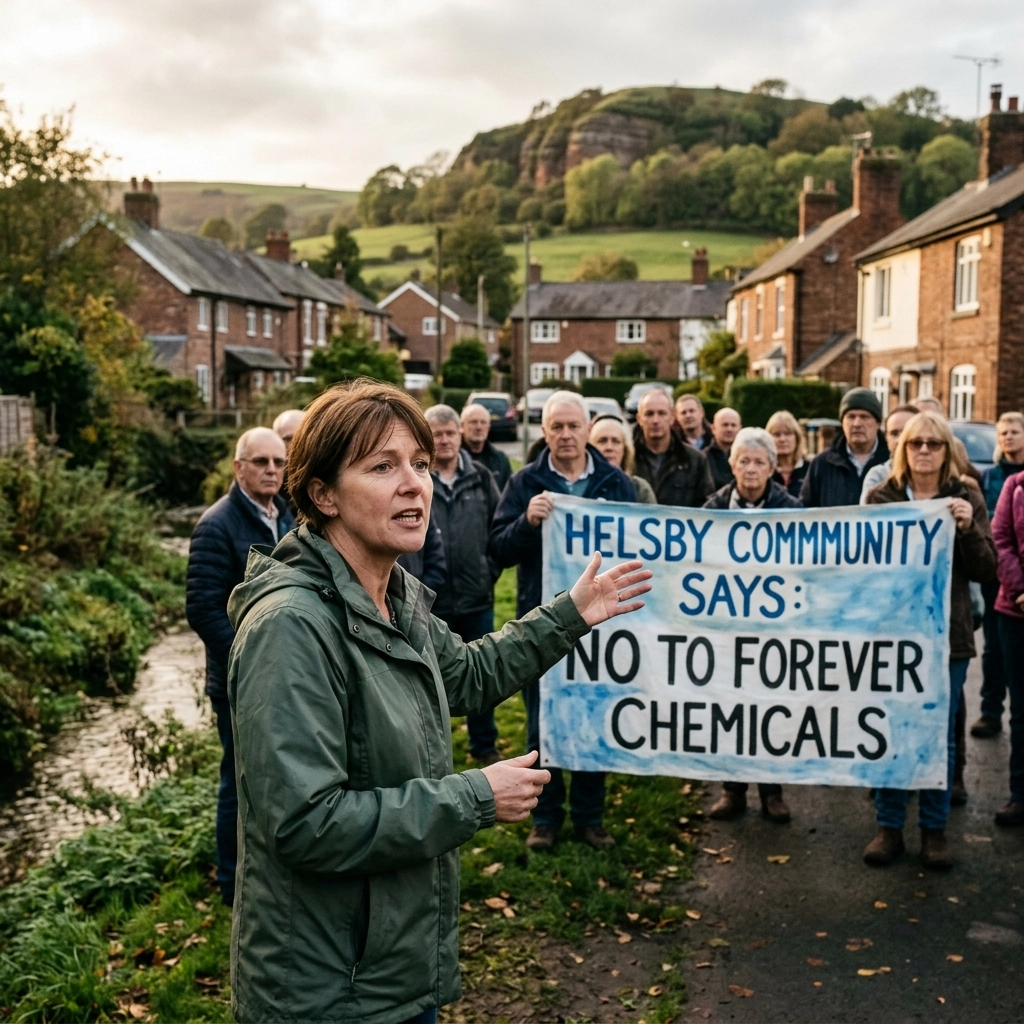
The village of Helsby in Cheshire is the sort of place that looks like it belongs on a postcard. Nestled beneath the dramatic sandstone cliffs of Helsby Hill, it offers sweeping views of the Mersey estuary and the kind of quiet, rural charm that makes urbanites consider a permanent move to the countryside. But beneath the lush lawns and the picturesque trails, a toxic legacy has been festering for decades. For the residents of this community, the fight isn't just about preserving a view; it’s about unearthing a hidden history of industrial waste that refuses to stay buried. This is a story of "forever chemicals," a determined local population, and the power of independent news in the UK to bring untold stories to the surface.
For nearly a century, Helsby was dominated by the BICC (British Insulated Callender's Cables) plant. It was a massive employer, a cornerstone of the local economy, and a symbol of British industrial might. However, like many industrial giants of the 20th century, its operations left behind more than just job opportunities and pension schemes. The plant used Polychlorinated Biphenyls, or PCBs: a group of man-made chemicals that are now infamous globally for their persistence in the environment and their potential to cause serious health issues, including cancer and immune system disruption. Though banned in the UK in 1981, PCBs are known as "forever chemicals" because they simply do not break down. Once they are in the soil or the water, they are there for the long haul.
The Industrial Ghost in the Garden
The issue in Helsby isn't just that PCBs were used; it’s where they ended up. For years, rumours circulated among the older generation of workers and residents about secret dumping sites. Stories were told of drums being rolled into pits and covered with earth, or waste being disposed of in ways that wouldn't pass a modern health and safety inspection. These weren't just idle campfire stories; they were the lived experiences of people who saw the inner workings of a massive factory that operated in an era of much looser environmental regulations.
When the BICC plant eventually closed and the land was earmarked for redevelopment, including new housing, the alarm bells began to ring. How do you build homes on land that might be saturated with some of the most persistent toxins known to man? The community began to ask questions that local authorities seemed ill-prepared to answer. The "Industrial Ghost" wasn't just a metaphor; it was a physical presence in the soil, potentially leaching into the groundwater and the very air the residents breathed. The fight for transparency began in earnest, as locals realised that the green fields they loved might be masking a chemical minefield.
The complexity of PCBs makes them particularly difficult to manage. They don't stay still. They can migrate through soil, bond with sediment, and enter the food chain. For a community like Helsby, where gardens are a pride and joy and children play in the local parks, the uncertainty was paralysing. It wasn't just about property values: though that was a concern: it was about the fundamental right to live in a safe environment. The "Green Fight" became a battle for the truth, led by people who refused to be silenced by bureaucratic jargon or corporate deflection.
The Podcast That Dug Up the Truth
The momentum of the Helsby campaign shifted dramatically with the release of the "Buried" podcast. In the world of modern media, podcasts have become a formidable tool for investigative journalism, providing the space and time to explore complex issues that a three-minute news segment simply cannot cover. The podcast didn't just report on the facts; it told a narrative of a community that felt forgotten by the powers that be. It highlighted the testimonies of former workers and local activists, weaving together a compelling case for a thorough, independent investigation.
The impact was immediate. Suddenly, the "untold stories" of Helsby were being discussed in kitchens and pubs across the country. The podcast acted as a catalyst, turning a local grievance into a national conversation about environmental justice and corporate accountability. It gave the residents a voice and, perhaps more importantly, it gave them evidence. By interviewing experts and tracking down archival documents, the investigation provided the technical weight needed to challenge official narratives. It wasn't just "angry villagers" anymore; it was a community backed by a rigorous journalistic probe.
This shift illustrates why independent news in the UK is so vital. When local governments and large corporations find themselves in a conflict of interest, it is often the independent voices that provide the necessary oversight. The residents of Helsby found themselves in a David vs Goliath situation, where the "Goliath" was a combination of historical industrial neglect and modern administrative inertia. The podcast provided the sling and the stone, allowing the community to demand a level of scrutiny that had previously been denied to them. The wit and grit of the local organisers, combined with the reach of the investigative narrative, created a pressure that the local council could no longer ignore.
Demanding Answers from the Top
As the public pressure mounted, Cheshire West and Chester Council found itself under the microscope. The council probe, long called for by the Helsby Residents Action Group, finally began to take shape. However, the community’s fight was far from over. A "probe" can mean many things, and for the people of Helsby, it had to be more than a superficial survey. They demanded deep-core soil testing, comprehensive water analysis, and a transparent reporting process that didn't hide behind "commercial confidentiality."
The council’s investigation has been a focal point of tension. On one side, officials argue that they are following established protocols and that public safety is the priority. On the other, residents point to the decades of inaction and the specific locations identified by former workers as dumping grounds that have yet to be fully explored. The mistrust is deep-seated, born from years of being told there was "nothing to worry about" while the evidence suggested otherwise. The fight is now about the scope of the investigation: ensuring that it doesn't just look where it's convenient to look, but where the toxic truth actually lies.
This ongoing struggle in Cheshire serves as a warning for other communities across the UK living in the shadow of former industrial sites. The "forever chemicals" aren't going away, and the responsibility for cleaning them up often falls into a legal and financial grey area. Who pays for the remediation of land contaminated fifty years ago by a company that no longer exists in the same form? In Helsby, the community is clear: the health of the residents and the integrity of the environment must come before the bottom line of developers or the convenience of local government. They are not just fighting for themselves; they are setting a precedent for environmental accountability in the 21st century.
As the probe continues, the eyes of the nation remain on this small Cheshire village. The story of Helsby is a testament to the power of community-led activism and the essential role of investigative storytelling. It proves that even when the truth is buried deep in the earth, a determined group of people: armed with the right information and a platform to share it: can bring it to light. The "Green Fight" is far from over, but for the first time in a generation, the people of Helsby feel like they are finally being heard.
The situation in Helsby remains a developing story, with community leaders continuing to push for a full and honest accounting of the site's industrial history. The lessons learned here about the persistence of PCBs and the necessity of independent oversight will likely resonate for years to come, as more "untold stories" of Britain’s industrial past begin to emerge into the modern day. For now, the residents stand vigilant, ensuring that their picturesque home is as safe as it looks on the surface.