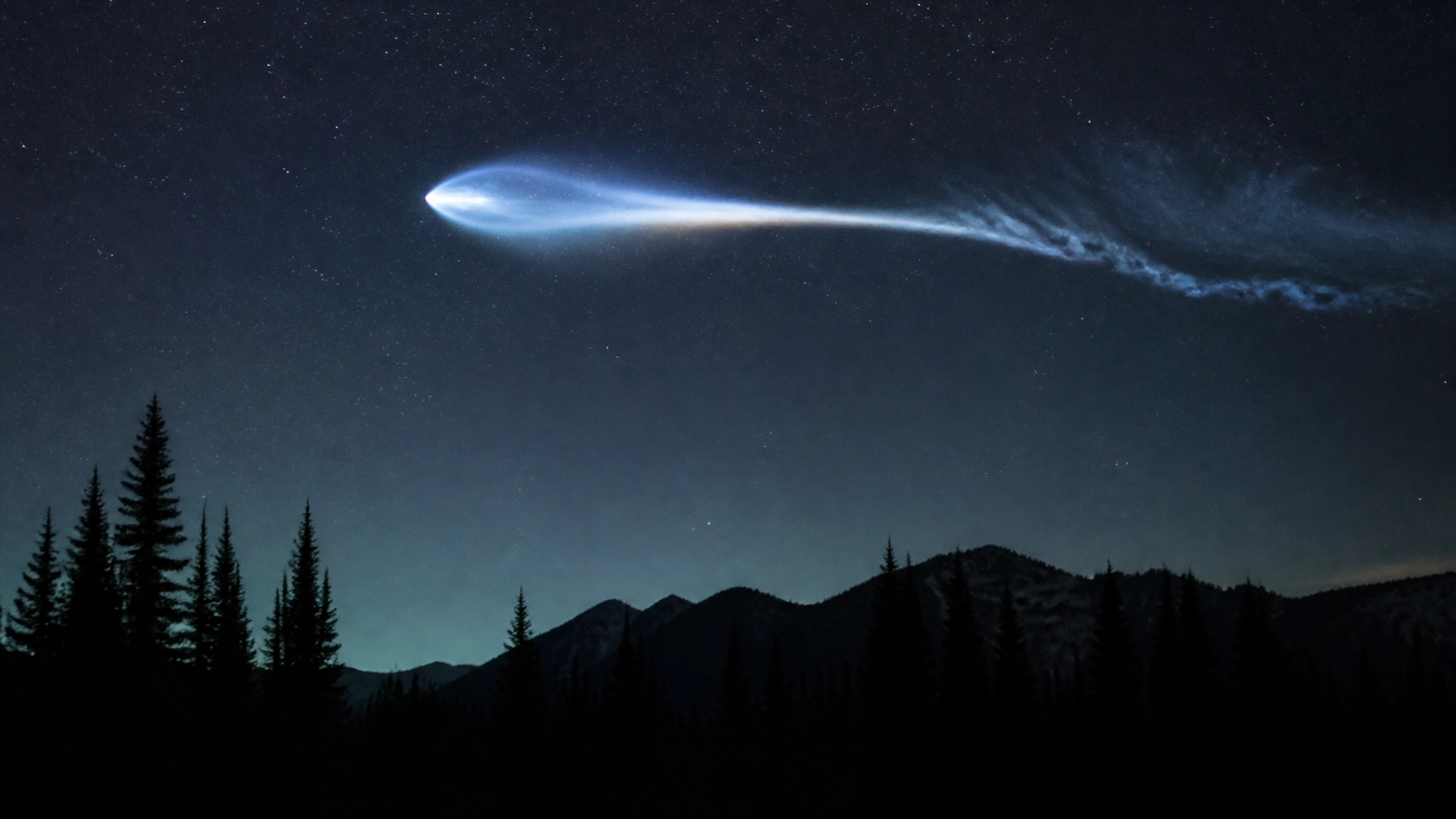
Residents across the northern and interior regions of British Columbia were left staring at the heavens on the night of 6 May 2026, as a massive, glowing object traversed the sky. The phenomenon, which appeared shortly after 10:00 PM, sparked a wave of reports across social media and to local authorities. Observers from Prince George to the Peace River region described a luminous, iridescent shape that moved with a steady, haunting grace. Unlike a traditional meteor, which typically streaks and vanishes in a matter of seconds, this object persisted for several minutes, trailing a ghostly, translucent plume that many witnesses compared to a deep-sea jellyfish swimming through the dark. The sheer scale of the display meant it was visible across vast distances, with similar reports emerging from parts of neighbouring Alberta.
The spectacle arrived at a time when public interest in aerial phenomena is at an all-time high. Within minutes of the first sighting, hundreds of residents had uploaded grainy smartphone footage and high-resolution photographs to digital platforms, debating the nature of what they were seeing. For many, the first instinct was to suspect something truly unidentified. In a region known for its vast wilderness and clear, unpolluted skies, the sight of a massive glowing orb with a shimmering tail felt like something out of a science-fiction epic. Some suggested it might be a weather balloon reflecting the setting sun at high altitudes, while others, more inclined toward the mysterious, questioned if it was a visitor from further afield.
The Science Behind the Shimmering Sky Jellyfish
The mystery was quickly addressed by the scientific community, though the explanation did little to dampen the awe of those who witnessed it. Astronomers from the H.R. MacMillan Space Centre and local astronomical societies across British Columbia identified the object as a SpaceX rocket. The vessel had been launched from Vandenberg Space Force Base in California earlier that evening, carrying a fresh payload of satellites intended for the Starlink constellation. What residents were witnessing was not the rocket itself, but a phenomenon known as the "space jellyfish" effect. This occurs when a rocket is launched just after sunset or before sunrise. While the ground is in darkness, the rocket climbs high enough into the atmosphere to be illuminated by sunlight that is still reaching those higher altitudes.
As the rocket ascends into the thinner air of the upper atmosphere, the exhaust gases from its engines expand rapidly due to the low ambient pressure. These gases, primarily water vapour and carbon dioxide, form a wide plume. When sunlight hits these expanding gases, they glow brightly against the dark backdrop of the night sky. The specific "jellyfish" shape is created by the interaction between the rocket’s plume and the surrounding atmospheric conditions. The ionisation of rocket fuel at these heights can add a vibrant blue or greenish tint to the glow, creating the otherworldly appearance that so often confuses observers on the ground. This specific launch was part of an ongoing effort to expand global internet coverage, a mission that is becoming a regular fixture of the modern nocturnal landscape.
The frequency of such events is on the rise as private space exploration and satellite deployment accelerate. In the last year alone, there have been dozens of similar launches, each with the potential to create these high-altitude light shows. For the people of British Columbia, this launch was particularly well-timed and positioned, occurring at an angle that allowed the plume to be caught perfectly by the sun's rays over the Pacific. While the explanation is grounded in human engineering and physics, the visual impact remains one of the most striking sights a person can witness from the ground, turning a routine commercial operation into a moment of collective wonder.
A History of Unidentified Aerial Sightings in the Region
British Columbia has long been a hotspot for those looking toward the stars for answers. The province’s geography, characterised by its rugged mountains and remote valleys, provides a perfect canvas for celestial events. Just weeks prior to this latest sighting, on 29 April 2026, a celestial event of a different kind gripped the region. A fireball meteor, estimated to be approximately one metre in diameter, tore through the atmosphere over Vancouver Island. That event saw over 120 individual reports submitted to tracking organisations. Unlike the slow, majestic drift of the SpaceX rocket, the meteor was a violent and sudden occurrence, lighting up the sky with a flash that was bright enough to cast shadows on the ground before disappearing over the Pacific Ocean near Bamfield.
The overlap of these two events: a natural meteor and a man-made rocket launch: highlights the complexity of modern sky-watching. Experts suggest that as more satellites are launched into orbit, the task of distinguishing between astronomical bodies, space debris, and active spacecraft becomes increasingly difficult for the average person. This has led to a renewed interest in "sky awareness," with local clubs reporting a surge in membership from people who want to understand the mechanics of the night sky. The 6 May event was a prime example of how a lack of immediate information can lead to wild speculation. Before the SpaceX confirmation, theories ranged from clandestine military experiments to the much-lampooned but ever-present "weather balloon" explanation.
The psychological impact of these sightings cannot be understated. In an era where much of our world is mapped and monitored, the sky remains a place where the unexpected can still happen. The "unidentified" element of such sightings taps into a deep human curiosity about our place in the universe. Even when the "U" in UFO is replaced with a terrestrial explanation, the sense of wonder remains. For the residents of British Columbia, who are used to the natural beauty of the aurora borealis and the Milky Way, the addition of man-made "jellyfish" to the celestial menu is a reminder of how the boundaries between Earth and space are becoming increasingly blurred.
Navigating a Future of More Frequent Celestial Displays
As we look toward the remainder of 2026, the people of British Columbia can expect more of these sightings. SpaceX, along with other private space firms, has a packed launch schedule for the coming months. Each of these missions carries the potential to create spectacular atmospheric effects, provided the timing and weather conditions align. This new reality poses a challenge for those tasked with monitoring the skies for genuine anomalies. When the sky is constantly filled with the glow of departing rockets and the glint of thousands of satellites, finding something truly unique becomes a game of extreme precision and scientific rigour.
The rise in satellite "trains": the long lines of lights that appear shortly after a Starlink deployment: has also changed the way we view the stars. While these offer a fascinating look at human progress, they have also drawn criticism from astronomers who argue that they interfere with deep-space observations. For the casual observer, however, they represent a new kind of constellation, one that moves and changes according to the needs of global telecommunications. The glowing object over the Interior of B.C. was a singular, massive version of this technological encroachment, a fleeting moment where the machinery of the 21st century looked like a visitor from another world.
The event of 6 May 2026 will likely be remembered as one of the most vivid examples of this phenomenon to date. The clear spring air and the specific trajectory of the Falcon 9 rocket combined to create a display that was as educational as it was beautiful. It served as a rare moment of unity, where people across hundreds of miles all stopped what they were doing to look up and wonder together. While the mystery was solved by morning, the memory of that glowing, translucent shape drifting over the Canadian wilderness will linger. It is a testament to the fact that even in an age of total information, the sky still holds the power to surprise us.
The SpaceX rocket launched from California successfully deployed its payload of 22 satellites into low Earth orbit shortly after the sighting. Monitoring stations across the Pacific confirmed that the second stage of the rocket performed a planned deorbit burn, which contributed to the final stages of the light show seen by observers. No debris from the launch reached the ground, as the components were designed to burn up completely upon re-entry into the atmosphere. Local astronomical societies have confirmed that no other significant celestial events were scheduled for that timeframe, solidifying the rocket launch as the sole cause of the glowing object.