









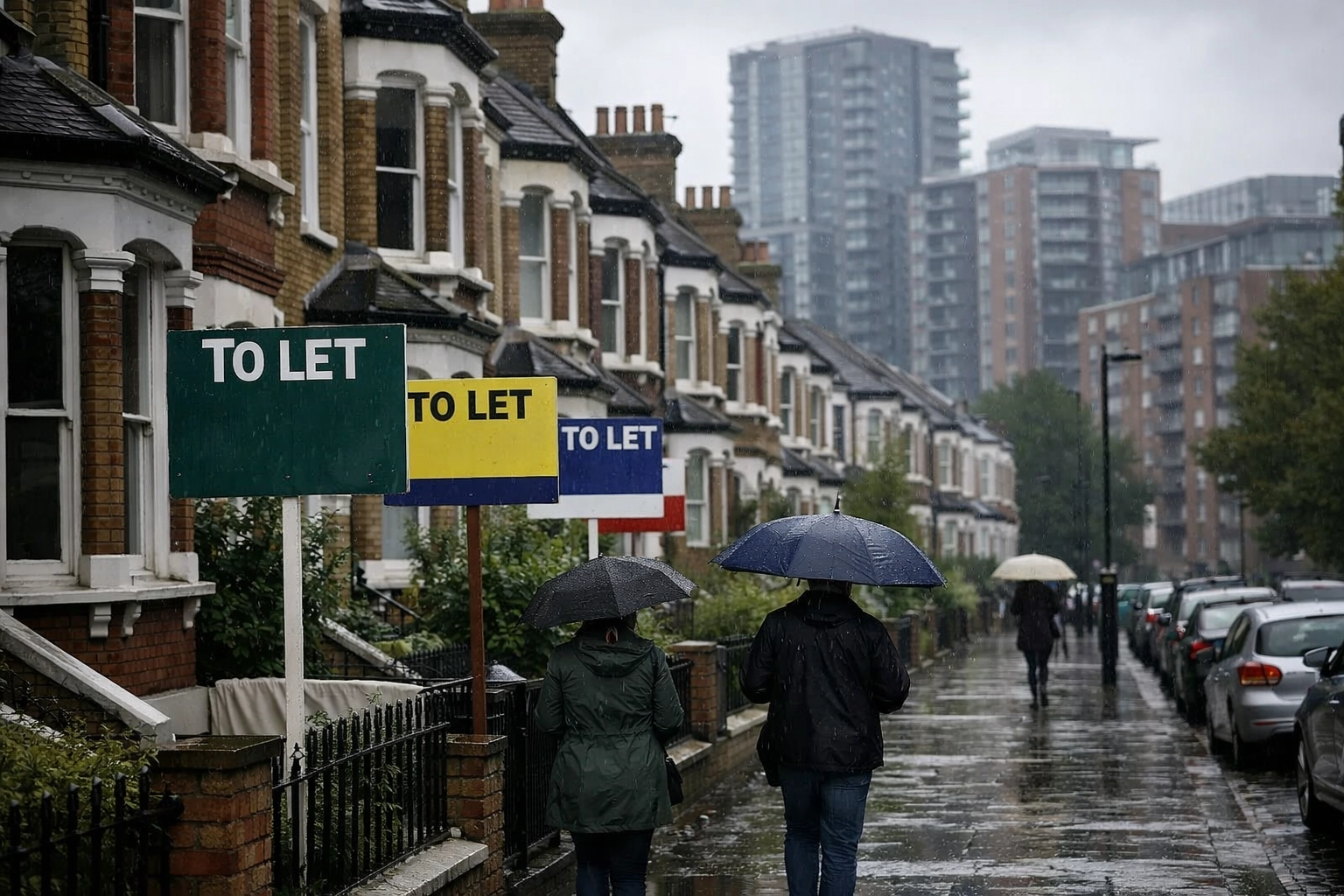
UK rents are at historic highs in March 2026, and the headline figures are only part of the story.
The private rented sector is being pulled in two directions at once: more households are relying on it for longer, while the number of homes available to rent is failing to keep up, especially at the affordable end.
That mismatch is showing up in everyday ways that renters recognise immediately, from viewings that feel like auditions to renewals that arrive with sharp increases and little room to negotiate.
The pressures are not evenly spread.
London remains the highest-cost market, but the past two years have also seen faster growth in many commuter towns and regional cities as demand spills outward and as higher mortgage costs reshape what landlords can charge and what buyers can afford.
Economists and housing analysts broadly agree on the core drivers: post-2022 interest-rate shifts that changed landlord finances, a slower pipeline of new homes, and a policy environment in which small landlords are reassessing risk.
The result is a market that looks less like a temporary stopgap and more like a long-term housing tenure for millions of working households, with knock-on effects for labour mobility, family formation, and local services.
The Vanishing Landlord: A Sector in Structural Decline
The supply squeeze is not just about new homes failing to appear.
It is also about existing rental homes disappearing from the market through sales, owner-occupation, and properties switching to other uses.
England’s overall housing delivery remains well below political targets, with 208,600 homes delivered last year against a wider ambition often framed as 1.5 million homes over a parliament.
That gap matters because population growth, household breakup, and long-standing underbuilding mean demand builds up even in years when the economy is sluggish.
At the same time, the make-up of the rental sector is changing.
Buy-to-let expanded rapidly in the years of ultra-low interest rates, when landlords could borrow cheaply and rely on rising property values to balance thin rental yields.
Since late 2022, higher borrowing costs have flipped those calculations, particularly for landlords on variable rates or refinancing fixed deals agreed during the low-rate era.
When a mortgage renewal jumps by hundreds of pounds a month, the choice for smaller landlords often becomes stark: raise rent sharply, inject cash to cover the gap, or sell.
In practice, many have sold, and tenant groups report that “no-fault” notices and end-of-tenancy sales are still a common route by which renters are displaced, even as the policy direction moves towards abolishing Section 21.
Industry estimates suggest around 600,000 homes have left the buy-to-let market over the past eight years, including roughly 150,000 sold since rates began rising in late 2022.
The number is debated, but the direction is hard to miss in letting agents’ stock levels and in the way competition at viewings has become normal in many areas.
Regulation is another part of the story, and it is not only about whether rules are “tougher.”
It is about uncertainty, timelines, and compliance costs landing on landlords who may own one or two properties and manage them as a side business.
The planned end of Section 21 “no-fault” evictions changes risk calculations because it affects how quickly a landlord can regain possession if rent arrears build, if a tenant relationship breaks down, or if the landlord wants to sell.
Supporters argue it is a basic fairness reform that reduces insecurity for tenants and forces the market to operate with clearer grounds for eviction.
Critics counter that it makes small-scale letting feel less controllable, especially for landlords already nervous about arrears and legal timelines.
Alongside that, the Renters Rights Act is expected to reshape tenancies, rent increases, and issues like pets, with campaigners arguing that long-term renters need stability that matches the reality of modern renting.
Energy standards add another layer, particularly for older homes.
EPC changes are a key pressure point because much of the private rented stock is in older terraces and converted flats where upgrades are not straightforward.
Insulation, ventilation, and heating improvements can be expensive and disruptive, and in some properties the cost of getting to a higher rating can be hard to recover through rent without pushing prices beyond local affordability.
For some landlords, the investment still makes sense as a long-term asset upgrade.
For others, especially those facing a refinancing shock, the upgrade bill becomes another reason to exit.
New supply is also facing bottlenecks.
Planning permissions have fallen to their lowest level in two decades, which matters because permissions are the forward indicator for what gets built later.
Developers have also faced higher build costs, tighter financing, and uncertainty about future demand as mortgage affordability has shifted.
Build-to-Rent schemes are expanding and are often presented by ministers and city leaders as a more professional, stable form of renting.
But they are not arriving quickly enough, and they tend to cluster in city centres and higher-demand locations, which can leave suburban and smaller-town shortages largely untouched.
Even where Build-to-Rent is delivered, it cannot easily replace the sheer number of small landlords’ homes leaving the market, and it rarely arrives at the price points that low- to middle-income households can manage without housing support.
The combined effect is a smaller, more expensive rental market serving a larger renter population.
That is why the crisis feels so persistent: it is being reinforced by multiple structural forces at once, rather than a single shock that can fade when the economy improves.
Record Inflation: The Financial Weight of British Rent
The rent crisis is often discussed like a national average, but renters experience it street by street.
Where supply is thinnest, rents can jump quickly, and early-2026 analysis has pointed to year-on-year increases of about 15% in some southern cities.
In those markets, listings can disappear within days, and it is common for tenants to feel they must decide on the spot, offer above asking, or accept less space than planned.
Letting agents and renters describe a market where the “asking rent” can be more of a starting point than a final price, particularly when multiple applicants compete and landlords choose the lowest risk profile rather than simply the highest offer.
The commuter belt effect has also been important.
As hybrid work settled into a new normal after the pandemic years, demand did not vanish from cities, but it did spread.
Some households traded a shorter commute for more space and then found that rent growth followed them outward.
That can turn once-cheaper towns into pressure points, with local wages struggling to keep up and long-term residents competing with new arrivals who bring higher salaries or larger household budgets.
The North and the Midlands have not been insulated.
In many places, rents started from a lower base, which means percentage rises can look dramatic, but the lived reality is the same: a growing share of income goes to housing.
Households spending a record share of take-home pay on rent is not just a personal budgeting issue.
It feeds into local economies, because rent is a fixed cost that crowds out spending on transport, food quality, childcare, and leisure.
When that happens at scale, it can dampen high street demand and increase reliance on credit, while also raising the stakes of any job loss or health shock.
For younger workers, the pressure is compounded by the changing path into home ownership.
Higher mortgage rates and stricter affordability tests have made it harder to pass lender checks, even for people with decent salaries.
At the same time, rising rents make it harder to save for a deposit, creating a loop where renting longer becomes the default, not the exception.
This is one reason the rental sector has become more politically sensitive: it increasingly includes people in their 30s and 40s with stable jobs who expected to buy earlier, alongside students, lower-income households, and recent arrivals.
Landlords’ costs still matter in the immediate rent-setting reality, especially for mortgaged properties.
With interest rates volatile, higher mortgage costs are frequently passed on through rents, but not evenly and not always immediately.
Some landlords raise rents at renewal; others try to keep good tenants by absorbing costs, then later sell when the numbers stop working.
In a tight market, the ability to pass on costs increases, because tenants have fewer alternatives and moving itself has become more expensive due to higher deposits, up-front rent demands, and the cost of relocating.
Policy debate is heating up because the pain is so visible.
Tenant advocacy and planned protests in London are increasing as calls for tighter controls grow, including discussions around rent stabilisation, longer default tenancies, and limits on in-tenancy increases.
Economists remain split on how far to go.
Some argue targeted controls can protect tenants from sudden shocks while still allowing landlords a reasonable return.
Others warn strict caps could accelerate landlord exits and reduce maintenance investment, worsening supply and quality over time.
The risk is that blunt controls may look like a quick fix but create longer-term distortions unless they are paired with a credible plan to expand supply and enforce standards.
What is clear is that the market is shifting from a short-term stopgap to a longer-term financial constraint.
For many households, the question is no longer whether rent will rise, but how often and by how much, and what that means for everything else in the budget.
Emergency Measures: The Growing Shadow of Homelessness
As rents rise and supply tightens, the crisis is increasingly spilling into local authority systems that were already under strain.
Homelessness is rising alongside the shortage of affordable private tenancies, and councils report growing difficulty in moving households from temporary accommodation into stable homes.
Official figures show homelessness is up by more than 10% over the past year, but front-line organisations also point to a wider layer of housing insecurity that is hard to count in real time.
The pressure on councils is financial as well as practical.
Emergency accommodation costs have escalated as hotels and short-term lets are used more often and for longer periods when self-contained temporary housing is not available.
Brighton Council has asked central government for emergency support, describing temporary housing costs as “unsustainable,” and similar warnings have been heard from other authorities facing a widening gap between need and available stock.
When councils spend more on nightly-paid accommodation, budgets are diverted from other services, and the ability to invest in prevention work becomes weaker, creating a cycle where problems are addressed later and at higher cost.
For families, the human impact is often about time.
Some households spend months in temporary accommodation because permanent rental homes are not available at the Local Housing Allowance level, or because landlords are reluctant to accept tenants who need housing support.
Long stays in temporary placements can disrupt schooling, work patterns, and healthcare access.
Even when accommodation is safe, it can be far from support networks, and frequent moves can create instability that shows up in attendance, mental health, and the ability to keep steady employment.
Hidden homelessness is a growing concern.
Sofa-surfing, overcrowding, informal sublets, and people staying in unsafe arrangements to avoid homelessness are widely thought to be rising but remain undercounted.
It is also part of why the crisis can feel bigger than the official figures suggest: the visible end of the problem is the household in emergency accommodation, but the invisible end is the household making compromises that are not captured until a situation breaks.
The policy choices in 2026 are therefore about more than rents alone.
Institutional Build-to-Rent is often presented as a route to add supply, but construction timelines do not match immediate need, and delivery tends to focus on higher-demand urban sites.
Social housing investment, council housebuilding, and targeted support to prevent evictions all sit alongside private rental reform, and the balance between those levers will shape outcomes.
Planning constraints and infrastructure capacity remain central, because even well-funded ambitions can stall if land, permissions, and build capacity do not line up.
Analysts expect the shortage to persist into 2027 and 2028 without major policy change, but “policy change” in housing is rarely a single switch.
It is a sequence of decisions about regulation, enforcement, taxation, planning, building, and welfare support, and those pieces interact.
The next phase will show whether the UK can expand supply fast enough to take pressure off rents, or whether the sector tightens further through 2026, with homelessness services carrying more of the burden in the meantime.