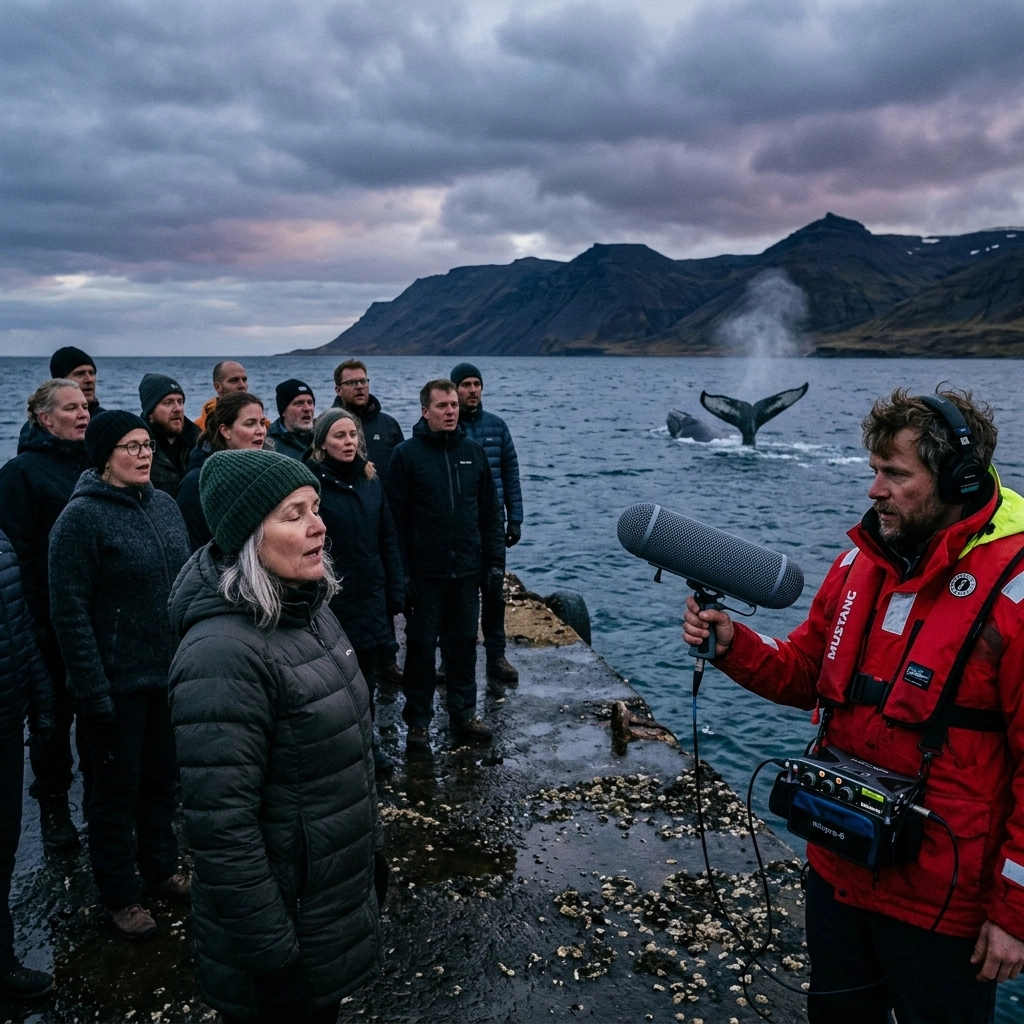
There is a certain kind of madness that only hits you when you spend too much time staring at the North Sea from a Margate park bench. It’s a creative, salt-crusted sort of madness that leads people to do things like opening artisanal seaweed shops or, in the case of the Social Singing Choir, deciding that human vocal chords simply aren’t enough. They needed something bigger. Something older. Something that weighs about 30 tonnes and lives in the freezing depths off the coast of Iceland.
As far as untold stories go, the journey of 'Wash Over Me' is right up there with the most unexpected. This isn’t your standard choral arrangement of a pop hit. This is a collaboration across species, a sonic bridge between the hip, revitalised streets of East Kent and the silent, crystalline waters of the North Atlantic. By taking underwater recordings of whales and turning them into the rhythmic backbone of a new composition, the Social Singing Choir is proving that independent news uk isn't just about politics and economics; it’s about the strange, beautiful ways we connect with the planet.
To get the lowdown on how one actually goes about harmonising with a humpback, we sat down for a hypothetical chinwag with a long-standing member of the choir. Let’s call him Baz. Baz has been singing bass for three years and has never once been asked to mimic a sonar ping until now.
A Submerged Symphony in East Kent
Interviewer: So, Baz. Let’s address the massive, blubbery elephant in the room. Why whales?
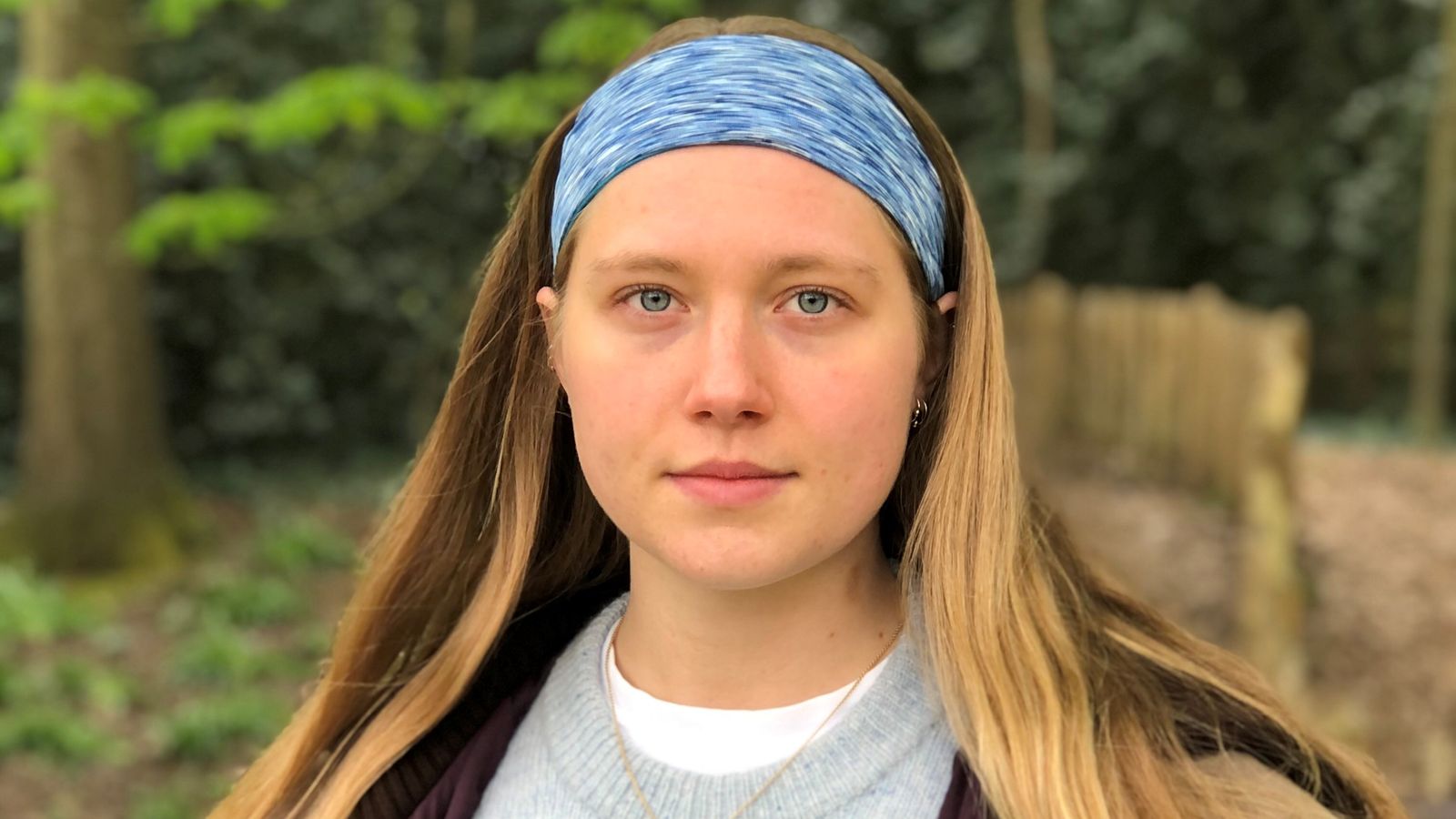
Baz: Honestly? Because we’d run out of David Bowie songs. No, I’m joking. It started with this idea of scale. We’re a big choir, there’s dozens of us, but when you stand on the beach at Margate and look out, you feel tiny. We wanted to capture that feeling. Our musical director had been talking to Rebecca Douglas, who is this incredible conservationist and photographer. she’d been out in Iceland capturing these haunting, booming recordings of whales underwater. When we heard them, they weren't just noises; they had a pulse. A beat. It felt like the ocean was trying to start a drum circle.
Interviewer: How do you actually turn a whale ‘song’ into a beat? Is there a lot of tech involved, or is it just a bloke with a laptop and a dream?
Baz: A bit of both. You can’t just hit ‘play’ on a whale recording and start singing ‘Sweet Caroline’ over the top. It doesn’t work like that. The frequencies are wild. Some of it is so low you feel it in your teeth before you hear it in your ears. We had to work with producers to isolate those rhythmic clicks and the deep, sweeping moans to create a tempo. It’s the original ambient house music, really. Except the DJ is a mammal the size of a double-decker bus.
Interviewer: Is it difficult to stay in time with a creature that doesn’t know what a metronome is?
Baz: It’s a nightmare, frankly. Whales don't care about your 4/4 time signature. They operate on ‘ocean time,’ which involves a lot of drifting and the occasional breach. But that’s the beauty of ‘Wash Over Me.’ It’s fluid. We had to learn to sing with the recordings, not just over them. It’s more of a conversation. You wait for the whale to finish its thought, then the choir responds. It’s the most polite we’ve ever been to a soloist.
Interviewer: You’ve been working closely with Rebecca Douglas on this. What’s the conservation angle?
Baz: It’s not just about making a cool track for Spotify. These recordings are a snapshot of an ecosystem that’s under immense pressure. By bringing these sounds into a choir rehearsal in a community hall in Margate, you’re making the abstract real. You can’t ignore the health of the oceans when you’re literally breathing in sync with its inhabitants. It’s bold, it’s a bit weird, and it’s exactly the kind of project that reminds people why we need to protect these giants.
The Logistics of Living with Leviathans
Interviewer: Tell us about the song itself. ‘Wash Over Me.’ What does it sound like?
Baz: It sounds like a cold morning on the Main Sands, but if the sand was made of velvet. It’s got this ethereal, sprawling quality. There are moments where the choir is practically whispering, and then the whale sounds kick in, that deep, percussive thud, and the whole room vibrates. It’s meant to be immersive. When we premiere it on May 22, it’s not just going to be a performance; it’s going to be a sensory overload. We want people to feel like they’ve been dunked in the Atlantic, but without the hypothermia.
Interviewer: Margate has a reputation for being a bit of a creative hub these days. Does the choir feel like a part of that ‘New Margate’ energy?
Baz: Margate has always been a bit ‘out there.’ We’ve just got more coffee shops now. But the Social Singing Choir is really about community. We’ve got people from all walks of life, teachers, plumbers, retirees, and people who probably spend too much on vintage knitwear. This project has unified us. There’s nothing like trying to hit a high C while a humpback whale is doing a bass solo to bring a group of strangers together. It’s one of those untold stories of local grit and global ambition.
Interviewer: What was the hardest part of the rehearsal process?
Baz: Trying not to laugh the first time we heard the raw recordings. Some whale noises are majestic. Others sound like a very large door hinge that desperately needs some WD-40. But once you get past that, you realise the complexity of what they’re doing. There’s a logic to it. We spent weeks just listening. Before we even sang a note, we just sat in the hall and let the Icelandic recordings play. It was like being in a very damp cathedral.
Interviewer: And the collaboration with Iceland, how did that come about?
Baz: Rebecca (Douglas) has a real connection to the place. She’s spent a lot of time out there documenting the wildlife. Iceland is this epic, raw environment, and Margate is… well, it’s Margate. But they both share that relationship with the sea. The water is the common denominator. We’re using sounds recorded thousands of miles away to tell a story right here on the Kent coast.
Beyond the Beach: A Call to Conservation
Interviewer: The premiere is May 22. Are you nervous?
Baz: Terrified. If the tech fails, I’m just a man standing on a stage making clicking noises with my tongue, which isn't a great look. But no, the excitement is huge. We’ve been keeping this under wraps for a while. It’s not every day you get to debut a track that features a guest appearance from the world’s largest mammals. We’re hoping it makes a splash: pun absolutely intended, I’m not even sorry.
Interviewer: What’s the ultimate goal for ‘Wash Over Me’?
Baz: We want it to go beyond Margate. We want people to hear it and think about the oceans differently. Music is a powerful way to bridge the gap between scientific data and emotional connection. You can read a report about whale populations and feel a bit sad, but when you sing with them? That stays with you. It’s about using our voices to amplify theirs.
Interviewer: Do you think the whales would like the song?
Baz: I’d like to think so. Though, knowing whales, they’d probably tell us we’re slightly flat in the bridge and that the percussion needs more ‘krill-energy.’ They’re tough critics, I imagine.
The Social Singing Choir’s project represents a fascinating intersection of art, environmentalism, and local community spirit. In a world where news can often feel repetitive, these are the stories that remind us of the ingenuity found in local corners of the UK. The use of whale beats isn't just a gimmick; it is a profound attempt to synchronise human culture with the natural world.
The recordings, captured by Rebecca Douglas during her expeditions in Iceland, provide a hauntingly beautiful foundation for ‘Wash Over Me.’ By stripping away the traditional instruments and relying on the organic rhythms of the deep, the choir has created something that feels both ancient and cutting-edge. It is a testament to the power of independent creative ventures to tackle massive themes like climate change through the lens of local art.
As the premiere on May 22 approaches, the anticipation in Margate is palpable. This isn't just a concert for the locals; it’s a signal to the rest of the country that community groups can lead the way in global conversations. Whether you’re a fan of choral music, a marine biology enthusiast, or just someone who appreciates a bit of creative daring, ‘Wash Over Me’ promises to be a landmark moment in the town’s cultural calendar.
In the end, the project serves as a reminder that we are never truly alone in our environment. Even in the middle of a bustling seaside town, the echoes of the giants in the North Atlantic are never far away. The Social Singing Choir is simply making sure we finally stop to listen: and perhaps, if we’re brave enough, to sing along.
The collaboration between the choir and the conservationists highlights a growing trend in the UK’s creative industries: the move towards "purpose-driven art." It’s no longer enough to just perform; there is a desire to participate in the survival of the subjects that inspire the music. By weaving the sounds of Icelandic whales into the fabric of East Kent’s social life, the project bridges the gap between the local and the global, the human and the wild. This initiative is a shining example of the untold stories that define the modern British landscape: stories of innovation, empathy, and a very loud, very rhythmic sea.