If you find yourself in the rolling hills of southeast Leicestershire on Easter Monday, you might expect a quiet afternoon of chocolate eggs and ecclesiastical reflection. You would be catastrophically wrong. Instead, you are likely to stumble upon a scene that looks less like a bank holiday and more like a medieval skirmish. This is the Hallaton Bottle Kicking, an event so archaic, so visceral, and so unashamedly British that it makes modern contact sports look like a game of tiddlywinks. It is a parochial boundary war disguised as a sporting event, and it has been keeping the local A&E departments on their toes for centuries.
At its heart, Bottle Kicking is a contest between the neighbouring villages of Hallaton and Medbourne. There are no pitch markings, no fancy kits, and, most importantly, almost no rules. The objective is to transport three wooden barrels, known as "bottles", over a mile of treacherous terrain, through hedges, across ditches, and over barbed wire, until they reach one of two designated streams that mark the village boundaries. It is a story of grit, ale, and an inexplicable amount of pastry. As part of our commitment to bringing you untold stories from across the British Isles, NowPWR delves into the glorious mayhem of this East Midlands tradition.
The Culinary Chaos of the Hare Pie Scramble
The madness does not begin with the physical exertion of the kicking; it begins with a pie. Not just any pie, but a Hare Pie, which serves as the traditional catalyst for the day’s events. The legend dates back centuries, allegedly born from a close encounter between two local ladies and a particularly aggressive bull. According to village lore, a hare darted across the path, distracting the bull and saving the women from a terminal case of trampling. In a fit of gratitude, the ladies bequeathed land to the local rectory on the condition that the vicar provided a hare pie, twelve penny loaves, and two barrels of ale for the poor of the parish every Easter Monday.
While the modern incarnation of the pie rarely contains actual hare, usually substituted for beef to keep things somewhat simpler, the ritual remains unchanged. The day kicks off with a colourful parade through the village of Medbourne, eventually winding its way to Hallaton. Here, the vicar stands atop the ancient Buttercross, a ten-foot-tall stone structure in the village square, to bless the pie. But this is no polite distribution. Once blessed, the pie is "scrambled." This means it is thrown piece by piece into the waiting crowd. Spectators dive for chunks of pastry and meat, a messy preamble to the main event that sets the tone for the physical confrontation to follow.
This tradition is a cornerstone of what makes this event one of the most fascinating untold stories in independent news uk. It represents a living link to a pre-industrial Britain where communal identity was forged through shared rituals and, quite often, shared snacks. After the pie has been successfully scattered and consumed by the brave and the hungry, the procession moves toward Hare Pie Bank, the high ground where the real battle commences.
The Bottles: A Trio of Heavy-Duty Kegs
To the uninitiated, the term "bottle kicking" might evoke images of teenagers punting plastic lemonade containers down a high street. In Hallaton, however, a "bottle" is a solid wooden barrel, similar to a small beer keg, bound with iron hoops. There are three of these in play. Two are "live" bottles, filled to the brim with local ale, while the third is a "dummy" bottle, solid wood and painted in bright red and white stripes. The dummy bottle contains no beer, but it is often the most fiercely contested of the lot, representing pure, unadulterated pride.
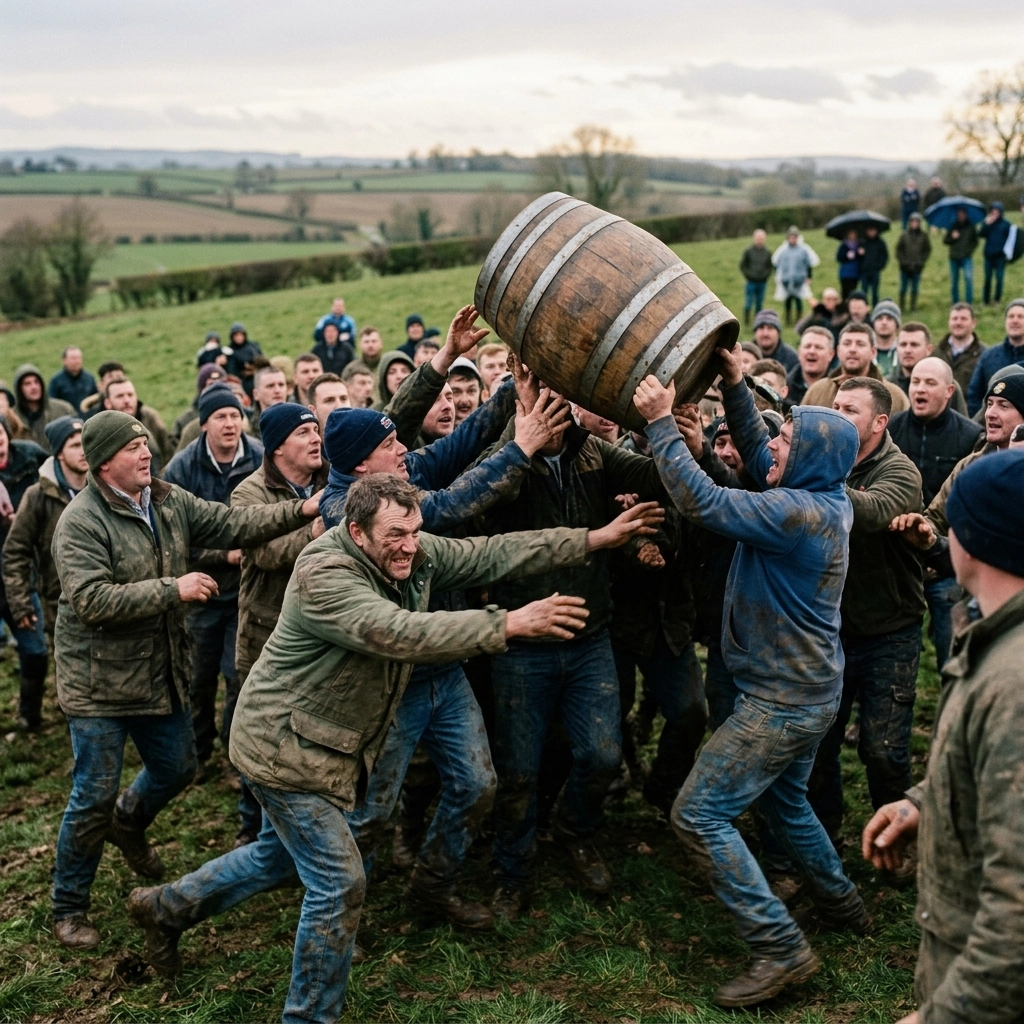
The game is played in a best-of-three format. Each bottle is tossed into the air at the top of Hare Pie Bank, and the moment it hits the turf, the world turns into a swirling mass of limbs. There are no teams in the conventional sense; there is simply the Hallaton side and the Medbourne side. Anyone can join in, and many do, leading to a "scrum" that can involve hundreds of people at once. The goal is to move the bottle to your village’s boundary stream. If Hallaton moves two bottles across their stream, they win. If Medbourne manages it, the glory goes to them.
What makes this particularly striking is the complete lack of a formal pitch. The "field of play" is whatever lies between the starting point and the streams. This includes ploughed fields, thorny hedgerows, and steep embankments. There is a magnificent, rugged honesty to the way the bottles are moved. There is no kicking involved, despite the name; it is a game of pushing, pulling, carrying, and occasionally hoarding the barrel beneath a pile of twenty grown men. It is a test of collective will, where the heavy wooden kegs become the most valuable objects in the county for a few hours of sweat-soaked lunacy.
The Field of Battle and the Art of the Scrum
If you were to draft a risk assessment for Bottle Kicking, the document would likely be several hundred pages long and consist mostly of the word "no." Injuries are not just a possibility; they are a tradition. Broken bones, dislocations, and impressive bruising are the standard trophies of the day. Emergency services are always on standby, watching from the sidelines as the mass of humanity heaves back and forth across the Leicestershire countryside. Yet, despite the violence of the scrum, there is a strict code of conduct. There is no "eye-gouging, no strangling, and no use of weapons." Beyond those basic tenets of human decency, almost anything goes.
The tactical side of the game is surprisingly complex. Veteran "kickers" know how to use the terrain to their advantage, funneling the scrum toward narrow gaps in hedges or using the downward slope of a hill to gain momentum. The dummy bottle is often used as a test of endurance, dragging the energy out of the opposition before the ale-filled bottles are introduced. There is no clock; the game lasts as long as it takes to get the barrels to the water. Some years the contest is over in a couple of hours; other years, the battle rages until the sun begins to dip below the horizon, leaving the participants caked in mud and glory.
Once the final bottle has been claimed and the winner declared, the focus shifts back to the village centre. The winning team is hoisted onto the Buttercross, where the "live" bottles are finally opened. The ale is drunk in a communal celebration that bridges the gap between the two villages, at least until next year. The losing village takes home only the empty dummy bottle, a reminder of their defeat until the next Easter Monday rolls around.
This event survives not because it makes sense in a modern, regulated world, but because it refuses to change. It is a stubborn, muddy, and beautiful piece of English heritage that continues to thrive in the face of health and safety culture. For those looking for independent news uk stories that celebrate the eccentric and the enduring, the Hallaton Bottle Kicking is a prime example of why local traditions matter. It is more than just a game; it is a parochial boundary war that reminds us of the power of community, the thrill of the struggle, and the undeniable appeal of a free beer at the end of a long, hard-fought day.