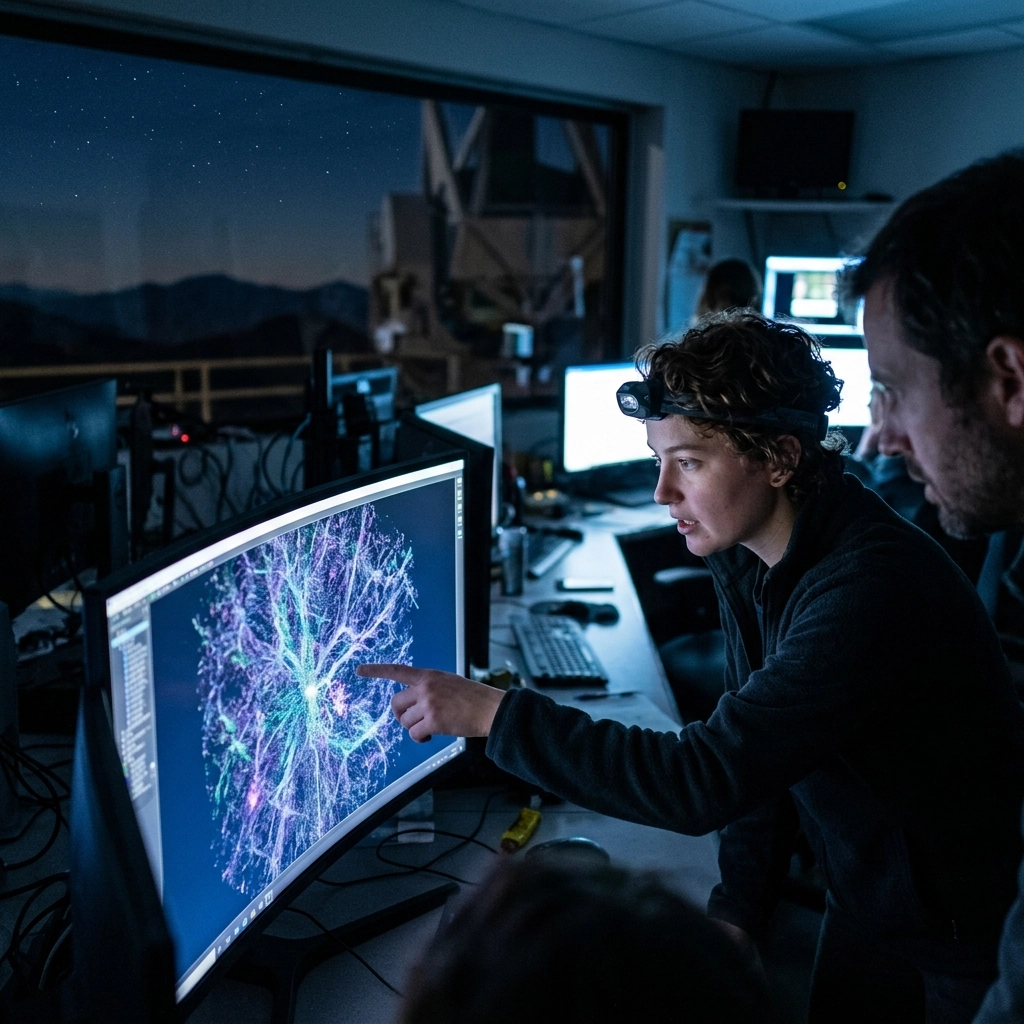
Humans have always been obsessed with maps. From the early sketches of coastlines on pieces of parchment to the high-definition satellite imagery we use to find the nearest coffee shop, we want to know where we are. But while we’ve spent centuries perfecting the geography of our own little blue marble, a massive team of scientists has been looking much, much further out. They’ve been working on a project that makes our standard GPS look like a child's drawing. We are talking about a cosmic GPS: a 3D map of 47 million galaxies that stretches across the vast reaches of space and time.
This isn’t just a fancy picture for a textbook. This project, led by the Dark Energy Spectroscopic Instrument (DESI), is an attempt to solve one of the greatest "untold stories" of our universe: what is actually pushing everything apart? As an independent news UK voice, we are diving into the science that feels like science fiction, exploring how 5,000 tiny robots are currently rewriting the history of the cosmos.
The scale of this map is hard to wrap your head around. Imagine every single dot on a screen represents an entire galaxy, each containing billions of stars, planets, and perhaps even other civilisations looking back at us. DESI has managed to pin down the locations of 47 million of these, creating the largest and most accurate 3D map ever made.
The Robotic Eye in the Sky
To build a map this big, you can’t just point a regular camera at the sky and hope for the best. You need something much more specialised. The DESI instrument lives at the Nicholas U. Mayall 4-meter Telescope in Arizona, but its heart is a marvel of modern engineering. It uses a array of 5,000 robotic fiber-optic sensors to capture the light from distant celestial objects.
Here is a breakdown of how this incredible bit of kit actually works:
- Precision Robotics: Every 20 minutes, 5,000 tiny robotic arms move into position. Each arm holds a fiber-optic cable that is thinner than a human hair.
- Targeting the Light: These robots align themselves perfectly with specific galaxies millions or billions of light-years away.
- Catching Photons: The light from these galaxies travels across the void, enters the cable, and is sent to a series of spectrographs.
- The Colour Code: The spectrographs split the light into its component colours, creating a "fingerprint" of the galaxy.
- Measuring Redshift: By looking at how these colours have shifted toward the red end of the spectrum (redshift), scientists can tell exactly how far away the galaxy is and how fast it’s moving.
This process is incredibly efficient. On a good night, DESI can map more than 100,000 objects. It is essentially 20 times more powerful than any tool we’ve had before. It’s the difference between trying to map London by walking every street and having a fleet of drones doing it from the air. This efficiency has allowed the team to surpass their original goals, mapping 47 million galaxies when they initially hoped for "only" 34 million.
The result of all this robotic dancing is a visual representation of the "cosmic web." This is the structure of the universe itself: vast filaments of galaxies strung together like glowing threads, with massive, empty "voids" in between them. It’s a breathtaking look at the architecture of existence, and it’s providing the data needed to answer the biggest question in physics.
Solving the Dark Energy Puzzle
So, why go through all this trouble? The answer lies in a mysterious substance called dark energy. If you look at the history of the universe, it started with the Big Bang and has been expanding ever since. For a long time, scientists thought gravity would eventually slow this expansion down, like a ball thrown into the air eventually falling back to Earth.
But in the late 1990s, we realised something weird was happening. The expansion isn't slowing down; it’s speeding up. Something is pushing the universe apart faster and faster. Scientists call this "dark energy," and it makes up roughly 70% of everything in the universe. The problem is, we have no idea what it is.
The new 3D map is our best tool for figuring it out. By mapping where galaxies are now and where they were billions of years ago, we can track the "push" of dark energy over time.
- A Time Machine in Reverse: Because light takes time to travel, looking at distant galaxies is like looking back in time. DESI has mapped objects whose light has taken 11 billion years to reach us.
- Tracking Growth: By comparing the distribution of galaxies at different stages of the universe's life, we can see how dark energy has influenced the growth of cosmic structures.
- Challenging Einstein: Some of the data coming back from DESI suggests that dark energy might not be a constant force, as previously thought. It might change over time, which would completely change our understanding of physics and gravity.
- The Big Rip or the Big Freeze: Understanding dark energy tells us how the universe will end. Will it keep expanding until every star goes cold (the Big Freeze), or will dark energy become so strong it literally tears atoms apart (the Big Rip)?
This is why this "independent news UK" perspective is so vital; while the headlines often focus on the politics of the day, the untold stories of our very existence are being written in the stars. The DESI map is showing us that the universe is far more dynamic and strange than we ever imagined. It’s not just a static map; it’s a living history of the tug-of-war between gravity trying to pull things together and dark energy trying to blow them apart.
Beyond the Map: What’s Next for Space Exploration?
Even though mapping 47 million galaxies is a monumental achievement, the team behind DESI isn't putting their feet up just yet. The survey is scheduled to continue through 2028, and they expect to add millions more galaxies to the database. The aim is to cover more of the sky and peer even deeper into the "dark ages" of the early universe.
What does the future hold for this cosmic GPS?
- 2027 Data Release: A massive, full-scale analysis of the five-year dataset is expected in 2027. This is when the real "eureka" moments regarding dark energy are likely to happen.
- Refining Gravity Models: Scientists will use the map to test General Relativity on the largest possible scales. If Einstein’s math doesn't hold up in these massive voids, we might need a whole new theory of gravity.
- The Neutrino Connection: The map will also help pin down the mass of neutrinos: tiny, ghostly particles that fly through us by the trillions every second but are incredibly hard to measure.
- Collaboration Across Borders: Over 900 researchers from 70 institutions are involved. It is a testament to what humans can achieve when we stop looking at our borders and start looking at the stars.
The beauty of this project is that it turns the sky into a laboratory. We don't have to build a machine big enough to simulate a galaxy; we just have to build a sensor precise enough to watch the galaxies that are already there. The 3D map allows us to see the "echoes" of the early universe, known as Baryon Acoustic Oscillations. These are essentially frozen sound waves from the Big Bang that determined where galaxies would eventually form. By measuring these waves across 47 million points, we are essentially "hearing" the birth of the cosmos.
As we move toward the late 2020s, our understanding of our place in the universe is shifting. We are no longer just observers; we are the mappers of the infinite. This 3D map doesn't just show us where the galaxies are; it shows us where we came from and where the entire universe is heading. It’s a story that’s still being told, one robotic arm movement at a time.
The Dark Energy Spectroscopic Instrument has provided a monumental leap in our ability to visualise the cosmos. By documenting 47 million galaxies with such precision, researchers have created a framework that will guide astronomical study for decades. While the mystery of dark energy remains one of the most significant challenges in modern science, this new 3D map offers the clearest path yet toward a solution. As the project continues to gather data through 2028, the scientific community awaits the further insights that will undoubtedly emerge from this unprecedented survey of our universe.