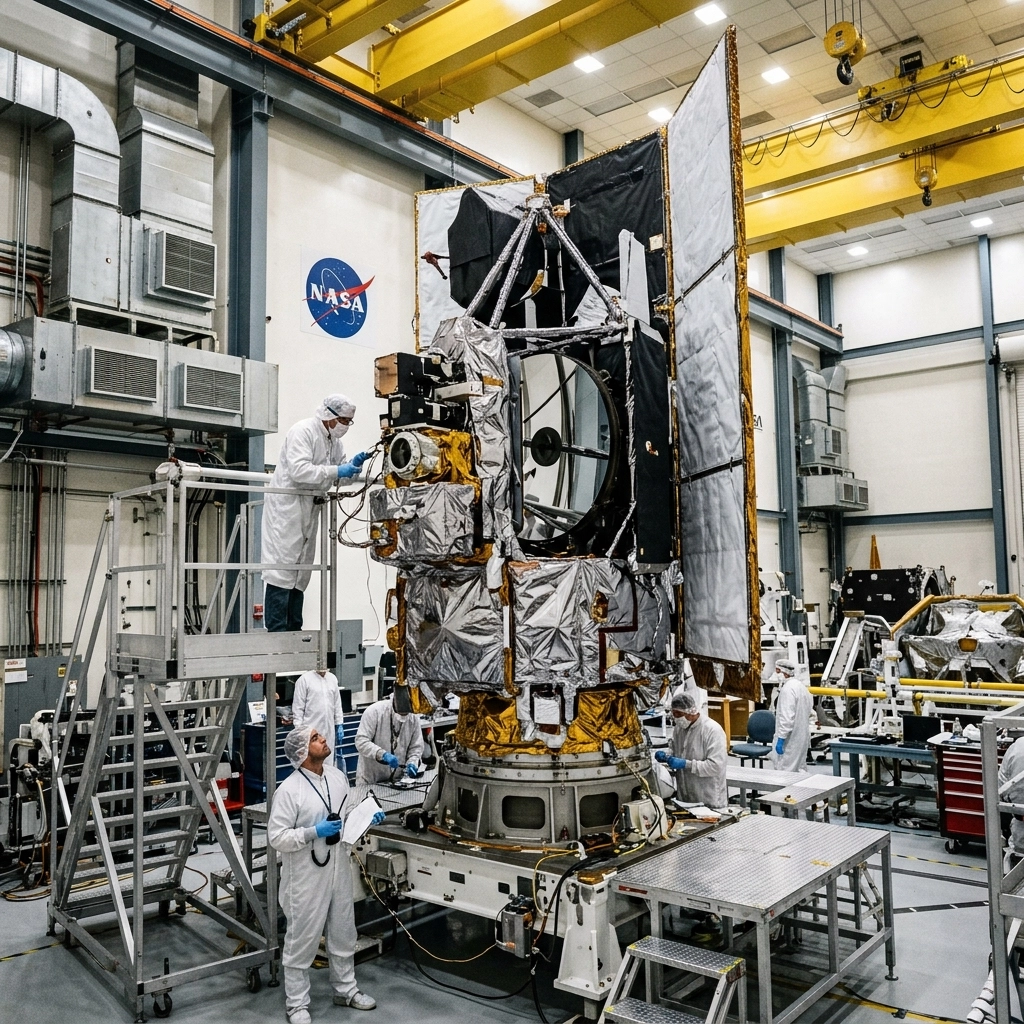
For decades, we have stared at the stars and wondered what lies in the gaps between the pinpricks of light. We have used the Hubble Space Telescope to peer deep into the past and the James Webb Space Telescope to see through the dust of creation. But now, a new titan is preparing to join the fray. The Nancy Grace Roman Space Telescope is officially assembled, tested, and nearly ready to take its place in the heavens.
Named after the “Mother of Hubble,” this observatory is not just another camera in the sky; it is a panoramic powerhouse. Imagine trying to see a forest through a straw: that is what many telescopes do. Roman, however, is like taking a panoramic photo of the entire woods in high definition. It is designed to capture the big picture, revealing the untold stories of our universe that have remained hidden in the dark for billions of years. As it completes its final checks at NASA’s Goddard Space Flight Center, the excitement in the scientific community is palpable. We are about to see the cosmos on a scale we never thought possible.
A Wide-Angle Lens on the Infinite Unknown
The sheer scale of what Roman can achieve is difficult to wrap your head around. While it has a mirror the same size as Hubble’s (2.4 metres across), its field of view is 100 times larger. This means that a single image from Roman will contain as much detail as a Hubble image but cover an area of the sky 100 times greater. It is the difference between looking at a single grain of sand and seeing the entire beach.
1. The Ghostly Glow of Rogue Planets
One of the most hauntingly beautiful things Roman will see is the “rogue” planets: worlds that have been kicked out of their solar systems and now wander the cold, dark void of interstellar space alone. Because Roman can survey such vast swaths of the Milky Way, it will be able to detect these lonely wanderers by watching how their gravity slightly warps the light of distant stars. We suspect there are billions of them, each carrying untold stories of planetary systems that fell apart long ago.
2. The Tapestry of Billion-Galaxy Surveys
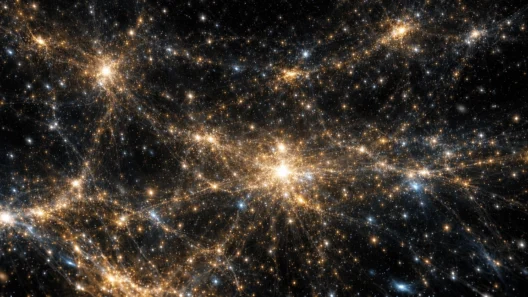
Hubble’s “Deep Field” images changed our understanding of the universe by showing thousands of galaxies in a tiny patch of sky. Roman will do this on a galactic scale. It is expected to map hundreds of millions, perhaps even billions, of galaxies during its primary mission. By seeing so many galaxies at once, astronomers can start to spot patterns in how they are distributed across the cosmos, which is key to understanding the very structure of reality.
3. The Dark Energy Tug-of-War
Something is pushing the universe apart, and we call it dark energy. We don’t really know what it is, but Roman is built specifically to find out. By observing the shapes and distances of millions of galaxies over time, the telescope will act as a cosmic surveyor, measuring the expansion of space with unprecedented precision. It will look for the “fingerprints” left by dark energy on the large-scale structure of the universe, finally shedding light on the force that determines the ultimate fate of everything.
The Search for Earth 2.0 and Beyond
While Roman is a master of the “big picture,” it also carries some of the most intricate technology ever sent into space to look at the very small: specifically, planets orbiting other stars. Its Coronagraph Instrument is a piece of engineering wizardry that would make even a sci-fi writer blush.
4. Seeing Through the Starlight
The biggest problem with seeing exoplanets is that their parent stars are billions of times brighter. It’s like trying to see a firefly hovering next to a searchlight from miles away. Roman’s Coronagraph Instrument uses a complex system of masks and mirrors to “block” the light of the star, allowing the faint glow of the planets around it to become visible. This will allow us to directly image gas giants and perhaps even see the chemical signatures of their atmospheres, revealing the untold stories of these distant, alien worlds.
5. A Census of the Milky Way
Roman isn’t just looking for one or two planets; it’s performing a massive statistical census. By monitoring hundreds of millions of stars in the crowded centre of our galaxy, it will find thousands of new worlds. This “Galactic Bulge Time-Domain Survey” will help us understand how common different types of planets are. Are Earth-like worlds rare? Are “Hot Jupiters” the norm? Roman will provide the data to answer these fundamental questions about our place in the galaxy.
6. The Evolution of Star Nurseries
Closer to home, Roman will peer into the thick clouds of gas and dust where stars are born. Because it sees in infrared light, it can look right through the dust that blocks the view of visible-light telescopes. It will show us the chaotic, violent, and beautiful process of stellar birth in entire clusters at once, rather than focusing on just one star at a time. We will see the birth of solar systems in real-time, providing a window into how our own sun and planets might have formed 4.5 billion years ago.
Unravelling the Fabric of Space and Time
The Nancy Grace Roman Space Telescope is more than just a camera; it is a time machine. Because light takes time to travel across the vast distances of space, Roman will be seeing light that has been travelling for ten billion years. It will see the universe as it was when it was just a fraction of its current age, allowing us to watch the growth of the cosmic web.
This mission represents a massive leap in our ability to process data. Roman will transmit more data back to Earth than any other NASA astrophysics mission before it. We are talking about terabytes of information every single day. To handle this, scientists are developing advanced AI and machine learning tools to sift through the images, looking for the needles in the cosmic haystack. Every pixel will be a potential discovery, a tiny piece of a puzzle that explains how we got here.
The launch, currently targeted for late 2026 aboard a SpaceX Falcon Heavy, will be a watershed moment for humanity. Once it reaches its destination at the second Lagrange point (L2), roughly 1.5 million kilometres from Earth, it will begin its five-year primary mission. It will work in tandem with the James Webb Space Telescope and the ground-based Vera C. Rubin Observatory, forming a “golden age” of astronomy that will likely rewrite our textbooks.
The Roman telescope reminds us that while we are small, our reach is vast. We are a species of explorers, and we are finally building the eyes we need to see the full majesty of our surroundings. The untold stories of the dark ages of the universe, the wanderings of lonely planets, and the mysterious push of dark energy are all waiting to be discovered.
The Nancy Grace Roman Space Telescope stands as a testament to human curiosity and engineering prowess. As the observatory moves toward its launch site at the Kennedy Space Center, it carries with it the hopes of thousands of scientists and the curiosity of millions. By providing a wide-angle view of the infrared universe, it will bridge the gaps in our knowledge and offer a clearer picture of the cosmos than we have ever dared to imagine. The final stages of testing ensure that once it reaches the silent vacuum of space, it will be ready to begin its historic watch over the infinite.