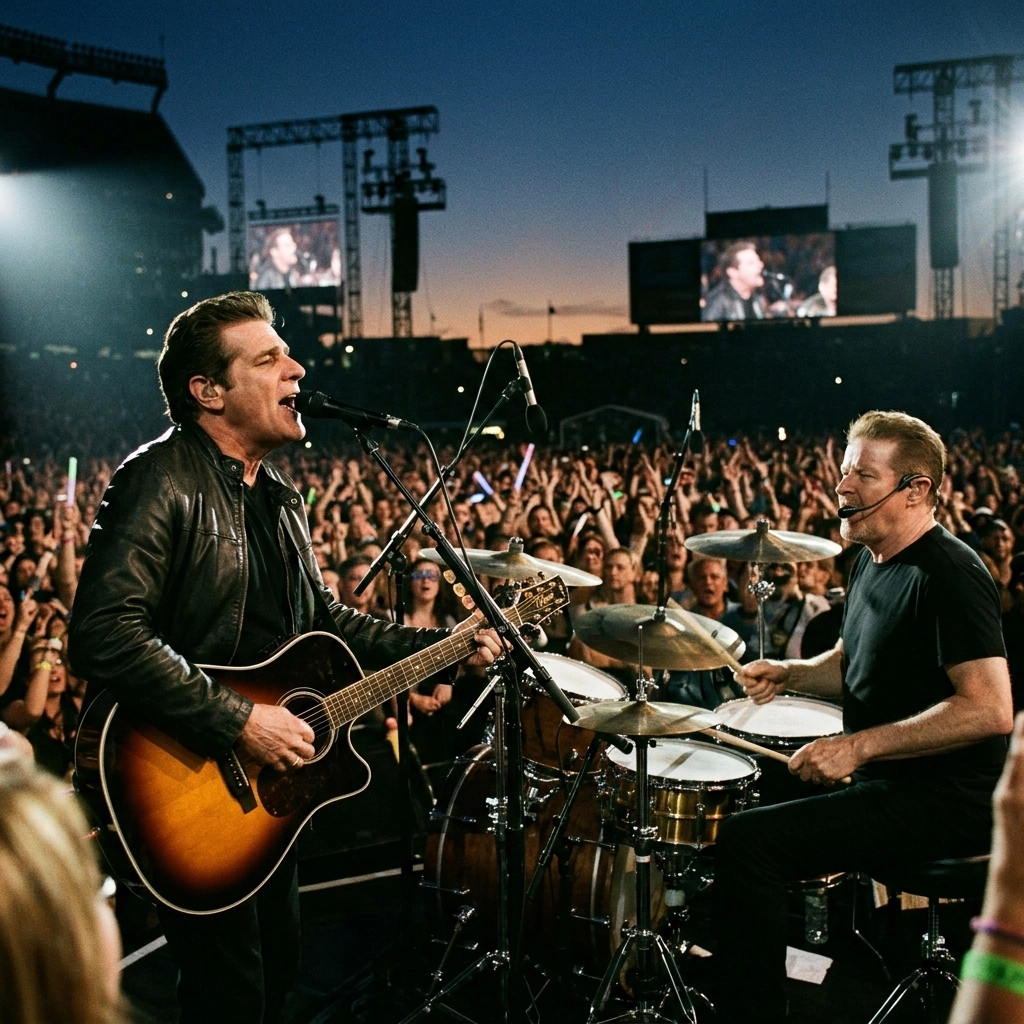
When you think of the ultimate heavyweight champion of the music world, names like Michael Jackson, The Beatles, or perhaps even Taylor Swift likely spring to mind. You imagine moonwalks, mop-tops, or record-breaking world tours. What you probably don’t picture is a group of weary-looking men in denim, harmonising about desert highways and tequila sunrises. Yet, if we look at the cold, hard data of the American recording industry, The Eagles didn’t just join the pantheon of greats; they essentially bought the building.
Their 1976 compilation, Their Greatest Hits (1971–1975), is currently certified 38x Platinum in the United States. To put that in perspective, it means the album has sold more copies in the US than Michael Jackson’s Thriller. For decades, these two titans have traded blows for the top spot, but the California rockers currently hold the crown. How did a collection of songs, most of which were already available on other albums, become the most successful piece of recorded audio in American history?
The answer lies in a mixture of perfect timing, ruthless industry strategy, and a sound that defined an era so accurately it became timeless. Through the lens of independent news uk culture desks, we can begin to unpick the untold stories of how this record became an immovable object in the charts.
The Calculated Alchemy of the Greatest Hits Era
In the early 1970s, the concept of a "Greatest Hits" album was often seen by artists as a bit of a white flag: a sign that the creative well had run dry or that the band was preparing to split. For The Eagles, however, it was a move born of necessity and label pragmatism. By 1975, the band was exhausted. They had released four albums in four years and were deep in the throes of recording Hotel California. Their manager, Irving Azoff, and their label, Asylum Records, needed something to keep the momentum going without demanding new material from a band that was already stretched thin.
The "untold stories" of the music industry often reveal that the biggest successes are the ones the artists themselves had the least to do with. Don Henley has famously remarked that the band wasn’t even consulted about the tracklist. It was a marketing tool, pure and simple. Yet, by stripping away the experimental "filler" of their earlier records and focusing purely on the radio-friendly gold, the label created a product that was essentially all-killer, no-filler.
This was the first album to ever receive the RIAA’s Platinum certification, a new award created in 1976 specifically because sales were reaching heights previously thought impossible. While other bands were trying to reinvent the wheel with progressive rock or burgeoning disco, The Eagles were being packaged as the definitive sound of the American experience. For those following independent news uk reports on cultural heritage, the Eagles represent a specific type of industrial efficiency that turned art into an evergreen commodity.
Why This Record Outpaced Every Global Megastar
One might wonder why this specific collection outlasted the cultural phenomenon of Thriller. The secret lies in the demographics. While Michael Jackson captured the youth and the global pop market, The Eagles captured the "Everyman". Their music bridged the gap between the rural country fan and the urban rock enthusiast. It was safe enough for the suburbs but had enough grit for the jukeboxes in dive bars.
The band’s journey wasn't always a vertical climb. Research into their early career shows that their second album, Desperado, actually stalled on the charts, peaking at a mere number 41. It was a conceptual gamble that didn’t quite pay off at the time. However, the label didn't panic. They leaned into the "untold stories" of the outlaw mythos, eventually finding their first number-one hit with "Best of My Love" from their third album. By the time the Greatest Hits was released, the public was primed.
The album benefited from a unique "double-dip" in the market. People who owned the individual albums bought the compilation for convenience, and new fans used it as an entry point. As the music industry transitioned from vinyl to 8track, then to cassette, CD, and eventually digital, Their Greatest Hits (1971–1975) became the "must-own" record for every new format. It became part of the furniture of the American household. In many ways, its success is a testament to the power of the middle-of-the-road. In the world of independent news uk analysis, we often see that while the fringes of culture get the headlines, the centre-ground gets the sales.
The Legacy of the Thirty-Eight Million Club
The final reason for the album's dominance is a matter of administrative persistence. In 2018, a massive audit of sales figures by the RIAA saw the Eagles jump from 29x Platinum to 38x Platinum in a single bound. This wasn't because they had suddenly sold nine million copies in a week, but because the label had finally tallied up years of digital streams and historical sales that hadn't been properly processed.
This brings us to a crucial point about chart "theft": visibility is everything. By keeping their catalogue tightly managed and ensuring every stream of "Take It Easy" or "Lyin' Eyes" counted towards the compilation’s total, the Eagles’ estate has managed to keep the record at the top of the pile. It is a masterclass in intellectual property management.
Culturally, the songs on this album: "Witchy Woman", "Peaceful Easy Feeling", "Already Gone": have become part of the sonic wallpaper of the Western world. They represent a specific brand of 1970s nostalgia that seems to be immune to the changing tides of fashion. Whether you are in a petrol station in the Midlands or a cafe in California, the chances of hearing an Eagles track are statistically higher than almost any other artist. This ubiquity feeds back into the sales; familiarity breeds a sense of essentiality.
The Eagles managed to "steal" the charts not through a single moment of flashy brilliance, but through a decade of consistent, high-quality songwriting followed by five decades of impeccable brand management. They proved that you don't need to be the most innovative band in the world to be the most successful; you just need to be the band that everyone can agree on. As we look back at the untold stories of the 70s rock scene, the Eagles stand as a reminder that sometimes, the most effective way to dominate the charts is to simply never leave them.
The record remains a fascinating case study for anyone interested in the mechanics of fame. It wasn't just about the music; it was about the packaging of an identity that resonated with millions. While Thriller might have the spectacle, Their Greatest Hits (1971–1975) has the stamina. It is the definitive soundtrack of a generation, meticulously maintained and defended by an industry that knows exactly what its audience wants.
The story of The Eagles is a reminder that chart success is often a marathon, not a sprint. By focusing on melodic consistency and a relatable narrative, they secured a position that even the biggest pop stars of the 21st century struggle to challenge. It is a record that continues to sell, continue to stream, and continue to define the very concept of a "classic" in the modern age.