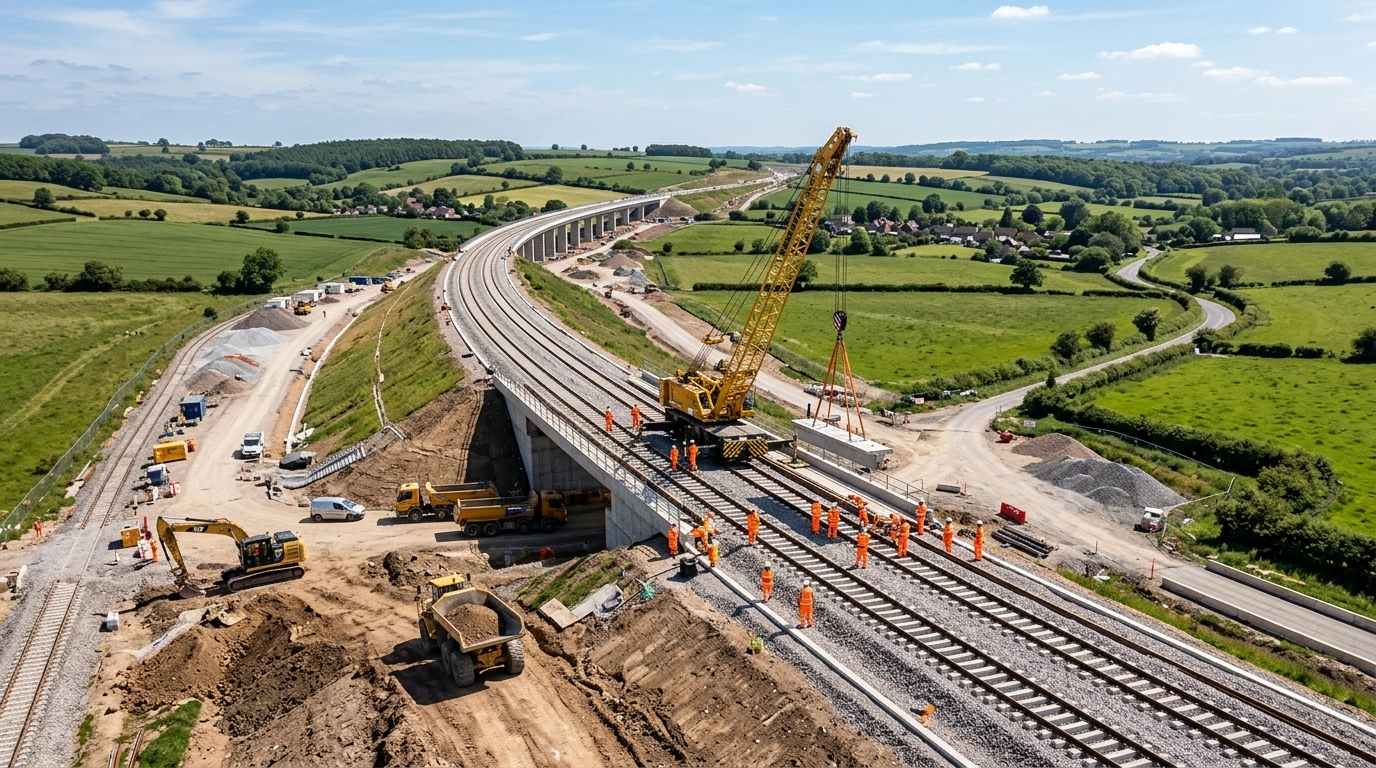
The High Speed 2 (HS2) rail project has long been touted as the backbone of Britain’s future transport infrastructure, a grand vision designed to shrink the distance between the North and South.
However, a damning new report has laid bare the reality of the project, branding it a “casebook example” of how not to manage a major national infrastructure programme. What began as a £37.5 billion endeavour to connect London, Birmingham, Manchester, and Leeds has spiralled into a financial black hole, with the cost of the remaining “rump” between London and Birmingham now threatening to crest the £100 billion mark. This astronomical figure is not merely the result of inflation or unforeseen engineering hurdles; it is the direct consequence of what critics are calling “political tunnel vision”: a stubborn refusal to acknowledge reality in favour of maintaining a prestige project at any cost.
For years, the public was fed a narrative of progress, even as the internal mechanisms of the project were grinding to a halt under the weight of mismanagement and a total lack of accountability. The recent findings from the Public Accounts Committee and various independent reviews highlight a systemic failure that stretches from the boardroom of HS2 Ltd to the highest offices in Whitehall. There was a pervasive culture of optimism bias, where risks were downplayed and costs were systematically underestimated to keep the project politically palatable. This lack of transparency has not only drained the public purse but has also severely tarnished the UK’s global reputation for delivering complex, high-stakes engineering projects.
Political pressure played a pivotal role in this decline. Successive governments were so deeply invested in the “levelling up” rhetoric associated with HS2 that they became blind to the mounting evidence of its dysfunction. Instead of pausing to reassess when the first signs of budget overruns appeared, they doubled down, fearing the political fallout of an admission of failure. This led to a cycle of deferring difficult decisions, which only served to compound the eventual costs. By the time the scale of the disaster was impossible to ignore, billions had already been sunk into preparatory works for sections of the track that may now never be built. It is a sobering reminder of what happens when political ego takes precedence over fiscal responsibility and sound project management.
A Deficit of Capability
At the heart of the HS2 debacle lies a profound deficit of capability and a total breakdown in trust between the delivery body, HS2 Ltd, and its paymasters at the Department for Transport (DfT). For a project of this magnitude to succeed, there must be a seamless integration of oversight and execution. Instead, reports suggest a fractured relationship defined by blurred lines of accountability and a lack of the specialized skills necessary to manage a £100 billion budget. The DfT has been accused of failing to provide the rigorous ministerial oversight required, while HS2 Ltd appeared to operate in a vacuum, insulated from the financial realities facing the rest of the country.
One of the most egregious contributors to the spiralling costs is the practice of “gold-plating”: the over-specification of design and engineering requirements far beyond what was strictly necessary for a functional high-speed rail line. Whether it was the insistence on bespoke architectural flourishes for stations or the construction of elaborate environmental mitigations like the infamous £100 million “bat tunnel,” the project became a playground for over-engineering. Each of these decisions, while perhaps justifiable in isolation, collectively added billions to the final bill. This lack of cost-discipline was allowed to flourish because those in charge were not operating under the constraints of a realistic, fixed budget.
Furthermore, the management of the supply chain has come under intense scrutiny.
Allegations of inflated labour rates and potential fraud are currently being investigated, suggesting that the “blank cheque” mentality surrounding HS2 filtered down to every level of the project. Without a strong “intelligent client” at the centre: someone capable of challenging contractors and ensuring value for money: the taxpayer was effectively left to pay whatever price was demanded. This capability gap has left the government in a position where it is now trying to “reset” a project that is already decades in the making and tens of billions over budget, a task that many fear may be too little, too late.
Salami-Slicing the Future
The most visible sign of HS2’s failure is the current state of the project’s geography. What was once a grand “Y-shaped” network serving the heart of the North has been reduced to a “salami-sliced” version of its original vision. The cancellation of the northern leg to Manchester and the eastern leg to Leeds has left many wondering what the ultimate point of the project actually is. By spending nearly £100 billion to connect London to Birmingham slightly faster, the government has arguably failed to deliver the transformative economic benefits that were used to justify the expenditure in the first place.
The impact of these constant political reversals cannot be overstated. Every time a section of the track is cancelled or redesigned, hundreds of millions: if not billions: of pounds in preparatory work are instantly vaporised. For instance, approximately £2 billion was spent on the Manchester leg alone before it was abruptly scrapped. Similarly, the ongoing indecision regarding the London terminus at Euston has led to a situation where two separate sets of station designs were commissioned and subsequently abandoned at a cost of £250 million. This kind of waste is a direct result of a “stop-start” approach to infrastructure that makes long-term planning impossible for both the government and the private sector.
Beyond the financial cost, there is a significant human and environmental toll.
Communities along the proposed routes have seen their lives upended for projects that may now never arrive. Vast swaths of the British countryside have been cleared, ancient woodlands have been disturbed, and homes have been compulsory-purchased, all for a vision that has been fundamentally compromised. The environmental impact of such massive earthworks is substantial, and when the promised shift from road to rail fails to materialise on the scale intended, the carbon “payback” period for the construction phase extends into the distant future. The project has become a monument to indecision, leaving a scar across the landscape with no certainty of a finished product.
Lessons from the Rail Wreckage
As the new administration attempts to pick up the pieces, the conversation has shifted toward how Britain can avoid such a catastrophic failure in the future. There is a growing consensus that major infrastructure projects must be insulated from the short-term whims of the five-year political cycle. The “rail wreckage” of HS2 serves as a powerful argument for a legally binding national transport strategy: one that is developed by experts, agreed upon cross-party, and protected from the “salami-slicing” that has plagued this project. Such a strategy would provide the stability and certainty that the industry needs to invest in skills and equipment, ultimately driving down costs.
There is also a pressing need for a radical overhaul of how these projects are governed. The current model, which relies on arm’s-length bodies like HS2 Ltd with limited financial delegations, has clearly failed. Future projects must have clearer lines of sight from the cabinet table to the construction site, with a dedicated delivery authority that possesses the commercial acumen to handle multi-billion pound contracts. The “reset” currently being discussed: which involves installing new leadership and tightening financial oversight: is a necessary first step, but it must be part of a wider cultural shift within the civil service toward transparency and realistic cost-benefit analysis.
Ultimately, the story of HS2 is a cautionary tale about the dangers of “prestige-first” governance.
It is a reminder that no vision, no matter how grand, is immune to the laws of economics or the necessity of competent management. As we look toward future projects, the focus must move away from the headline-grabbing speed of a train and toward the quiet, rigorous discipline of project delivery. If the UK is to remain a leader in global infrastructure, it must learn the hard lessons of the last decade: that transparency is not a hurdle to progress, but the only foundation upon which it can be built. For more insights into how these stories impact our daily lives and our national future, join the conversation. The £100 billion spent on HS2 may never be recovered, but if it buys us a more honest and capable way of building our country, it might yet serve some purpose.