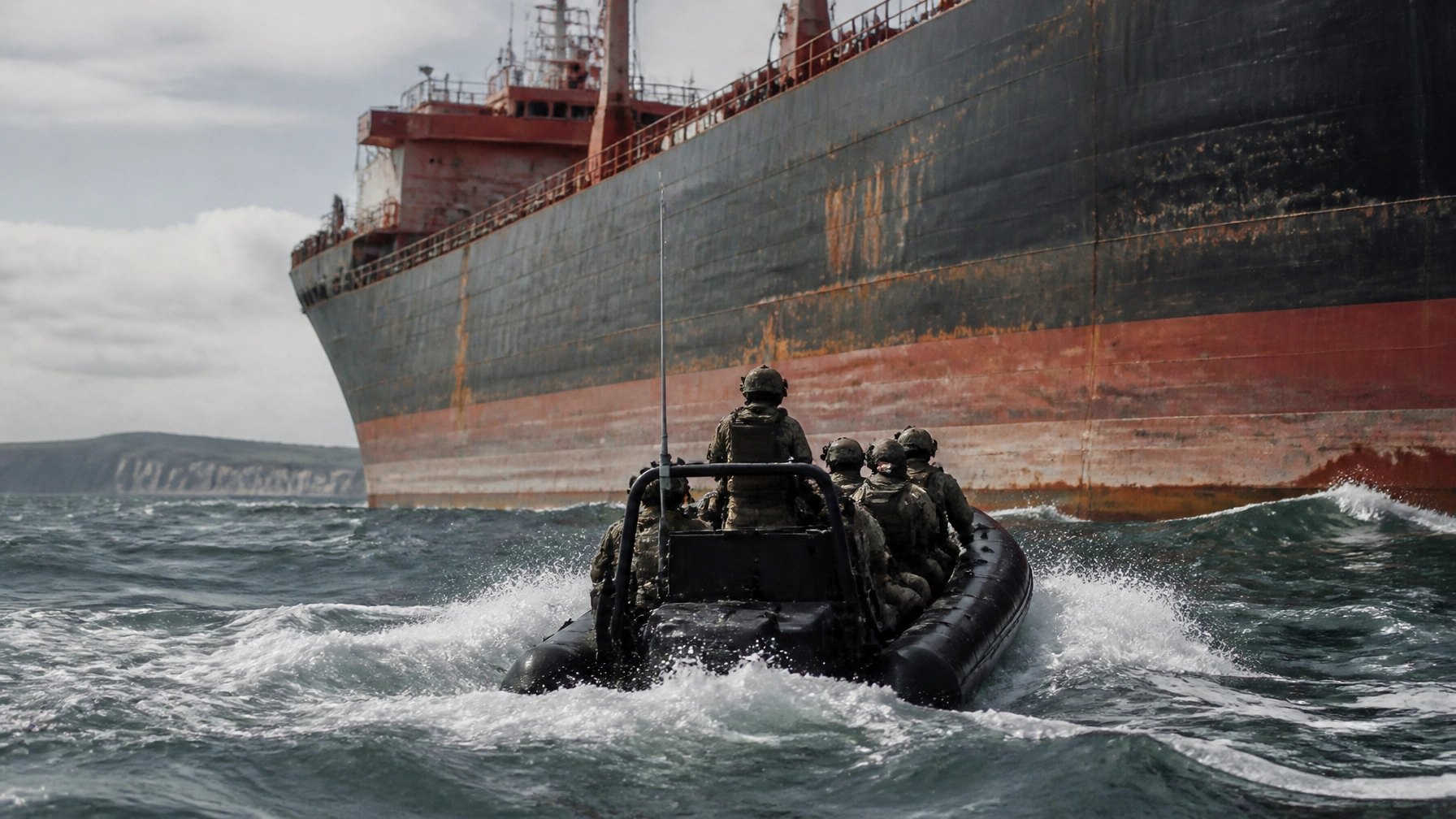
In a precision maritime strike conducted under the veil of early morning mist, elite Royal Marines from 42 Commando have intercepted and seized a Russian-linked oil tanker in the English Channel. The vessel, identified as the MV Smyrtos, was boarded in international waters before being escorted to a secure anchorage off the coast of Portland, Dorset. This high-stakes operation marks a significant escalation in the ongoing effort to disrupt the financial lifelines supporting the Kremlin’s military operations.
The Smyrtos, an Aframax-class crude oil tanker stretching 244 metres in length, was reportedly carrying approximately 700,000 barrels of Urals crude oil. Intelligence suggests the cargo was destined for international markets, intended to bypass stringent sanctions through the use of what maritime experts describe as the "shadow fleet": a network of ageing, often under-insured vessels that operate under flags of convenience to mask their true ownership and the origin of their cargo.
The Pre-Dawn Boarding Operation
The mission began in the small hours of the morning, involving a sophisticated multi-asset task group. Elements of 42 Commando, the Royal Marines’ specialist maritime boarding unit, launched from the decks of Royal Navy vessels and RAF aircraft. Support was provided by HMS Sutherland and the minehunter HMS Ledbury, while overhead, an RAF P-8 Poseidon maritime patrol aircraft provided constant surveillance and sensor data to the command team.
The boarding itself was executed with clinical efficiency. Commandos fast-roped from Merlin and Chinook helicopters onto the deck of the Smyrtos while rigid-hulled inflatable boats (RIBs) provided security from the waterline. Despite the volatile nature of the cargo and the strategic importance of the seizure, the operation was conducted without gunfire. The crew of 25, primarily consisting of Georgian and Indian nationals, reportedly offered no resistance as the elite troops took control of the bridge and engine room. The vessel’s captain was subsequently detained on suspicion of sanctions-related offences and is currently being questioned by authorities.
Once the ship was secured, it was directed toward the deep-water harbour facilities at Portland. The location was chosen for its strategic proximity and the ability of UK authorities to maintain a tight security perimeter. Environmental specialists and National Crime Agency (NCA) officers boarded the vessel shortly after its arrival at the Dorset anchorage to begin a comprehensive forensic audit of the ship’s logs and cargo manifests.
Neutralising the Shadow Fleet
The seizure of the MV Smyrtos highlights the growing problem of the global "shadow fleet." For months, security analysts have warned that Russia has been amassing a fleet of hundreds of older tankers to move oil outside the reach of G7-led price caps and sanctions. These vessels often switch off their Automatic Identification Systems (AIS): a practice known as "going dark": to hide their locations during ship-to-ship transfers in the middle of the ocean.
By targeting the Smyrtos, British authorities have sent a clear message that the English Channel will not serve as a safe corridor for such activities. The vessel had recently departed from the Russian port of Ust-Luga and was ostensibly bound for Port Said in Egypt. However, investigations revealed that the tanker was effectively stateless. The African nation of Cameroon had revoked the ship’s registration earlier this month, leaving it without a valid flag of state. This stateless status provided the critical legal opening required for the Royal Navy to intervene in international waters.
The environmental risks posed by these shadow vessels are also a primary concern for maritime authorities. Many ships in this clandestine network are near the end of their operational lives and may lack the rigorous maintenance standards required by major international shipping registries. A spill in the congested waters of the English Channel would have catastrophic consequences for the British coastline and the delicate marine ecosystems of the South Coast. By bringing the Smyrtos into Portland under military escort, the UK has mitigated a potential environmental disaster while simultaneously delivering a blow to the economic machinery of the war.
Legal Framework and Strategic Impact
The legal basis for the raid rests upon Article 110 of the United Nations Convention on the Law of the Sea (UNCLOS), which permits the boarding of ships on the high seas when there are reasonable grounds for suspecting that the vessel is without nationality. Once the stateless nature of the Smyrtos was confirmed, the Royal Marines were authorised to act. This operation represents the first time the UK has used these specific powers to seize a tanker suspected of facilitating the trade of sanctioned Russian oil.
This move signals a shift in strategy from passive monitoring to active interdiction. For much of the past two years, the focus has been on financial sanctions and diplomatic pressure. However, the resilience of the shadow fleet has necessitated a more direct approach. The seizure of 700,000 barrels of oil represents millions of pounds in lost revenue for the Russian state, a figure that becomes even more significant when considering the potential for further seizures of similar vessels.
In the coming days, the MV Smyrtos will remain under the watchful eye of the Royal Navy off the Dorset coast. Legal experts from the Crown Prosecution Service and the Treasury are expected to examine the case to determine whether the cargo can be permanently seized and the vessel sold or scrapped. For the residents of Portland and Weymouth, the sight of the massive tanker at anchor serves as a visible reminder of the UK's front-line role in the current global geopolitical struggle. The success of 42 Commando in this mission underscores the capability of the Royal Marines to operate in complex, high-risk environments to protect national interests and uphold international law.