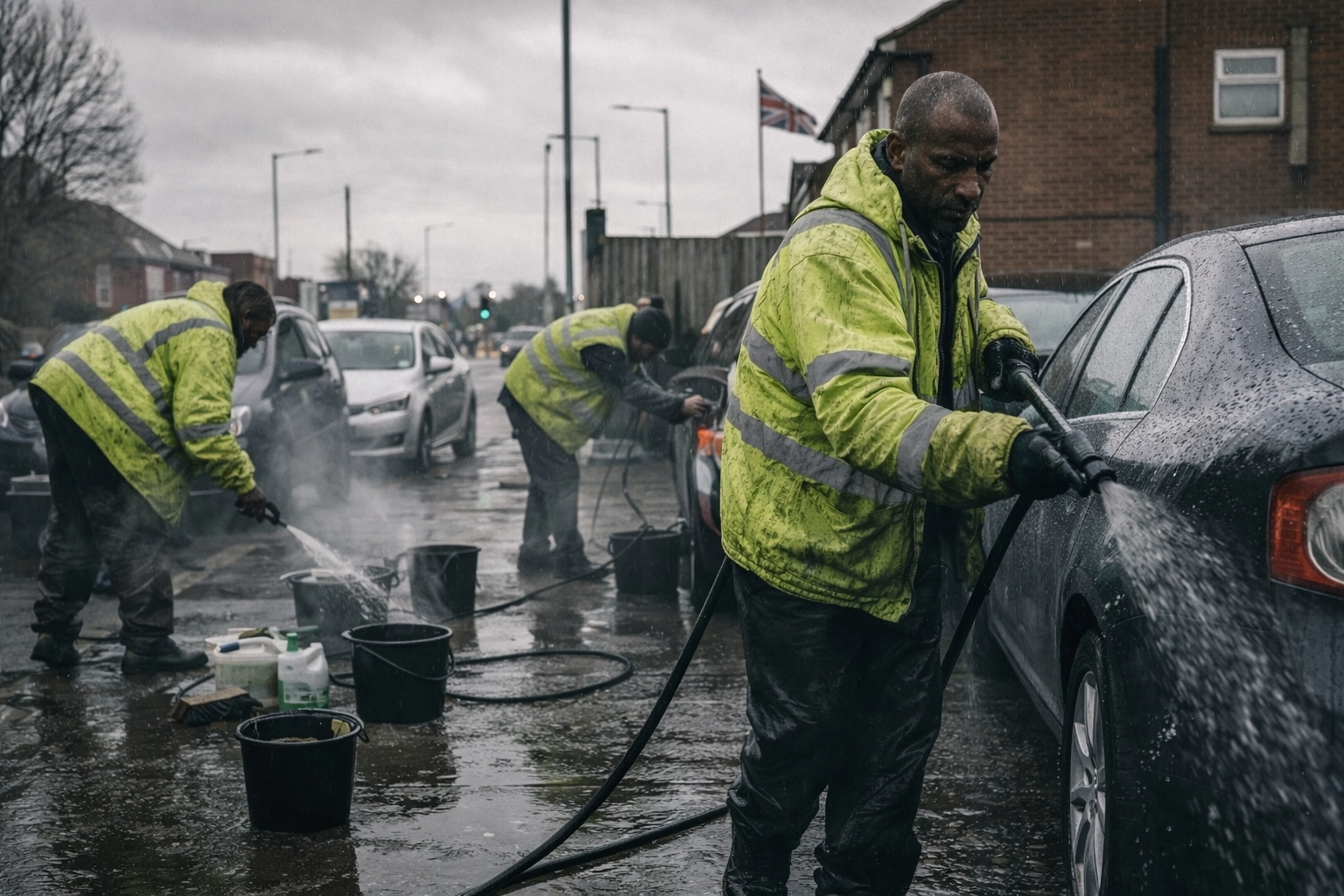
It is a familiar sight on almost every British high street or converted petrol station forecourt: a group of men in high-visibility vests, sponges in hand, ready to transform a salt-caked SUV into a gleaming vehicle for a handful of pounds. For most of us, the hand car wash is a triumph of convenience and value. We pull in, wait ten minutes, hand over a tenner, and drive away feeling satisfied. However, behind the suds and the rhythmic scrubbing lies a darker reality that many of us choose to ignore. This is one of the most pressing untold stories of our modern economy, and it is happening in plain sight.
Recent investigations and academic research have started to pull back the curtain on the hand car wash industry in the United Kingdom. What they have found is not just a story of corner-cutting or tax evasion, but a systemic issue of labour exploitation that frequently crosses the line into modern slavery. While it might feel uncomfortable to consider while you are waiting for your hubcaps to be polished, the person cleaning your car might not be there by choice, and they certainly might not be receiving the legal protections or wages they are entitled to.
As an independent news UK outlet, we believe it is vital to look at the sectors that often go overlooked. The hand car wash industry has exploded in size over the last two decades, yet it remains one of the least regulated parts of the UK service economy. This lack of oversight has created a vacuum where exploitation can thrive, turning a simple service into a high-risk zone for human rights abuses.
The Hidden Reality Behind the Five-Pound Wash
The economics of a hand car wash are often the first clue that something is amiss. When a business offers a full exterior wash for five or six pounds, the numbers simply do not add up if they are paying the National Living Wage, providing holiday pay, and investing in the necessary safety equipment. Research conducted by Nottingham Trent University (NTU) and The Clewer Initiative has shed light on just how deep these issues go. Their findings suggest that the sector is "endemically unlawful."
According to these studies, over 90% of hand car washes in the UK are likely employing workers illegally in some capacity. This does not always mean the workers are victims of human trafficking, but it frequently involves a lack of proper employment records, zero access to personal protective equipment (PPE), and wages that fall significantly below the legal minimum. In many cases, these workers are essentially invisible to the state, operating in a shadow economy where their rights are non-existent.
The research also highlighted that modern slavery risk is not confined to specific regions or "dodgy" neighbourhoods. It is a universal issue. The correlation between the location of a car wash and the risk of exploitation is surprisingly weak, meaning that a car wash in an affluent suburb is just as likely to be exploiting its staff as one in a busy city centre. This "risk everywhere" reality makes it incredibly difficult for authorities to police and even harder for the average consumer to know if they are inadvertently supporting a criminal enterprise.
Workers in these environments are often subjected to what is known as debt bondage. They may have been brought to the UK with the promise of well-paid work, only to find themselves "owing" their employers for travel, accommodation, and food. Their documents are often confiscated, and they are forced to work long hours in wet, cold conditions to pay off an ever-increasing debt. These are the untold stories of the men who stand on our forecourts, often ignored by the thousands of drivers who pass through every day.
Spotting the Signs of Labour Exploitation
Recognising modern slavery is not always straightforward. It rarely looks like the dramatic scenes portrayed in films. Instead, it is a series of subtle indicators that, when added together, point to a situation of extreme exploitation. Because these businesses operate in public, the signs are often right there for us to see, provided we know what to look for.
Physical appearance is often the most immediate indicator. Workers in hand car washes should ideally be wearing waterproof boots, gloves, and trousers. The chemicals used to strip grime from cars are often highly acidic or alkaline; without protection, they can cause severe chemical burns and long-term respiratory issues. If you see workers scrubbing cars in trainers and hoodies in the middle of a British winter, it is a significant red flag. Beyond their clothing, the physical demeanour of the workers can tell a story. Do they look fearful, anxious, or submissive? Do they avoid eye contact with customers or seem to be constantly looking over their shoulder at a "supervisor" or "boss"?
The living conditions associated with these car washes are another major concern. It is not uncommon for workers to live on-site in makeshift accommodations, such as shipping containers, overcrowded caravans, or the back rooms of the car wash itself. If you notice bedding, cooking equipment, or laundry hanging in areas that should be purely commercial, it is a strong sign that the workers are being forced to live where they work. This level of control by an employer over a worker’s private life is a classic hallmark of modern slavery.
Furthermore, the lack of transparency in transactions is a key indicator. Businesses that insist on cash only and refuse to provide a receipt are often doing so to avoid leaving a paper trail for HMRC or labour inspectors. While many small businesses prefer cash, the hand car wash sector uses it as a shield to hide the true number of staff they employ and the actual hours those staff are working. As an independent news UK source, we see how these small, seemingly insignificant details often point to much larger, more systemic failures in our regulatory systems.
Taking Action and Making Ethical Choices
The scale of the problem can feel overwhelming for an individual consumer. However, the power to change this industry lies largely in the hands of the public and the choices they make. Awareness is the first step, but action is what creates pressure for change. One of the most effective tools developed in recent years to combat this issue is the Safe Car Wash App, launched by The Clewer Initiative.
The app allows users to enter the location of a car wash and answer a few simple questions about what they see: questions about PPE, the presence of children, and the overall vibe of the operation. If the responses suggest a high risk of modern slavery, the app encourages the user to report the business to the Modern Slavery Helpline. This crowdsourced data is invaluable for police and the Gangmasters and Labour Abuse Authority (GLAA), providing them with real-time intelligence on where to focus their inspections. It turns the everyday consumer into a pair of eyes for the authorities, helping to uncover the untold stories of those who are being exploited.
Choosing where to wash your car also makes a significant difference. Many supermarkets and larger chains now host franchised car washes that are subject to much stricter audits and compliance checks. While they might cost a few pounds more than the independent forecourt down the road, that extra cost often covers the fair wages and safety equipment that are missing in exploitative setups. Looking for the Responsible Car Wash Scheme (RCWS) logo is another way to ensure that a business has been vetted and meets legal standards for employment and environmental protection.
Ultimately, tackling modern slavery in UK car washes requires a shift in how we value labour. We have become accustomed to "cheap" services without questioning who is paying the ultimate price for that low cost. By choosing to support ethical businesses and reporting suspicious activity, we can help dismantle the business model that makes exploitation profitable. The truth about UK car washes is uncomfortable, but by bringing these issues into the light, we can work towards a future where no one is forced to work in the shadows.
The fight against modern slavery is an ongoing challenge that requires the cooperation of government, law enforcement, and the public. It is about recognising the humanity of the person holding the sponge and ensuring that the convenience of a clean car does not come at the cost of someone else’s freedom. As part of the independent news UK conversation, stories like this matter because they expose untold stories hiding in everyday places. A clearer public understanding, backed by ethical choices and vigilance, can help reduce the space in which exploitation survives.