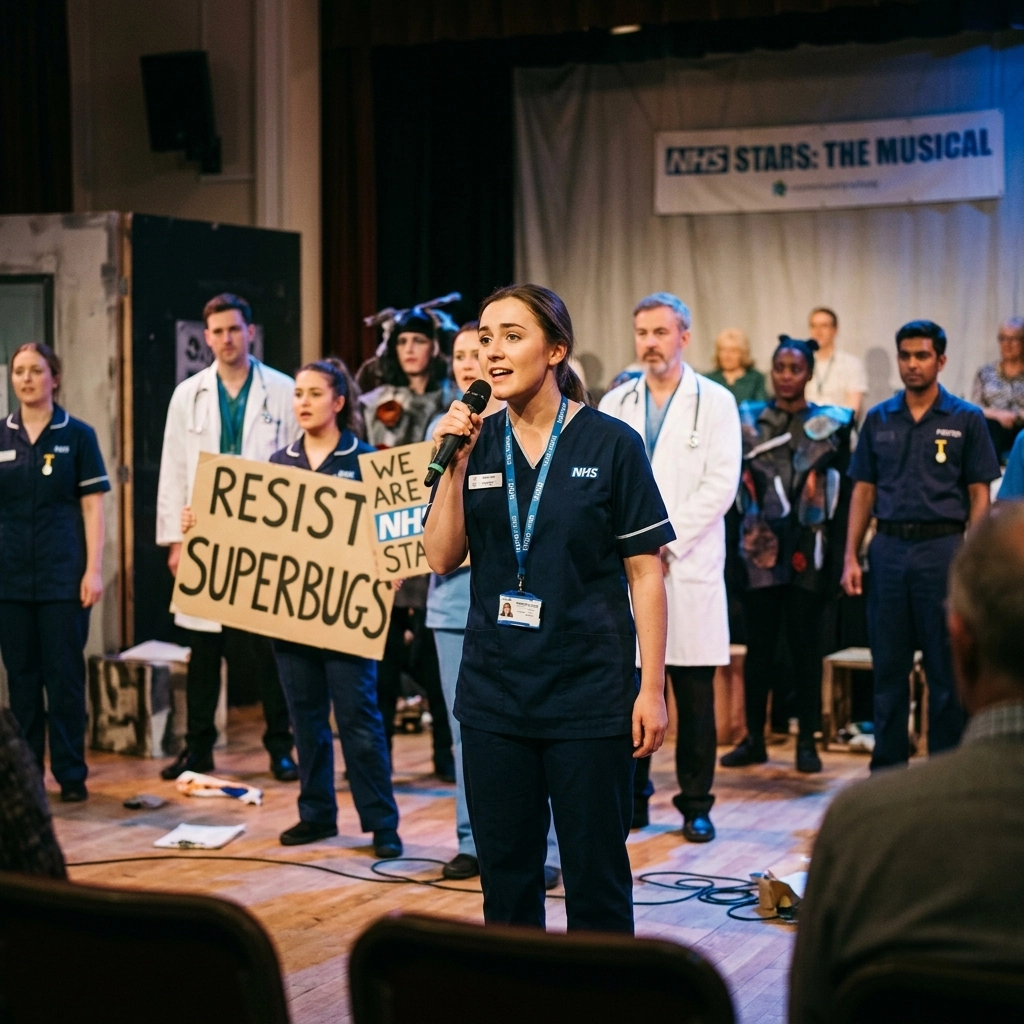
If you had ‘musical about antibiotic-resistant bacteria’ on your 2026 bingo card, congratulations, you’ve hit the jackpot. While the West End is usually busy with another revival of a classic or a jukebox musical based on a boy band everyone forgot by 2015, a production called Lifeline is doing something radically different. It’s loud, it’s folk-inspired, and it features an ensemble of 60 actual NHS workers.
Yes, you read that right. Doctors, nurses, vets, and scientists are stepping off the wards and under the spotlights to tell a story that is as much about our future survival as it is about medical history. As part of our commitment to bringing you independent news uk and the kind of untold stories that usually get buried in medical journals, we sat down with the show’s writer, Robin Hiley, to figure out how you turn a lab experiment into a show-stopping number.
The Man, The Mould, And The Music
NowPWR: Robin, let’s address the elephant in the room. A musical about Alexander Fleming and penicillin. Most people think of a lab coat and a petri dish, not a jazz hand. Why theatre?
Robin Hiley: It does sound a bit mental when you say it out loud, doesn't it? But theatre is actually the perfect medium for this. When Alexander Fleming discovered penicillin in 1928, it wasn't just a win for science; it was a revolution for humanity. We went from a world where a scratched finger could kill you to a world where we felt invincible. That’s a huge emotional arc.
The problem is, that invincibility has made us complacent. We’ve used antibiotics like they’re sweets, and now the superbugs are biting back. If I write a white paper about Antimicrobial Resistance (AMR), three people read it and two of them fall asleep. If I put 60 NHS staff on stage singing their hearts out about the fragility of life, people actually listen. It’s about taking those untold stories from the lab and making them feel personal.
NowPWR: The show splits its time between the 1920s and a modern-day ward in Edinburgh. How do you bridge that gap without it feeling like a history lecture?
Robin Hiley: We focus on the humans. In the past, we have Fleming, who was a bit of a rebel and, frankly, a bit messy in his lab, trying to convince the world he’s found a miracle. In the present, we have Jess, a junior doctor dealing with the reality of those miracles failing. Jess is the heart of the show. She’s facing patients with infections that simply won't respond to the ‘big guns’ of the pharmacy. It’s a parallel of hope and warning. Fleming actually warned us about this in his 1945 Nobel Prize speech. He said the public would demand the drug, use it incorrectly, and teach the bacteria how to resist it. He was a prophet, and we’re the ones living through the ‘I told you so’ phase.
Healthcare Heroes On Center Stage
NowPWR: You’ve got 60 NHS staff in the ensemble. Logistics-wise, that sounds like a nightmare. How do you coordinate rehearsals with people who are literally saving lives during the day?
Robin Hiley: Honestly? It’s a miracle of scheduling and a lot of caffeine. We have doctors, nurses, dentists, and even vets. They don't all perform every night: we rotate them. But having them there changes the entire energy of the room. When a nurse is on stage singing about the pressure of the ward, she’s not ‘acting.’ She’s reflecting. It brings a level of authenticity you just can’t buy with a professional cast alone.
NowPWR: Is there a specific moment in the show where the audience realizes these aren’t just actors in scrubs?
Robin Hiley: There’s a scene where the ensemble describes the rhythm of the hospital: the beeps, the rushes, the quiet moments. You can see the audience leaning in because the body language is so specific. These performers know exactly how it feels to hold a patient’s hand when the medicine isn’t working. They aren't just there for the spectacle; they are there because they care about the message. Many of them see the impact of AMR every single day. This is their way of shouting from the rooftops that we need to change how we view medicine. It’s a bit offbeat for a musical, but that’s why it works. You can find more about these kinds of unique productions in our offbeat section.
NowPWR: Dealing with NHS staff also means dealing with the reality of the healthcare system. Did the current state of the NHS bleed into the script?
Robin Hiley: Absolutely. You can’t write about the NHS in 2026 without acknowledging the strain. But the musical isn’t a political hit-piece. It’s a love letter to the people who keep the system running despite the odds. It’s about the ‘lifeline’ they provide. We wanted to highlight the wellness of the staff too: how art and community can be a form of therapy for those who give so much of themselves. It fits right into that wellness category because, for these staff members, singing is a release.
A Global Warning Set To A Folk Beat
NowPWR: The music is described as ‘Scottish folk.’ That feels very grounded. Why that specific sound for a story about global science?
Robin Hiley: Folk music is the music of the people. It’s storytelling at its most basic and honest. Fleming was Scottish, so there’s a historical link there, but folk music also has this driving, percussive energy that mirrors the way bacteria divide and grow. We have a six-piece band with whistles, fiddles, and a lot of heart. It keeps the show from feeling too ‘clinical.’ It’s raw. It’s bold. It’s exactly what you need when you’re trying to explain that the age of easy cures might be coming to an end.
NowPWR: You recently took the show to the United Nations. That’s a long way from the Edinburgh Fringe. What was the reaction from global leaders?
Robin Hiley: It was surreal. We were the first musical to ever perform there. Seeing ambassadors and scientists watching a musical about superbugs was a ‘pinch me’ moment. But it proved that this isn't just a UK problem. AMR is a global threat. If we lose the ability to use antibiotics effectively, surgery becomes incredibly dangerous, chemotherapy becomes almost impossible, and even childbirth carries a much higher risk. The UN performance was about using the power of independent news uk and culture to move the needle on policy. We need international cooperation, and sometimes a catchy chorus is the best way to get people in the same room talking.
NowPWR: What do you want the audience to do after they leave the theatre? Other than hum the tunes, obviously.
Robin Hiley: I want them to think twice before asking for antibiotics for a common cold. I want them to understand that these drugs are a precious, finite resource. But mostly, I want them to see the people behind the scrubs. We call them ‘heroes’ so often that we forget they’re humans who get tired, who love music, and who are genuinely worried about the future of medicine. If the audience walks away with a bit more respect for the science and a lot more respect for the staff, then we’ve done our job.
NowPWR: Any final words for the sceptics who think science and musical theatre shouldn't mix?
Robin Hiley: Come and see it. If you aren't moved by 60 healthcare professionals harmonising about the discovery of the century, you might need to check your own pulse. It’s bold, it’s a bit weird, and it’s arguably the most important story we could be telling right now.
The production of Lifeline continues its run, proving that the most impactful stories often come from the most unexpected places. By blending historical drama with modern-day urgency, it manages to turn a complex scientific crisis into a human experience that resonates long after the final curtain call. As the theatre world looks for new ways to engage with the reality of the 21st century, this musical stands as a testament to the power of collaboration between the arts and the frontline of medicine.
The intersection of science and culture remains a vital space for public engagement, especially concerning global health challenges. Through productions like this, the narrative of antimicrobial resistance is shifted from a distant, abstract threat to a tangible, immediate concern. By centring the voices of those who work within the healthcare system, the show provides a unique perspective that is both educational and deeply moving, ensuring that the legacy of Alexander Fleming continues to spark conversation and action in the modern era.