









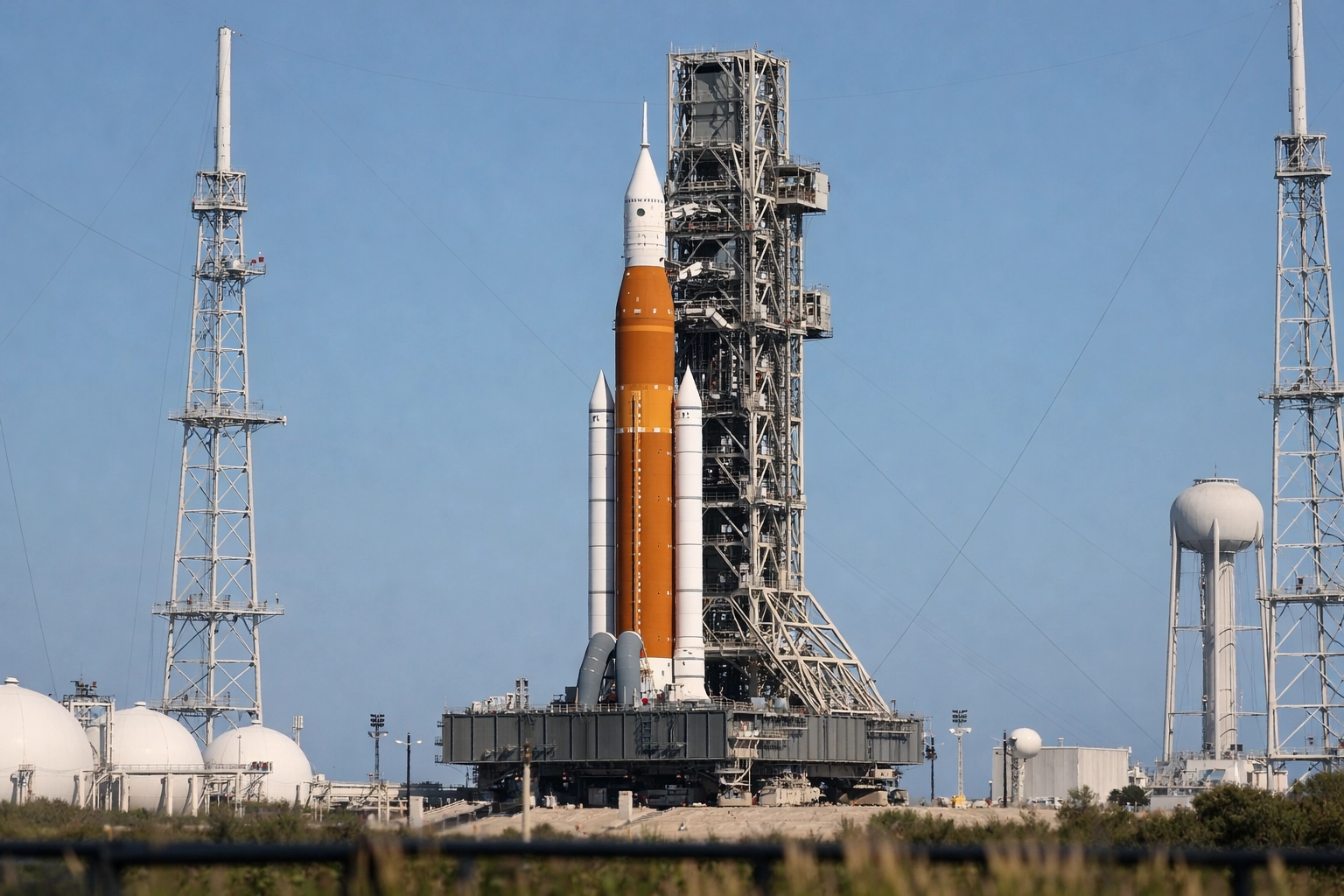
NASA’s Artemis II mission has reached a defining milestone as the Space Launch System (SLS) rocket and Orion spacecraft arrived at Launch Pad 39B at the Kennedy Space Centre in Florida.
This movement signals the beginning of the final countdown for the first crewed mission to the vicinity of the Moon in over five decades.
The mission, currently targeted for a launch in April 2026, will carry four astronauts on a ten-day flight that serves as the ultimate proving ground for deep-space exploration technology.
It follows the successful uncrewed Artemis I mission in late 2022, which saw the Orion capsule orbit the Moon and return safely to Earth, testing the core heat shield and structural integrity of the craft.
With the hardware now situated on the launchpad, engineers and flight controllers are entering a period of intensive systems checks and final flight preparations.
The crew, consisting of three Americans and one Canadian, has officially entered the pre-launch quarantine phase to ensure their health and safety before the high-stakes journey begins.
This mission represents the most significant step toward a permanent human presence on the lunar surface since the conclusion of the Apollo programme in 1972.
Technical precision and the power of the SLS rocket
The Artemis II mission relies on the Space Launch System (SLS), the most powerful rocket ever built by NASA.
Standing at nearly 100 metres tall, the SLS provides roughly 15 per cent more thrust at launch than the Saturn V rockets that powered the Apollo era.
At the heart of the vehicle are four RS-25 engines and two massive solid rocket boosters, which together generate 8.8 million pounds of maximum thrust.
This immense power is required to propel the Orion spacecraft and its crew out of Earth's gravity and onto a lunar trajectory.
The Orion spacecraft itself is a marvel of modern engineering, designed specifically to sustain human life for weeks in the harsh environment of deep space.
It features an advanced life support system that regulates atmospheric pressure, oxygen levels, and temperature while removing carbon dioxide and moisture.
Engineers have also focused heavily on the Orion Crew Survival System, which includes newly designed flight suits tailored for the specific physical demands of the Artemis missions.
The launchpad arrival follows a series of rigorous tests, including a "wet dress rehearsal" in February 2026.
During that exercise, technicians identified several liquid hydrogen leaks in the ground service equipment, leading to a brief delay in the rollout schedule.
Repairs were conducted on-site, and the propellant lines have since been certified for the upcoming flight.
The SLS rocket will also test its integrated communications and navigation systems, ensuring that the crew can remain in constant contact with Mission Control in Houston while behind the far side of the Moon.
These systems are critical for the mission’s success, as the spacecraft will experience periods of total communication blackout as it passes behind the lunar mass.
A historic crew for a deep-space journey
The four astronauts selected for Artemis II carry the weight of global expectations as they prepare to venture further into space than any human in history.
Commander Reid Wiseman leads the mission, bringing extensive experience from his previous long-duration stay on the International Space Station (ISS).
Joining him is Pilot Victor Glover, who will become the first person of colour to participate in a lunar mission, having previously served as the pilot for the SpaceX Crew-1 mission.
Mission Specialist Christina Koch, who holds the record for the longest single spaceflight by a woman, will serve as a key technical officer during the flight.
The crew is rounded out by Jeremy Hansen of the Canadian Space Agency (CSA), representing the international partnership that is a cornerstone of the Artemis programme.
Hansen’s inclusion marks a historic first for Canada and highlights the collaborative nature of modern space exploration.
The astronauts have undergone thousands of hours of training, ranging from geology field trips to simulate lunar observations to high-fidelity simulations of every possible flight contingency.
Part of their preparation involved practising the "free-return trajectory," a safety-first flight path that uses the Moon’s gravity to naturally pull the spacecraft back toward Earth.
This ensures that even if the main propulsion systems were to fail after the initial burn toward the Moon, the crew would still return home safely.
During the ten-day mission, the crew will also conduct a series of scientific investigations and technology demonstrations.
These include monitoring radiation levels within the cabin to better understand the risks posed to future crews travelling to Mars.
The astronauts will also test the manual handling characteristics of the Orion capsule, ensuring that pilots can take control of the craft during docking or emergency manoeuvres in future missions.
The mission profile and the return to Earth
The flight plan for Artemis II is a complex sequence of manoeuvres designed to test every aspect of deep-space travel.
After lifting off from Florida, the SLS will place Orion into a high Earth orbit, where the crew will perform a series of checks on the life support and communication systems.
Once the spacecraft is cleared for the next phase, the Interim Cryogenic Propulsion Stage (ICPS) will perform a Trans-Lunar Injection burn.
This burn will send the crew on a four-day journey toward the Moon, where they will come within 10,000 kilometres of the lunar surface.
On the sixth day of the flight, the crew will reach their furthest point from Earth, providing a unique vantage point for Earth-based science and photography.
During this phase, the crew will pass over the lunar far side, an area that remains largely unexplored and invisible from Earth.
The data collected during this flyby will be vital for the Artemis III mission, which aims to land the first woman and the next man on the lunar South Pole.
The South Pole is of particular interest to NASA and its partners due to the presence of water ice in permanently shadowed craters.
This ice could potentially be harvested for drinking water, oxygen, and even rocket propellant, supporting long-term lunar habitation.
Following the lunar flyby, Artemis II will begin its four-day trek back to Earth, culminating in a high-speed re-entry into the atmosphere.
The Orion capsule will hit the atmosphere at speeds of Mach 32, generating temperatures of nearly 2,800 degrees Celsius on the heat shield.
The final stage of the mission involves a series of parachute deployments to slow the craft for a splashdown in the Pacific Ocean.
Recovery teams from the US Navy and NASA are already conducting drills to ensure a rapid and safe retrieval of the crew and the spacecraft.
The success of Artemis II will pave the way for a new era of exploration, moving humanity closer to the ultimate goal of reaching Mars in the coming decades.