For over seven decades, a simple white headstone in the Venray War Cemetery in the Netherlands stood as a silent tribute to a man whose family remained thousands of miles away, unaware of his final resting place.
Sergeant Leslie Heath had been just another name on a list of the missing, a phantom figure in the archives of a global conflict that reshaped the world. Back in Liverpool, his son, also named Leslie, grew up with the heavy weight of absence, a boy who knew his father only through grainy photographs and the hushed tones of family stories. The void left by the Second World War was not just a historical fact for the Heath family; it was a living, breathing silence that lasted for seventy-five years. That silence was finally broken recently in a sun-drenched corner of a Dutch graveyard, where two men who had never met before shared a moment of profound connection over a grave that had been both a mystery and a mission.
The journey to this encounter began in the chaotic final years of the war. Sergeant Heath was part of a generation of young British men sent across the Channel to fight for a future they would never see. When he was killed in action, the fog of war claimed his identity for the official records, leaving his family in Liverpool to wonder for generations where he had fallen. For the younger Leslie, the search for his father wasn't just a genealogical hobby; it was a quest for closure. He had spent a lifetime wondering if his father was buried in an unmarked grave or if he had simply vanished into the earth of continental Europe. The breakthrough came through painstaking research and the dedicated work of historians and volunteers who refuse to let the names of the fallen fade into obscurity. When the confirmation finally arrived that Sergeant Heath was indeed buried at Venray, it set in motion a pilgrimage that would bridge the gap between Liverpool and the small Dutch town.
The Guardian of a Stranger's Legacy
What Leslie found when he arrived in the Netherlands was perhaps even more moving than the discovery of the grave itself. For years, the plot had not been neglected. It had been meticulously cared for by a local volunteer named Rob, a man who had never met the soldier buried beneath the soil but felt a deep, personal responsibility to honour him. In the Netherlands, the tradition of "adopting" war graves is a cultural phenomenon that speaks to the lasting gratitude of a nation liberated from occupation. Families, individuals, and even schoolchildren take on the task of visiting these sites, laying flowers, and researching the lives of the men who died far from home. Rob had taken Sergeant Heath’s grave under his wing, visiting it regularly, ensuring the grass was trim and the stone was clean. He didn't do it for recognition or reward; he did it because he believed that as long as someone remembered, the sacrifice was not in vain.
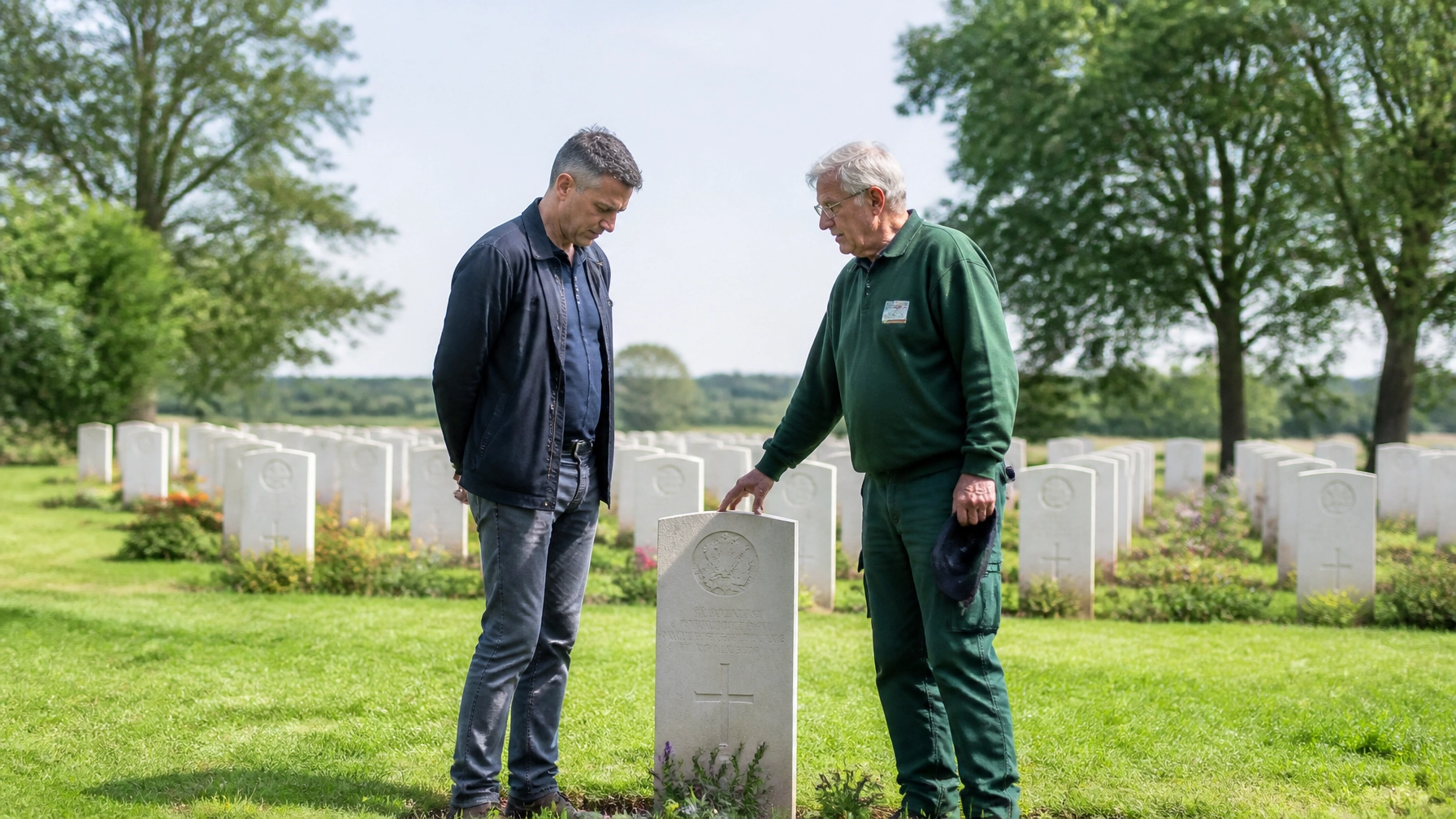
When Leslie and Rob finally met at the graveside, the atmosphere was thick with a shared sense of duty and relief. It was a meeting of two worlds: the biological son who had carried the loss in his heart, and the spiritual guardian who had carried the memory in his actions. They stood together by the pristine white headstone, two men from different backgrounds and different countries, united by a single name etched in stone. For Leslie, seeing the flowers Rob had placed and hearing about the years of quiet care was a revelation. It transformed the cold reality of a war cemetery into a place of warmth and human kindness. The man who had been a missing statistic for seventy-five years was, in fact, a cherished part of a Dutch community's collective memory.
A Pilgrimage of Closure and Gratitude
The conversation between the two men flowed with an ease that belied their lifelong separation. They spoke about the war, about the man who had died so young, and about the strange paths that had brought them to this specific patch of grass in Venray. For Leslie, the visit was the culmination of a life's worth of questions. Standing where his father lay, he was finally able to say the words he had held onto for decades. The presence of Rob added a layer of peace to the experience; it was the realization that even when a family is absent, the human spirit can step in to provide the dignity that every fallen soldier deserves. The meticulous rows of headstones at Venray, each representing a life cut short, can often feel overwhelming in their scale, but the personal connection between Leslie and Rob brought the focus back to the individual, to the father, and to the friend.
This encounter highlights a broader truth about the way we process the history of conflict. While the grand narratives of battles and treaties are written in textbooks, the real history of war is found in the quiet corners of cemeteries and in the hearts of those left behind. The Dutch people’s commitment to these graves is a testament to a unique form of international friendship. It is a promise made by one generation to another, ensuring that the liberation of their country is never taken for granted. For the people of Venray, these soldiers aren't just foreign casualties; they are the "liberators" who gave everything so that future generations could live in peace. Rob’s dedication is a living example of this philosophy, a bridge of gratitude that spans the North Sea and connects the docks of Liverpool to the fields of the Netherlands.
The Living Breath of Remembrance
As the afternoon sun cast long shadows over the cemetery, the significance of the moment was clear to everyone present. This wasn't just about the past; it was about the present and the future. By finding his father's grave and meeting its caretaker, Leslie had ensured that the story of Sergeant Heath would continue. It is a story that now includes the kindness of a stranger and the persistence of a son's love. The two men exchanged contact details, promising that this first meeting would not be their last. The grave of Sergeant Heath is no longer just a site of mourning; it is a site of friendship and a symbol of a shared history that continues to evolve. In a world that often feels divided, the sight of a Liverpudlian and a Dutchman standing together in a war cemetery provides a powerful reminder of our common humanity and the enduring power of respect.
The legacy of Sergeant Leslie Heath is now firmly rooted in both Liverpool and Venray. For his son, the journey home would be a lighter one, the seventy-five-year-old weight of the "missing" status finally lifted. He leaves behind a father who is well-tended and a new friend who understands the value of a name. The work of volunteers like Rob continues across the Netherlands and Europe, a quiet army of remembrance that ensures no headstone is ever truly lonely. As the gates of the Venray War Cemetery close at the end of the day, the rows of white stones stand as a testament to those who fell, but the story of Leslie and Rob serves as a testament to those who remember. It is through these personal connections that history stays alive, turning the cold stone of the past into the warm, living memory of the present.
{“@type”:”BlogPosting”,”image”:”https://cdn.marblism.com/W0Jr2_8JGJ4.webp”,”author”:{“name”:”Penny”,”@type”:”Person”},”@context”:”https://schema.org”,”headline”:”A Son’s Journey: Meeting the Man Tending a Father’s Grave”,”publisher”:{“logo”:{“url”:”https://nowpwr.com/logo.png”,”@type”:”ImageObject”},”name”:”NowPWR”,”@type”:”Organization”},”description”:”The moving story of Leslie Heath from Liverpool, who finally visited his father’s WWII grave in the Netherlands and met the volunteer caretaker who had been tending it for decades.”,”datePublished”:”2026-05-30″}