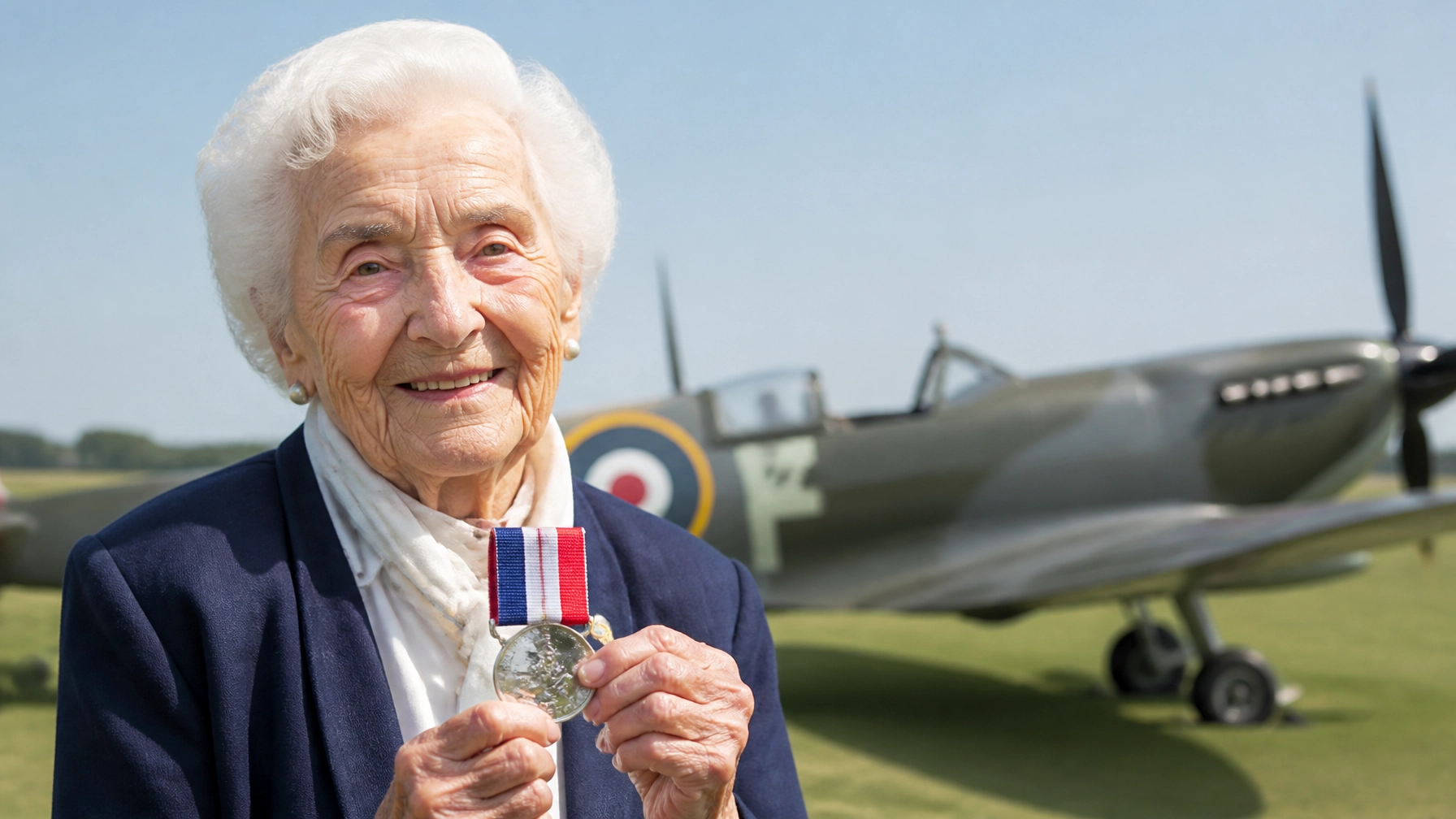
A centenarian veteran whose hands once helped maintain the legendary aircraft that defended British skies has finally been reunited with a symbol of her wartime service. Kathleen Clement, who recently celebrated her 100th birthday, was presented with a replacement Loyal Service Medal during a moving ceremony that brought her vital contributions to the Second World War back into the spotlight. The original medal, awarded for her work on the Supermarine Spitfire, had been lost for many years, leaving a gap in the physical record of a remarkable life dedicated to the nation’s defence.
The presentation of the replacement medal was not merely a formal gesture but a profound acknowledgement of the silent army of workers who kept the Royal Air Force in the air during Britain's darkest hours. Surrounded by family and local dignitaries in South Wales, Kathleen’s milestone birthday became a dual celebration of longevity and legacy. The sight of the silver medal, glinting in the light as it was returned to its rightful owner, served as a reminder that the passage of time cannot dim the importance of the work performed by those who laboured behind the scenes in the factories and hangars of the 1940s.
For Kathleen, the return of the medal sparked a wave of nostalgia and pride. While many associate the Spitfire with the pilots who flew them into combat, the survival of the country depended equally on the technical skill and tireless efforts of those on the ground. Kathleen was part of a generation of women who stepped into roles previously reserved for men, proving that they were more than capable of handling the intricate engineering and demanding maintenance required to keep high-performance fighter planes operational.
A Lifetime of Service and Dedication
The story of Kathleen Clement is woven into the broader tapestry of the British home front, where the lines between civilian and military life were often blurred by the shared goal of national survival. During the war, her daily life was defined by the roar of Merlin engines and the smell of aviation fuel and grease. Working on the Spitfire was no simple task; the aircraft was a masterpiece of aerodynamic design, but it required constant, meticulous care to ensure it remained the superior interceptor the RAF needed.
In the factories and maintenance units where Kathleen worked, the atmosphere was one of high stakes and intense precision. The Spitfire's elliptical wing, while providing its iconic silhouette and exceptional handling, was notoriously difficult to manufacture and repair. Kathleen and her colleagues worked through long shifts, often under the threat of aerial bombardment, to ensure that every rivet was secure and every engine component was tuned to perfection. This was a time when the "Spitfire Fund" saw local communities across the country raising pennies to buy planes, and for Kathleen, seeing those planes take to the air was the ultimate reward for her labour.
The Loyal Service Medal was originally awarded to signify this unwavering commitment. For decades, the absence of the physical medal was a quiet source of regret, but the recent efforts to secure a replacement have ensured that her 100th year is marked by the full recognition she deserves. The ceremony highlighted the fact that the contributions of women like Kathleen were not just supplementary to the war effort; they were the very foundation upon which victory was built. Her dedication to the craft of aviation engineering helped turn the tide of history, ensuring that the "Few" had the machines they needed to prevail.
The Engineering Legacy of the Spitfire
To understand the weight of Kathleen’s contribution, one must look at the aircraft itself. The Supermarine Spitfire remains perhaps the most famous fighter plane in history, a symbol of British defiance and engineering excellence. It was a sophisticated machine for its time, featuring a stressed-skin aluminium construction that demanded high levels of technical proficiency from those building and maintaining it. For a young woman in the 1940s to master these skills was a significant achievement that challenged the social norms of the era.
The maintenance of these aircraft was a continuous cycle of inspection and repair. In the heat of battle, planes would return with bullet holes, shrapnel damage, and mechanical strain. It was the responsibility of ground crews and factory workers to turn these battered machines around and get them back into the flight line. Kathleen’s role in this process meant she was directly responsible for the safety of the pilots who took those planes into the sky. Every adjustment made to a carburettor or every patch applied to a wing was a life-saving action.
As the years have passed, the number of people who can claim first-hand experience working on these legendary machines has dwindled. This makes Kathleen’s centenary and the recovery of her medal even more significant. She represents a living link to a pivotal moment in technological and social history. The Spitfire was more than just a weapon; it was a catalyst for change, opening doors for women in engineering and technical trades that would never fully close again. By honouring Kathleen, we also honour the spirit of innovation and resilience that defined her generation.
Recognition for the Unsung Heroes of the Air
The presentation of the replacement medal to Kathleen Clement serves as a poignant reminder that history is not only made by those in the headlines, but by the millions of individuals who performed their duties with quiet excellence. For many veterans of the home front, their service was often overlooked in the immediate post-war years as the nation focused on rebuilding and looking toward the future. However, in recent decades, there has been a concerted effort to ensure that the "backroom" heroes receive the accolades they were often denied at the time.
The Loyal Service Medal is a testament to the fact that service to the country takes many forms. Whether in the cockpit, on the assembly line, or in the repair hangar, each role was a vital piece of the puzzle. Kathleen’s story resonates because it is a story of persistence: both in her wartime work and in the long life she has lived since. Reaching the age of 100 is a feat in itself, but to do so with the same spirit of pride and modesty that she carried during the war is truly remarkable.
As the ceremony concluded and the medal was pinned back where it belonged, the significance of the moment was felt by everyone in attendance. It was a victory for memory over time. In a world that is rapidly changing, the values that Kathleen Clement stands for: duty, precision, and quiet strength: remain as relevant as ever. The Spitfire may now be a museum piece, a graceful relic of a bygone age, but the people who built it, maintained it, and loved it are the true heart of its legend. Kathleen has finally received her due, and in doing so, has reminded us all of the extraordinary things that ordinary people can achieve when the world demands it of them.