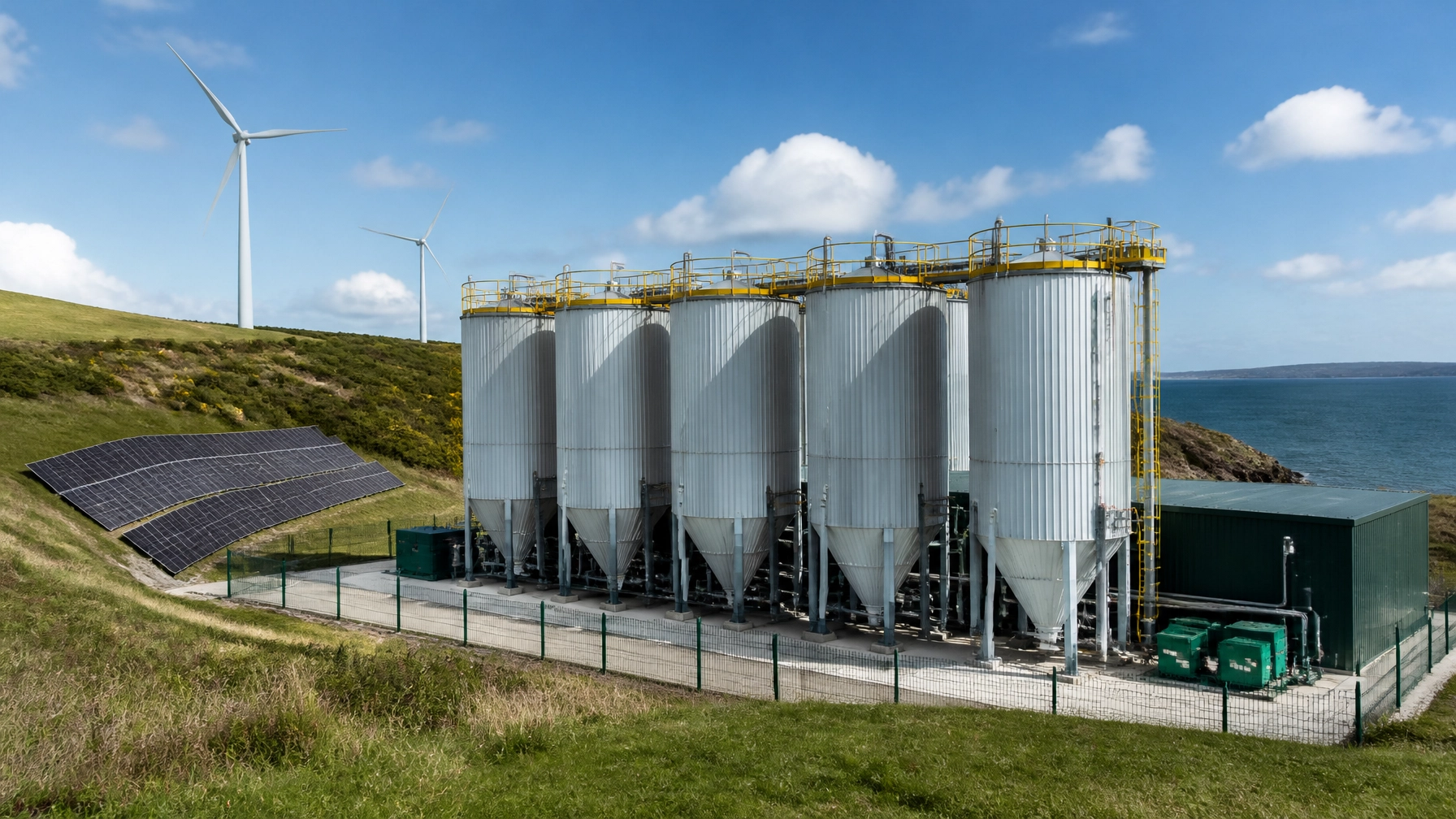
In a quiet corner of the British coastline, a small community is quietly demonstrating how the United Kingdom might finally break its reliance on fossil fuels.
While the national debate often centres on massive offshore wind farms or controversial nuclear projects, the town of Sandwich in Kent has turned to something far more fundamental: sand. By combining the natural abundance of the seaside with cutting-edge thermal storage technology, this historic town is setting a blueprint for a decentralized, carbon-neutral future that could be replicated across the country.
The project, which has recently reached a major operational milestone, utilizes a "sand battery" to store surplus energy generated by local solar and wind sources. During the day, when the sun is high over the Channel and the coastal breeze is at its peak, the town often produces more electricity than its inhabitants can consume. Previously, this excess energy was either lost or sold back to a strained national grid at a fraction of its value. Now, it is being converted into heat and stored in a massive, insulated silo filled with low-grade sand, capable of reaching temperatures of up to 600 degrees Celsius.
This stored heat is not just sitting idle; it provides a consistent, reliable source of energy for the town’s district heating network and can even be converted back into electricity when the sun sets and the wind drops. For the residents, the impact has been immediate and visible. Energy bills have begun to stabilize, and the town has seen a significant reduction in its carbon footprint, all while maintaining the aesthetic integrity of its historic streets. It is a transformation that feels both futuristic and deeply rooted in the local environment, proving that the tools for a green revolution are often right beneath our feet.
A Revolution Built on Grains of Sand
The technology at the heart of the Sandwich initiative is deceptively simple, yet it addresses one of the biggest hurdles in the transition to renewable energy: intermittency. Solar and wind power are notoriously fickle, often producing the most energy when it is needed the least. Conventional lithium-ion batteries are effective for short-term storage but remain expensive and difficult to scale. Sand, however, is cheap, abundant, and exceptionally good at retaining heat over long periods.
In the Sandwich facility, electricity from local renewables powers a resistance heater, which in turn heats air that is circulated through the sand. Because sand has a high boiling point and does not degrade like chemical batteries, it can store this thermal energy for weeks or even months. When the town requires heating or power during the cold winter nights, the process is reversed. Air is passed through the hot sand and used to generate steam for turbines or to heat water for local homes and businesses.
What makes this approach particularly appealing to British policymakers is its scalability. Unlike large-scale pumped hydro storage, which requires specific geographical features like mountains and reservoirs, sand batteries can be built almost anywhere. In a coastal town like Sandwich, the proximity to both wind resources and industrial space makes it an ideal testing ground. The facility itself is a model of modern engineering, housed in sleek, unobtrusive containers that blend into the industrial landscape of the East Kent coast, far from the eyesore that many feared such a project might become.
Local Innovation Meets Global Ambition
The success in Sandwich is not merely a technical achievement; it is a testament to the power of community-led innovation. The project was born from a collaboration between local councils, environmental consultants, and a handful of pioneering technology firms who saw the potential for a localized energy loop. By taking control of their own energy production and storage, the people of Sandwich have insulated themselves from the volatility of global energy markets, a move that has become increasingly attractive in the current economic climate.
Local businesses have been some of the biggest beneficiaries of the "Sand and Sun" initiative. Small-scale manufacturers and hospitality venues, often the hardest hit by rising utility costs, are now plugged into a grid that prioritizes local consumption. The reliability of the thermal store means that even during peak demand, the town can rely on its "battery" rather than drawing expensive power from the national network. This has created a virtuous cycle of investment, with the savings being reinvested into further green infrastructure, such as electric vehicle charging points and expanded solar arrays on public buildings.
Furthermore, the project has turned this tiny town into a hub for green tourism and education. Engineers and planners from across Europe have begun visiting the site to study how a small-scale, sand-based system can integrate with existing 19th-century infrastructure. It challenges the notion that a green transition requires a complete dismantling of the old world. In Sandwich, the medieval gates and timber-framed houses now coexist with a 21st-century energy system, showing that heritage and sustainability are not mutually exclusive but can, in fact, empower one another.
The Future of British Energy Storage
As the United Kingdom pushes toward its ambitious 2030 and 2050 climate targets, the lessons from the Kent coast are becoming impossible to ignore. The "Sandwich Model" suggests that the future of the British grid may not be a single, centralized entity, but rather a patchwork of smart, self-sufficient communities. If every town with access to renewable resources could store its own surplus, the strain on the national infrastructure would be drastically reduced, and the need for backup gas-fired power stations could eventually be eliminated entirely.
There are, of course, challenges to overcome before sand batteries become a common sight in every British town. Regulatory hurdles and the initial capital investment required for thermal storage remain significant barriers for many local authorities. However, the operational data coming out of Sandwich is providing a compelling case for government subsidies and private investment. By proving that the technology is both reliable and cost-effective in a real-world British setting, the project has cleared the way for a new wave of "sand power" developments across the country.
Ultimately, what has been achieved in this small corner of the country is a shift in perspective. It is a reminder that the transition to a sustainable world is as much about clever engineering as it is about grand policy. By looking at the sun and the sand: two of the most basic elements of the British seaside: the people of Sandwich have found a way to secure their future. As the sun sets over the English Channel, the golden light reflecting off the thermal storage tanks serves as a beacon of what is possible when a community decides to lead the way. The green energy revolution is no longer a distant prospect; in this tiny town, it is already here, powered by the very ground they walk on.