









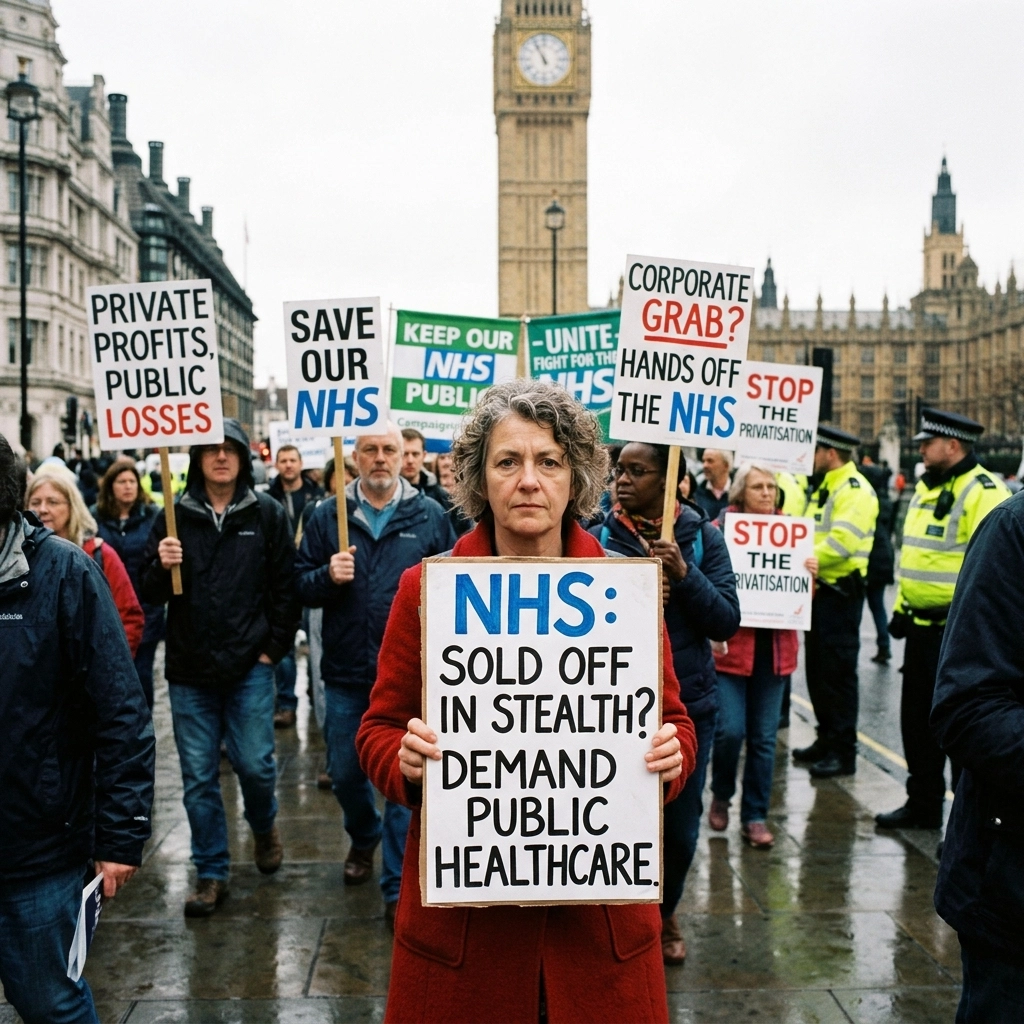
NHS Future: Privatisation by Stealth?
The National Health Service is entering a period of profound structural transformation as the Government implements its new 10-Year Health Plan.
Ministers insist the reforms are essential to modernising a system under unprecedented strain, but critics argue the changes represent a fundamental shift toward private sector involvement.
Recent data suggests that the boundary between public provision and private enterprise is becoming increasingly blurred.
While the principle of care remaining free at the point of use is frequently reaffirmed in Whitehall, the delivery of that care is shifting into new hands.
This evolution follows a decade of elective backlogs and mounting infrastructure debt that has forced the Treasury to look for alternative funding and delivery models.
For those seeking independent news UK, the debate centers on whether this is a necessary evolution or a calculated erosion of the state’s role.
Untold stories of patients waiting months for routine procedures are being used by both sides of the argument to justify their respective positions.
The 10-Year Health Plan explicitly outlines a future where private sector capacity is not merely a temporary overflow valve but a permanent fixture of the NHS landscape.
This move marks the most significant change in health policy since the 2012 Health and Care Act, which initially opened the door to wider competitive tendering.
The emergence of new public-private partnership models
The Government's latest strategy introduces what it terms "Integrated Health Organisations," a model designed to streamline patient pathways through the use of external expertise.
According to policy documents released earlier this year, these partnerships will see private firms managing specific clinical pathways, such as orthopaedics and diagnostic imaging.
The stated aim is to reduce the record-high waiting lists that have plagued the service since the early 2020s.
By leveraging private sector infrastructure, the NHS aims to clear the elective backlog within the next five years, a target many health analysts view as ambitious.
However, the British Medical Association (BMA) has raised concerns that these public-private partnerships could lead to a "fragmented" service.
They argue that while private providers may excel at high-volume, low-complexity procedures, the more difficult and expensive cases will remain the sole responsibility of the state.
This could create a two-tier system where profit-driven entities cherry-pick the most lucrative treatments.
Parliamentary briefings discussed in February 2026 highlighted that the 10-Year Health Plan represents a "dramatic divergence" from the principle of the NHS as a purely publicly provided service.
Ministers have countered this by pointing to the success of specific diagnostic hubs where private imaging technology has significantly reduced cancer detection times.
The debate is no longer about whether the private sector should be involved, but to what extent they should influence the clinical direction of the service.
Industry experts suggest that the sheer scale of the investment required to digitise the NHS means the state cannot act alone.
Cloud computing, AI diagnostics, and remote monitoring tools are largely the products of the private tech sector, making their involvement a logistical necessity in 2026.
For the general public, the distinction between who owns the equipment and who employs the doctor is often secondary to the speed of treatment.
Yet, the long-term implications for the NHS workforce remain a point of contention among trade unions.
They fear that the migration of staff to better-funded private partners will exacerbate the existing recruitment crisis in traditional NHS trusts.
Structural reforms and the removal of competitive tendering
The legal framework governing how the NHS buys services has undergone a radical overhaul since the pandemic era.
The 2022 Health and Care Act removed the previous requirement for mandatory competitive tendering, a move originally intended to reduce bureaucracy.
Under the new Provider Selection Regime, commissioners can award contracts directly to existing providers if they believe it is in the best interest of patients.
While this was intended to favour local NHS trusts, it has also simplified the process for established private healthcare groups to renew long-term contracts without facing a full public tender.
The failure of Circle Group’s franchise of Hinchingbrooke Hospital in 2015 remains a cautionary tale in the history of NHS outsourcing.
In that instance, the private operator handed the contract back to the state after performance levels plummeted and financial losses mounted.
Despite this historical setback, the current administration argues that the lessons of the past have been learned.
The new models focus on outcomes and patient satisfaction rather than just the lowest cost, according to the Department of Health and Social Care.
There is a concerted effort to ensure that only NHS organisations can lead the new Integrated Care Boards, theoretically keeping the "keys to the kingdom" in public hands.
Critics, however, point to the "revolving door" between healthcare consultancy firms and NHS leadership positions as evidence of a different reality.
Untold stories from within the procurement departments suggest that the expertise to manage these complex contracts is increasingly found within the private sector itself.
This creates a dependency on external consultants to oversee the very system that is supposed to be publicly accountable.
Legal experts have noted that the lack of transparent tendering makes it harder for independent news UK outlets to scrutinise how public money is being spent.
The shift toward "stealth privatisation" is often not found in the headlines, but in the fine print of local commissioning agreements.
Each time a new diagnostic centre is opened or a digital GP service is launched, the role of the state subtly shifts from provider to payer.
This transition is facilitated by the need for rapid modernisation that the central government has struggled to fund directly through taxation.
The result is a hybrid system that looks like the traditional NHS on the surface but operates on a commercially driven backbone.
Economic pressures and the debate over long-term sustainability
The economic argument for increasing private sector involvement is often framed around the concept of sustainability.
With an ageing population and the rising cost of medical technology, the financial burden on the taxpayer is growing at an unsustainable rate.
Recent OECD figures placed the UK among the top three countries for health expenditure, challenging the narrative that the NHS is being deliberately underfunded.
Instead, the government argues that the issue is one of efficiency and the allocation of resources.
They contend that private sector competition drives innovation and forces public providers to modernise their outdated administrative systems.
The Treasury has been increasingly reluctant to sign off on "blank cheque" funding increases without guaranteed structural reforms.
This has led to a situation where local trusts are encouraged to find "innovative" ways to generate revenue, often involving the expansion of private patient units within NHS hospitals.
These units allow trusts to treat self-paying patients or those with private insurance, using the profits to subsidise their NHS operations.
While this generates much-needed cash, it raises ethical questions about the prioritisation of care based on the ability to pay.
Patient advocacy groups warn that the more the NHS relies on these commercial income streams, the more it will mirror the insurance-based models seen in other parts of the world.
The BMA has warned that the "structural incentives" created by this model will inevitably lead to a prioritisation of profitable elective surgeries over complex, chronic care.
Chronic disease management, social care, and mental health services are rarely profitable, leading to fears they will continue to be neglected in a market-driven environment.
The 10-Year Health Plan attempts to address this by mandating "parity of esteem" for mental health, but the funding mechanisms remain heavily weighted toward acute surgical interventions.
As 2026 progresses, the impact of these changes will become more visible to the millions who rely on the service every day.
Whether the integration of private providers will successfully reduce waiting times without compromising the quality of care remains the central question of the decade.
For now, the NHS remains a public institution, but its internal mechanics are being fundamentally re-engineered.
The debate over the future of the health service is far from over, as the balance between public duty and private profit continues to shift.