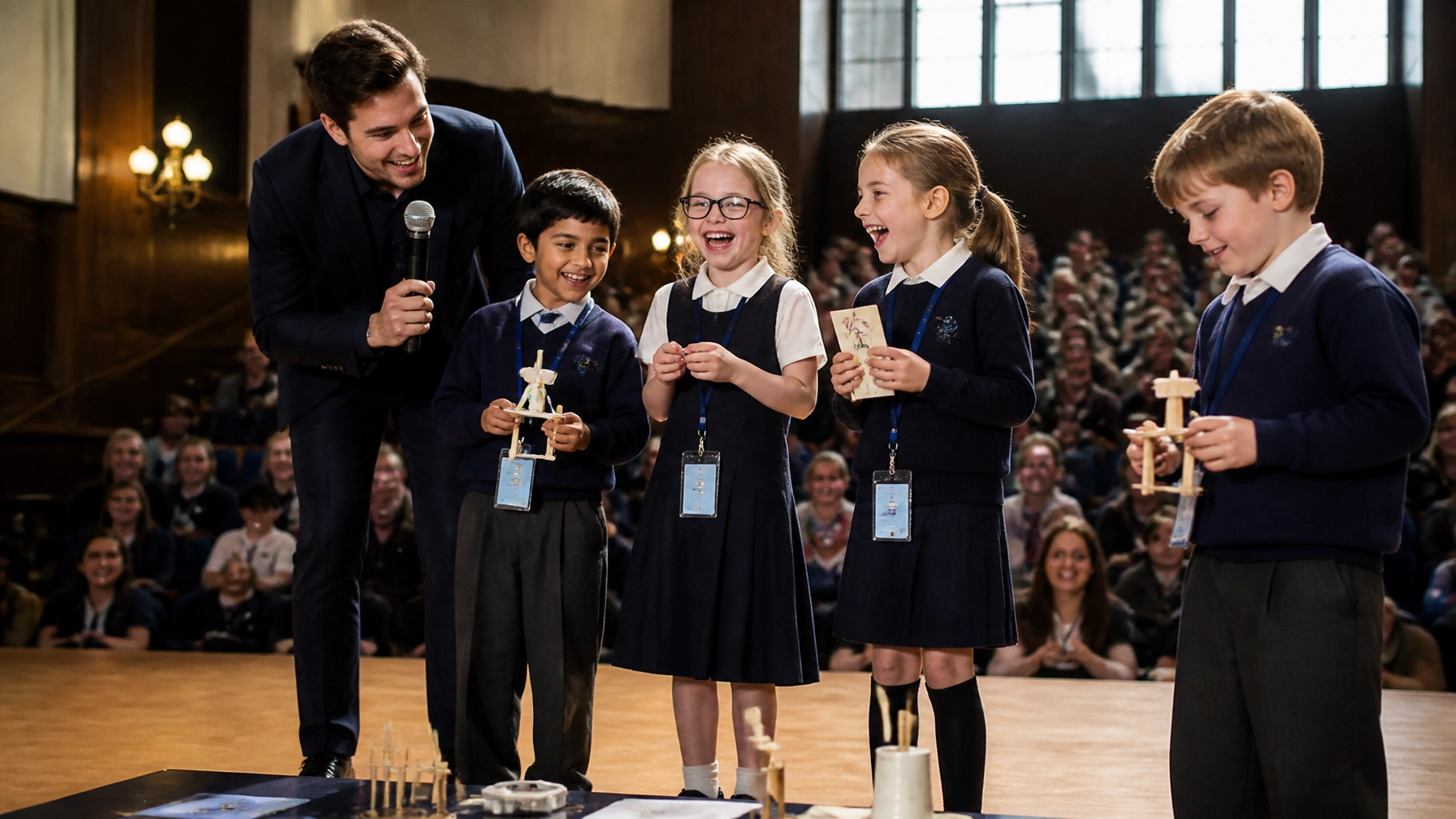
The atmosphere within the University of Warwick’s Butterworth Hall was nothing short of electric this week as the culmination of months of creative problem-solving and lateral thinking reached its peak. Hundreds of primary school pupils from across the United Kingdom and Ireland gathered for the final of School Tasking, a competition that has rapidly become one of the most sought-after extracurricular events in the academic calendar. Based on the widely popular television format, the event saw young minds pushed to their limits through a series of whimsical, often baffling, and entirely original challenges designed to test their wit rather than their ability to recite facts from a textbook.
At the heart of the proceedings was the creator of the format himself, Alex Horne. Stepping onto the stage to a roar of approval that would rival a stadium concert, Horne brought his signature brand of deadpan humour and infectious enthusiasm to a hall filled with Year 5 students. The event marked the Champion of Champions final, where regional winners from dozens of local competitions converged to determine who would take home the ultimate trophy. For the children involved, this was more than just a day out of the classroom; it was an opportunity to showcase their brilliance on a grand stage, proving that the next generation of thinkers is as bold as it is imaginative.
The competition is the brainchild of Dr Ali Struthers from the University of Warwick’s Law School. What began as a local project to engage younger children with the concept of law has expanded into a massive outreach programme involving over sixty universities. By using the playful and accessible language of tasks, the project introduces children to legal concepts, rules, and the importance of interpretation in a way that feels like play rather than study. It is a testament to the power of creative education, and the final at Warwick served as a shining example of how institutions can connect with their local communities in meaningful, lasting ways.
A Creative Path to Legal Education
The primary objective of the School Tasking initiative is to demystify higher education and subjects like law for children who might otherwise feel these paths are out of reach. By framing legal education through the lens of creativity, the project breaks down barriers. Throughout the academic year, law students from participating universities visit local primary schools to run sessions where pupils are given tasks that mirror the challenges seen on the screen. These tasks require the children to read instructions carefully, think outside the box, and often find loopholes: skills that are essential for any aspiring solicitor or barrister.
During the final at Butterworth Hall, the stakes were raised with live tasks that demanded immediate innovation. One such task involved the students having to identify which member of the massive audience was closest in height to a rubber chicken. The task sounded simple on the surface, but it required the teams to communicate effectively, estimate proportions, and make quick decisions under the watchful eye of Horne. Another challenge saw children attempting to land beanbags into a mortar board perched precariously on a stand, a task that combined physical coordination with the pressure of a live performance.
What makes this approach so successful is the way it rewards 'incorrect' thinking. In a traditional school setting, there is often a binary between right and wrong answers. School Tasking celebrates the 'third way': the solution that is technically within the rules but completely unexpected. This mirrors the real-world application of law, where interpretation and the ability to argue a unique perspective are highly valued. By encouraging children to be silly, they inadvertently become more analytical, learning that the most effective way to solve a problem is rarely the most obvious one.
Championship Glory for Visiting Schools
While the competition was fierce throughout the day, the spotlight shone brightest on the visiting teams who had travelled long distances to represent their regions. A significant highlight of the event’s history, and a major talking point during this year’s proceedings, was the incredible success of the teams from Ireland. In particular, the pupils from Stanhope Street Primary School in Dublin have become legendary within the School Tasking circuit. Having crossed the Irish Sea to compete, their presence added a truly international flavour to the gathering at Warwick.
The victory of the Dublin pupils in the Champion of Champions final was a moment of pure joy that transcended regional rivalries. To see a group of young students travel from another country and triumph in such a high-pressure environment was an inspiration to everyone in attendance. Their success was not just a win for their school, but a validation of the entire project's reach. It proved that the language of creativity and problem-solving is universal, and that with the right support, children from any background can excel on a national and international stage.
The Irish contingent brought a unique energy to the competition, often approaching the tasks with a blend of humour and tactical precision that left the judges: and Alex Horne: thoroughly impressed. Their journey to the final involved winning multiple rounds back home, showing a consistent level of ingenuity. As they lifted the trophy, the cheers from their peers and the other competing schools demonstrated the spirit of the event. It is a competition where, despite only one team being able to claim the title of champions, every child leaves feeling like they have achieved something extraordinary. This sense of collective achievement is a core tenet of why the University of Warwick continues to host and expand the programme year after year.
Inspiring the Next Generation of Thinkers
Beyond the immediate thrill of the competition, the School Tasking final serves a much larger purpose in the landscape of British and Irish education. It acts as a bridge between primary education and the world of universities, making the idea of further study seem attainable and, perhaps more importantly, fun. For many of the children sitting in the Butterworth Hall, this was their first time on a university campus. By associating that experience with laughter, creativity, and the presence of a well-known figure like Alex Horne, the university is planting seeds of ambition that could grow into lifelong academic journeys.
Alex Horne’s involvement is a crucial component of this success. His ability to interact with the children as equals, taking their ridiculous suggestions seriously and treating their creative efforts with genuine respect, creates an environment where they feel safe to take risks. He doesn't just host; he participates in the madness, often finding himself the target of the children's jokes. This level of engagement from a high-profile creator shows the students that their ideas have value in the real world. It reinforces the idea that being 'creative' is not just a hobby, but a professional skill that can lead to incredible careers.
As the day drew to a close and the final beanbag was thrown, the impact of the event was visible on the faces of every teacher, parent, and pupil. The University of Warwick has created something truly special with School Tasking, and the presence of schools from as far afield as Dublin highlights the growing importance of this initiative. In an age where education is often dominated by standardised testing and rigid curricula, events like this provide a necessary breath of fresh air. They remind us that at the heart of learning is a sense of wonder and a willingness to ask 'what if?'. For the champions from Dublin and the hundreds of other pupils who took part, the lessons learned on the Warwick stage will likely stay with them much longer than any traditional classroom lesson. They have learned that they are capable of solving the impossible, and that is a prize far more valuable than any trophy.