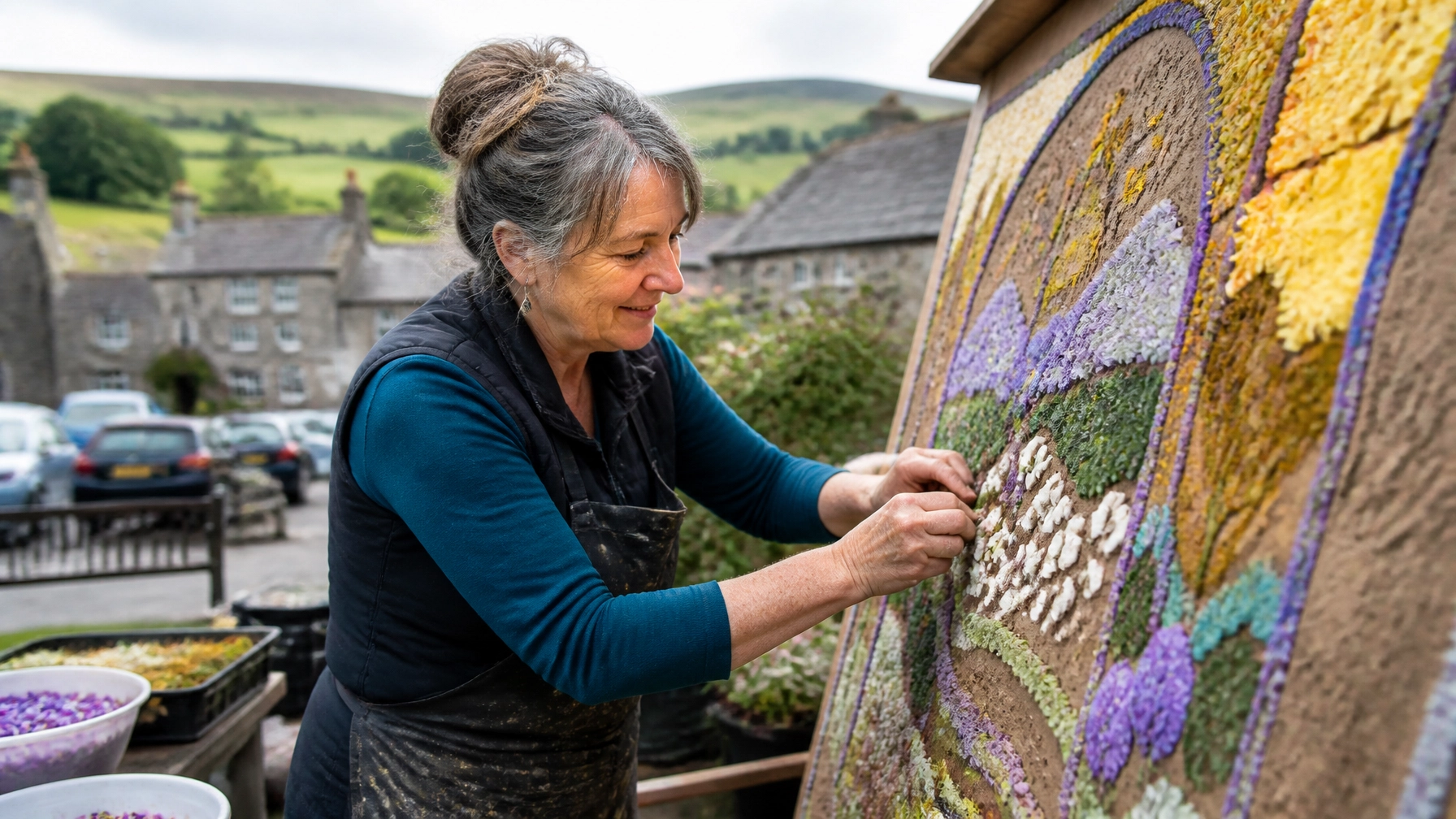
As the morning mist lifts from the limestone valleys of the Peak District, the air in the small village squares begins to hum with a very specific kind of industry. It is a season of quiet dedication, marked by the scent of damp clay and the vibrant hues of millions of flower petals. This year, the tradition carries a particular weight for one individual. Wendy Greatorex is celebrating four decades of commitment to the ancient art of well dressing, a milestone that represents not just personal achievement, but the continued survival of one of Britain’s most distinctive and beautiful customs.
Well dressing is a tradition almost entirely unique to Derbyshire and the surrounding fringes of the Peak District. It is a way of giving thanks for the purity of the water supply, a custom that some trace back to the aftermath of the Black Death or even further to pagan times. For Wendy, however, the history is written in the forty summers she has spent hunched over wooden boards, meticulously placing individual petals to create towering mosaics of biblical scenes, local landscapes, and commemorative displays. Her journey began as a curious observer and transformed into a lifetime of creative service that has seen her become a pillar of her community’s annual celebrations.
The process of well dressing is an arduous one, requiring patience that few modern hobbies demand. It begins long before the first petal is picked. The foundations of these ephemeral masterpieces are heavy wooden trays, which must be soaked in local streams or ponds to prevent them from warping. Once saturated, they are filled with "puddled" clay: clay that has been kneaded, often by foot, until it reaches a smooth, dough-like consistency. This clay serves as the canvas for the artists. For forty years, Wendy has been at the heart of this preparation, ensuring the ground is perfectly level and the moisture content is just right to hold the design for the duration of the village festival.
A Lifetime Sculpted in Clay
Wendy Greatorex’s involvement began in the early 1980s, a time when many rural traditions were at risk of fading away as younger generations moved towards the cities. She recalls her first year as an apprentice of sorts, tasked with the "background work": the tedious filling in of large areas of green moss or grey lichen. It was under the watchful eyes of the village elders that she learned the "pointing" of the design, where the outline of the chosen picture is pricked through paper into the wet clay. This blueprint must be followed with absolute precision; there is no room for error once the organic materials begin to be applied.
Over the decades, Wendy moved from the edges of the boards to the very centre, eventually taking on the role of lead designer. Her designs have become legendary in her local parish, known for their intricate detail and their ability to capture the play of light on the Derbyshire hills using nothing more than natural flora. To look at a piece of Wendy’s work is to see forty years of observation. She knows exactly which petals will retain their colour the longest and which will curl under the summer sun. She understands that the blue of a hydrangea is perfect for a summer sky, while the silver-grey of a lamb’s ear leaf provides the perfect texture for a stone wall.
The commitment required is staggering. During the "dressing week," Wendy and her team of volunteers often work from dawn until late into the evening. Because the materials are all natural and the clay must stay moist, the boards cannot be prepared months in advance. Everything must be completed in a flurry of activity just days before the well is blessed. For forty years, Wendy has managed this delicate dance of timing and artistry, leading her team with a mixture of gentle encouragement and an uncompromising eye for detail. Her kitchen table often becomes a temporary depot for tubs of petals, seeds, and berries, as the entire village contributes to the collection of materials.
The Art of the Petal
What makes well dressing truly remarkable is the strict adherence to natural materials. No artificial dyes, no plastic, and no paints are permitted. The entire image must be constructed from the gifts of the earth. This is the "Art of the Petal" that Wendy has mastered. The technique is known as "petalling," where individual petals are overlapped like the scales of a fish or the tiles on a roof. This ensures that rain runs off the surface rather than soaking into the clay and causing the design to slump.
Wendy’s expertise lies in her encyclopaedic knowledge of the local hedgerows and gardens. She can identify the exact moment a marigold is ready to be harvested for its vibrant orange or when the alder cones are dry enough to represent the dark bark of a tree. Some of her most celebrated works have utilised unconventional materials: peppercorns for the eyes of a bird, individual grains of rice for a toothy grin, or the tiny, delicate seeds of a poppy to create fine lines of shadow. It is a slow, meditative process that requires a steady hand and a deep connection to the environment.
The challenges have changed over forty years. Climate change has shifted the blooming times of certain flowers, forcing Wendy to adapt her palettes. Some years, the elderflower is gone before the dressing begins; in others, the roses are late. This unpredictability is part of the charm and the challenge of the craft. Wendy has often remarked that the flowers dictate the design as much as the artist does. If the hydrangea crop is poor, the sky might be made of delphiniums. This flexibility, born of decades of experience, is what allows the tradition to remain vibrant and responsive to the world around it.
Safeguarding the Peak's Floral Legacy
As Wendy Greatorex celebrates her fortieth anniversary, the conversation naturally turns to the future. The preservation of well dressing depends entirely on the passing of knowledge from one generation to the next. It is a craft that cannot be learned from a book or a video; it must be felt in the hands. The "feel" of the clay, the pressure required to set a petal without bruising it, and the communal spirit of the "puddling" are all things that must be experienced in person.
Wendy has spent the last decade focusing heavily on mentorship. She has welcomed school groups into the "petalling sheds," showing children how to create their own small boards and instilling in them a pride in their local heritage. For her, the milestone is not just about looking back at the hundreds of boards she has helped create, but about ensuring that the forty-first year, and the fiftieth, and the hundredth, are secured. She sees the tradition as a vital link between the people of the Peak District and the land they inhabit. In an increasingly digital world, the physical, tactile nature of well dressing offers a grounding experience that connects the community to its roots.
The legacy of Wendy Greatorex is visible every summer across the village wells. It is seen in the sharp lines of a mountain silhouette and the soft glow of a floral sunset. More importantly, it is seen in the groups of young people who now stand beside her, tweezers in hand, learning the patience and the passion that she has modelled for forty years. As the wells are blessed this season, the water will flow past masterpieces that are more than just art; they are a testament to four decades of dedication, a celebration of the Peak District's enduring spirit, and a floral tribute to a tradition that remains as fresh and vibrant as the petals from which it is made.