For the better part of two decades, engineered stone has been the undisputed king of the British kitchen. Walk into any modern home or scroll through a lifestyle magazine, and you are almost guaranteed to see those sleek, non-porous quartz countertops. They are durable, they come in every imaginable shade of grey and white, and they are significantly more affordable than natural marble or high-end granite. But beneath the polished surface of this home improvement staple lies a grim reality that has recently forced the government to step in with drastic new measures. The dust created when these slabs are cut is effectively a death sentence for the men and women working in the trade.
The issue at the heart of this health crisis is silica. While natural stone like granite contains around 30 per cent silica, and marble contains even less, engineered stone is a different beast entirely. It is a man-made product composed of crushed stone bound together by resin, and it can contain upwards of 95 per cent crystalline silica. When this material is cut, ground, or polished, it releases a fine, invisible dust. If inhaled, these microscopic shards of silica lodge themselves deep within the lung tissue, causing permanent scarring and inflammation. This is silicosis, a progressive and incurable lung disease that has been around since the Industrial Revolution but is currently seeing a terrifying resurgence in a much more aggressive form.
The Rising Tide of Silicosis Cases
In recent months, the UK has been forced to confront the human cost of our obsession with quartz kitchens. The medical community is sounding the alarm over "acute silicosis," a version of the disease that strikes much faster than the traditional form seen in coal miners. While old-fashioned silicosis might take twenty or thirty years to develop, workers in the engineered stone industry are being diagnosed after just a few years of exposure. We are seeing men in their twenties and thirties: the very people who are out there fitting our dream kitchens: being told they have the lung capacity of an eighty-year-old and may only have months to live.
The stories coming out of workshops across the country are harrowing. We have seen reports of workers like Marek Marzec, a stonemason who moved to the UK for a better life, only to find himself in need of a lung transplant at the age of 48 after years of cutting quartz. There are others, even younger, like Malik Al-Khalil, who was diagnosed at just 28. These aren't just isolated incidents; they are the tip of an iceberg. Because the disease has a latency period, many workers who are currently healthy might already have the seeds of the disease sown in their lungs. The lack of awareness in smaller workshops, where "dry cutting" has been common practice to save time and mess, has created a ticking time bomb for the NHS.
The tragedy of this situation is that it was entirely preventable. For years, the industry operated with a degree of complacency, assuming that standard dust masks and a bit of ventilation were enough. However, the sheer concentration of silica in engineered stone means that even small amounts of dust are incredibly toxic. Unlike natural stone, which produces a heavier dust that falls to the ground, the dust from quartz remains suspended in the air, invisible to the naked eye but lethal to the lungs. This has led many health experts to label engineered stone as the "asbestos of the 2020s," a comparison that is becoming harder to ignore as the death toll rises.
Strengthening the Safety Net in the UK
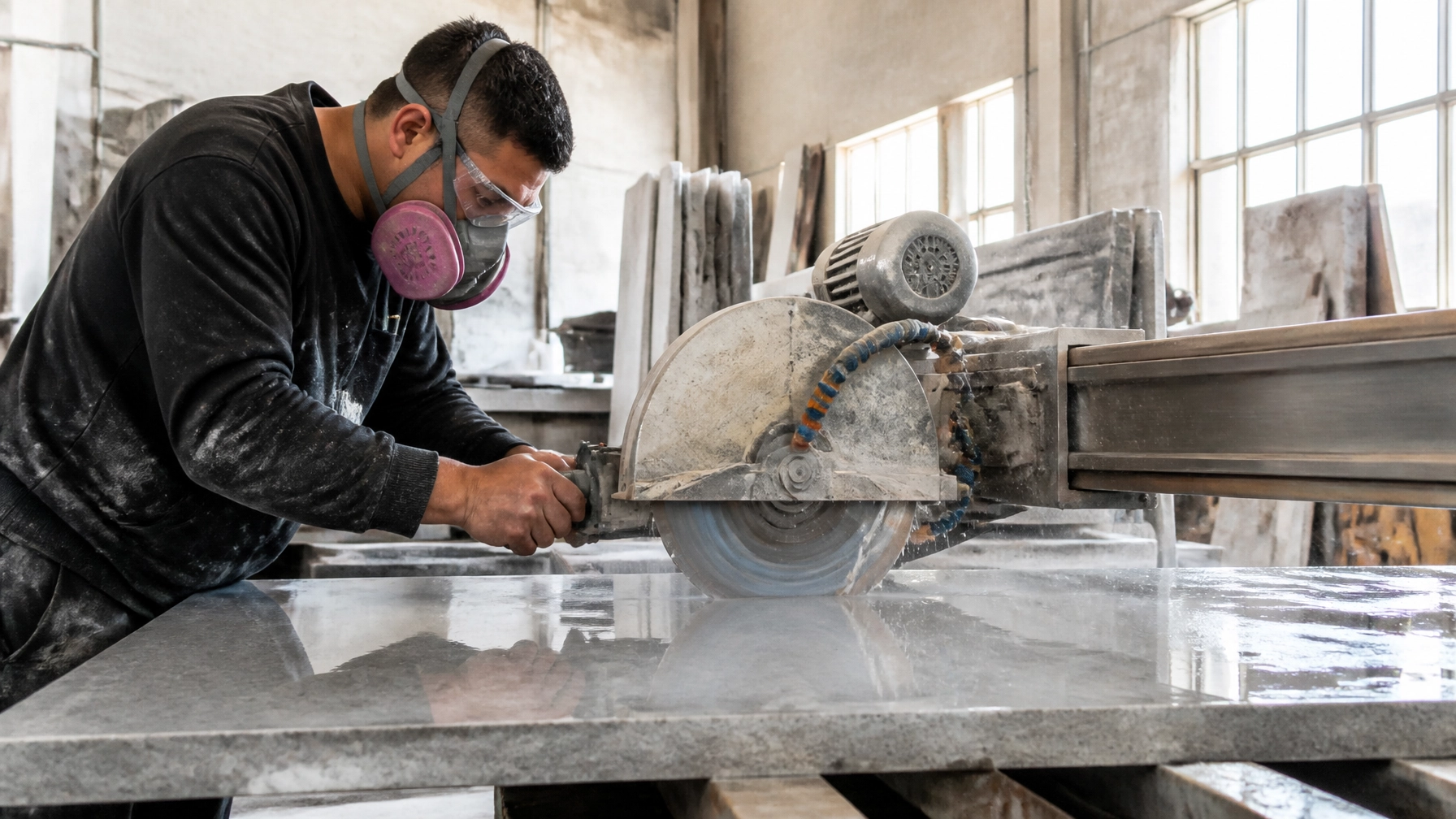
In response to the mounting evidence and public pressure, the Health and Safety Executive has finally drawn a line in the sand. As of this week, new and much stricter legal requirements have come into force across the UK. The most significant change is the absolute ban on dry cutting. From now on, any business caught cutting engineered stone without high-pressure water suppression systems is facing immediate enforcement action. The idea is simple: the water catches the dust at the point of impact, turning it into a slurry that cannot be inhaled. While this has been recommended for a while, it is now a non-negotiable legal mandate.
The new rules go much further than just adding water. Employers are now legally required to provide high-specification respiratory protective equipment that is fit-tested for each individual worker. They must also implement rigorous health surveillance programmes, meaning workers must have regular lung function tests and X-rays to catch the early signs of disease before it becomes fatal. The HSE has announced a massive wave of over 1,000 inspections scheduled for the coming months to ensure that these workshops are actually following the rules. This isn't just about giving guidance anymore; it is about active policing of a dangerous industry.
However, there are concerns about whether these rules go far enough. While large, reputable suppliers and fabricators have already invested thousands of pounds in wet-cutting technology and sophisticated extraction systems, the industry is fragmented. There are hundreds of small, "back-street" workshops that operate on thin margins and may struggle to afford the necessary upgrades. These are the places where the risk is highest, and where workers: often from immigrant backgrounds who may not be fully aware of their rights: are most vulnerable. The HSE’s challenge will be finding and regulating these smaller players who often fly under the radar until it is too late.
The Case for a Total Product Ban
The debate has now shifted from how we can work with engineered stone safely to whether we should be using it at all. Australia has already taken the lead globally by implementing a total ban on the most dangerous types of engineered stone, arguing that the health risk is simply too high to manage effectively through regulation alone. In the UK, trade unions and some health advocacy groups are calling for a similar move. They argue that as long as the product is on the market, someone, somewhere, will take a shortcut and cut it dry, leading to more avoidable deaths.
The industry response is, predictably, more cautious. Manufacturers argue that the product is perfectly safe when handled correctly and that a ban would devastate the construction and home renovation sectors. They point to the thousands of jobs that rely on quartz fabrication and argue that moving to lower-silica alternatives: some of which are already being developed: is a better way forward. Some companies have already started phasing out slabs with more than 40 per cent silica, but critics say even that is too high when compared to natural materials.
As consumers, we also have a role to play in this conversation. The demand for "perfect" kitchen surfaces has driven the growth of this industry, often without any thought for how those surfaces are made. There are plenty of alternatives available, from recycled glass and ceramic slabs to sustainably sourced natural wood or traditional natural stone like marble and granite. While these might require a bit more maintenance or a slightly different aesthetic, they don't carry the same lethal baggage. The question for the British public is whether the convenience of a stain-resistant countertop is worth the life of the person who made it.
As the HSE begins its nationwide crackdown, the next few months will be a turning point. If the 1,000 planned inspections reveal widespread non-compliance, the pressure for a total ban will likely become irresistible. For now, the new rules represent a much-needed intervention in a sector that has been left to its own devices for too long. We are finally taking the "killer" out of the kitchen, but for many workers already suffering, these changes have come far too late. The focus now is on ensuring that not one more person has to sacrifice their breath for the sake of a home renovation.