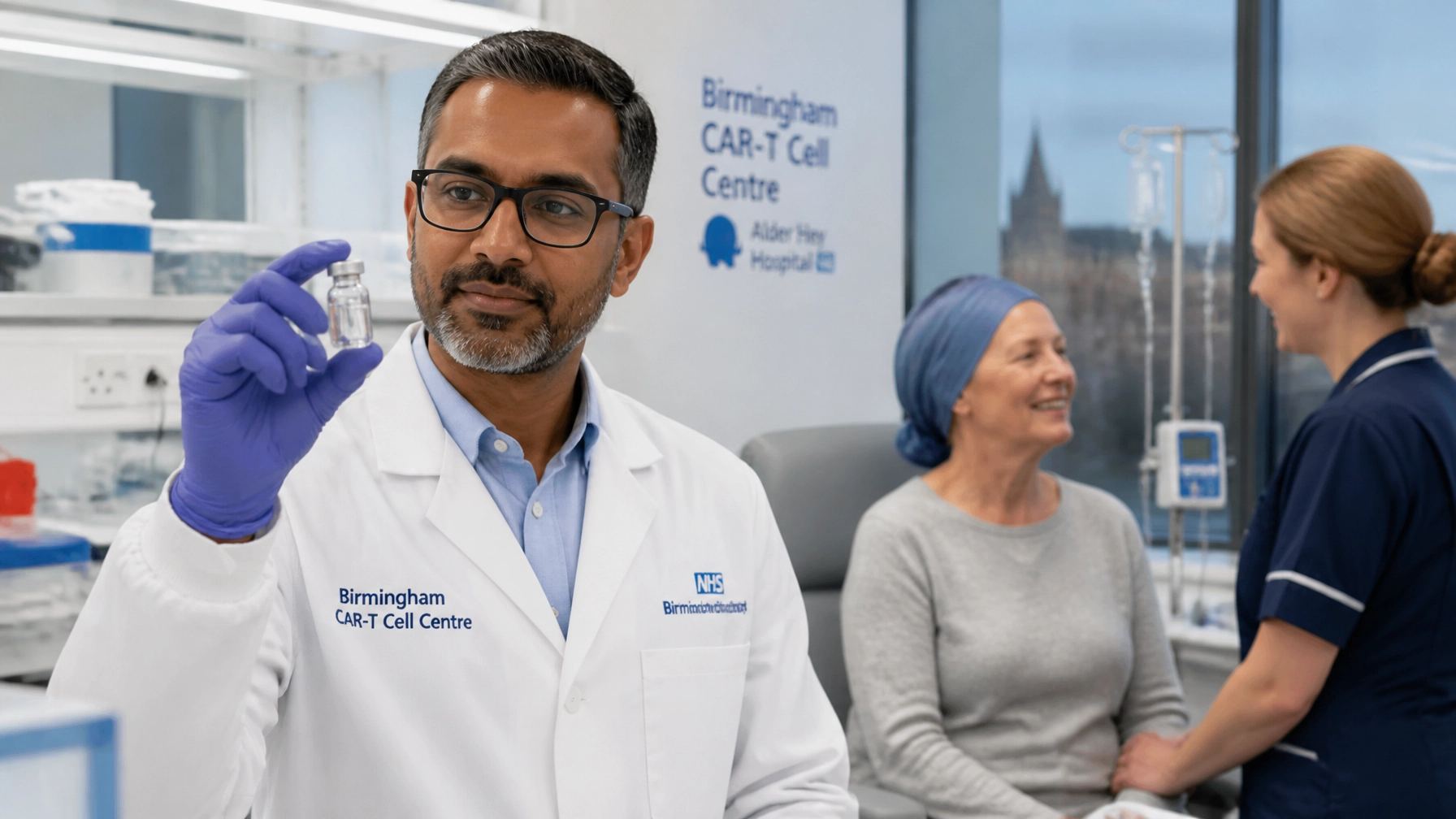
Queen Elizabeth Hospital in Birmingham has reached a significant milestone in the treatment of blood cancer, marking a new era for patients who have exhausted traditional options. Lesley Newton, a 64-year-old grandmother, has become one of the first individuals to benefit from a pioneering roll-out of CAR-T cell therapy at the facility. This revolutionary approach, often described by medical professionals as a ‘living treatment’, involves modifying a patient’s own immune cells to recognise and destroy cancer cells with unprecedented precision. For many in the West Midlands and beyond, this development represents more than just a medical advancement; it is a profound shift in the landscape of oncology that offers a genuine chance at long-term remission.
The process of CAR-T therapy is complex and highly personalised. It begins with the collection of T-cells from the patient’s blood, which are then sent to a specialist laboratory. In these controlled environments, scientists use genetic engineering to equip the cells with chimeric antigen receptors (CARs). These receptors act like a biological GPS, enabling the T-cells to track down specific proteins found on the surface of cancer cells. Once these enhanced cells are infused back into the patient, they multiply and launch a targeted attack on the disease. Unlike chemotherapy, which can impact healthy and cancerous cells alike, this therapy is designed to be a self-sustaining force within the body, continuing to monitor for the return of cancer long after the initial treatment.
Lesley Newton’s journey reflects the experience of many who have lived through the standard cycles of treatment. Having previously undergone intensive chemotherapy and other interventions, the limitations of conventional medicine were becoming increasingly clear. The introduction of CAR-T therapy at Queen Elizabeth Hospital provided a vital lifeline when other avenues had reached their natural conclusion. Medical staff at the hospital have observed that patients receiving this therapy often see results where other treatments have failed, with some cases showing a complete disappearance of cancer cells within weeks. This level of efficacy is particularly notable in aggressive forms of lymphoma and leukaemia, where the window for effective intervention is often very narrow.
The Science Behind Personalised Immune Response
The success of CAR-T therapy rests on the ability to reprogramme the body’s own defence mechanisms. T-cells are the workhorses of the human immune system, responsible for identifying and neutralising threats. However, cancer cells are notoriously adept at hiding from these natural defences, often mimicking healthy tissue to avoid detection. By introducing the chimeric antigen receptor, scientists effectively peel back this cloak of invisibility. The modification process takes several weeks, during which time the patient may undergo a short course of 'bridging' chemotherapy to keep the disease stable. Once the CAR-T cells are ready, they are administered through a single infusion, which serves as the starting point for a dynamic biological process that evolves within the bloodstream.
The logistics of providing such a treatment are immense. Queen Elizabeth Hospital has invested in specialised infrastructure to support the delivery of this therapy, ensuring that patients are monitored around the clock by multi-disciplinary teams. Because the treatment involves a powerful immune response, medical professionals must be prepared to manage side effects such as cytokine release syndrome, which can occur as the modified cells begin their work. The presence of this technology in Birmingham means that patients no longer have to travel vast distances to London or international centres to access cutting-edge care. This local availability is crucial for recovery, allowing patients to remain close to their support networks during a physically and emotionally demanding period.
The clinical data emerging from these treatments is consistently encouraging. In trials and initial roll-outs across the UK, a significant percentage of patients who were previously considered terminal have achieved deep remission. For those with B-cell malignancies, the response rates have been transformative, with many remaining disease-free years after their infusion. The durability of this response is what earns CAR-T its reputation as a ‘living cure’. Because the modified cells can persist in the body for a long duration, they provide a form of ongoing surveillance, ready to react if any remaining cancer cells begin to proliferate. This long-term protection is a stark contrast to the temporary reprieves often associated with traditional pharmacological interventions.
Transforming the Treatment Landscape in Birmingham
For the staff at University Hospitals Birmingham NHS Foundation Trust, the implementation of this therapy is the result of years of preparation and research. The Queen Elizabeth Hospital has long been a hub for haematological excellence, and the addition of CAR-T therapy cements its status as a leader in the field. The impact on the local community is significant, providing hope to families who have watched loved ones struggle with the side effects and diminishing returns of standard care. The therapy is currently being prioritised for specific types of blood cancer, but researchers are already looking at how the technology could be adapted for solid tumours, such as those found in the lungs or breast, which would further expand its life-saving potential.
The experience of Lesley Newton serves as a powerful testament to the human impact of these scientific breakthroughs. The ability to return to daily life, to spend time with grandchildren, and to look toward the future without the immediate shadow of illness is the ultimate goal of any medical intervention. Her story is one of many that are beginning to emerge from the Birmingham facility, as more patients are integrated into the CAR-T programme. The focus remains on ensuring that the treatment is delivered safely and effectively, with a rigorous focus on patient outcomes and the long-term monitoring of the modified cells. This patient-centric approach ensures that the technology is not just a scientific marvel, but a practical tool for healing.
Innovation in this sector is moving at a rapid pace. Scientists are now exploring ‘off-the-shelf’ CAR-T treatments, which would use donor cells instead of the patient’s own. This would significantly reduce the waiting time for treatment, as the cells would not need to be individually manufactured for every person. While this is still in the developmental phase, the foundation laid by the current personalised approach is what makes these future possibilities achievable. The commitment to research and development within the NHS ensures that British patients remain at the forefront of global medical progress, receiving the latest treatments as soon as they are proven to be safe and effective.
Future Horizons for Living Cancer Treatments
As the CAR-T programme continues to expand, the focus is shifting toward making the therapy more accessible and reducing the time it takes to manufacture the modified cells. At present, the process from cell collection to infusion can take several weeks, a period that is critical for patients with fast-moving cancers. Improvements in laboratory automation and logistics are expected to shorten this window, allowing the immune system to fight back sooner. Furthermore, research into different types of receptors is ongoing, with the aim of targeting a broader range of cancer types and reducing the likelihood of the disease developing resistance to the therapy. The collaboration between hospitals, universities, and the pharmaceutical industry is driving these advancements at an unprecedented speed.
The economic and social benefits of achieving long-term remission cannot be overstated. By providing a treatment that can potentially cure a patient with a single infusion, the long-term burden on the healthcare system is reduced, as the need for continuous, life-long medication and frequent hospital admissions is minimised. More importantly, the quality of life for the patient is vastly improved. The transition from a state of terminal illness to one of active recovery is a profound shift that affects not only the individual but their entire family and social circle. The success of the Birmingham roll-out is a clear indication that the investment in high-tech, personalised medicine is delivering tangible results for the British public.
The integration of CAR-T therapy into standard clinical practice represents a fundamental change in how we perceive and treat cancer. It is no longer just about managing a disease, but about harnessing the inherent power of the human body to heal itself. The work being done at Queen Elizabeth Hospital is a vital part of this global effort, proving that with the right technology and expertise, even the most challenging cases can find a path to recovery. As more patients like Lesley Newton complete their treatment and return to their lives, the evidence for the efficacy of this ‘living cure’ continues to grow, marking a bright chapter in the history of oncology.
Clinical trials across the United Kingdom involving CAR-T cells have shown that approximately 64 per cent of patients with certain types of leukaemia remain disease-free years after treatment. At Queen Elizabeth Hospital, the focus remains on the delivery of this care to adult patients with relapsed or refractory B-cell lymphoma. The therapy involves the extraction of white blood cells through a process called apheresis, followed by genetic modification in a lab. Once the cells are reintroduced, they can expand up to 10,000-fold within the patient's body to target and destroy malignant cells. Current NHS protocols ensure that this treatment is available to those who have not responded to at least two other types of treatment.