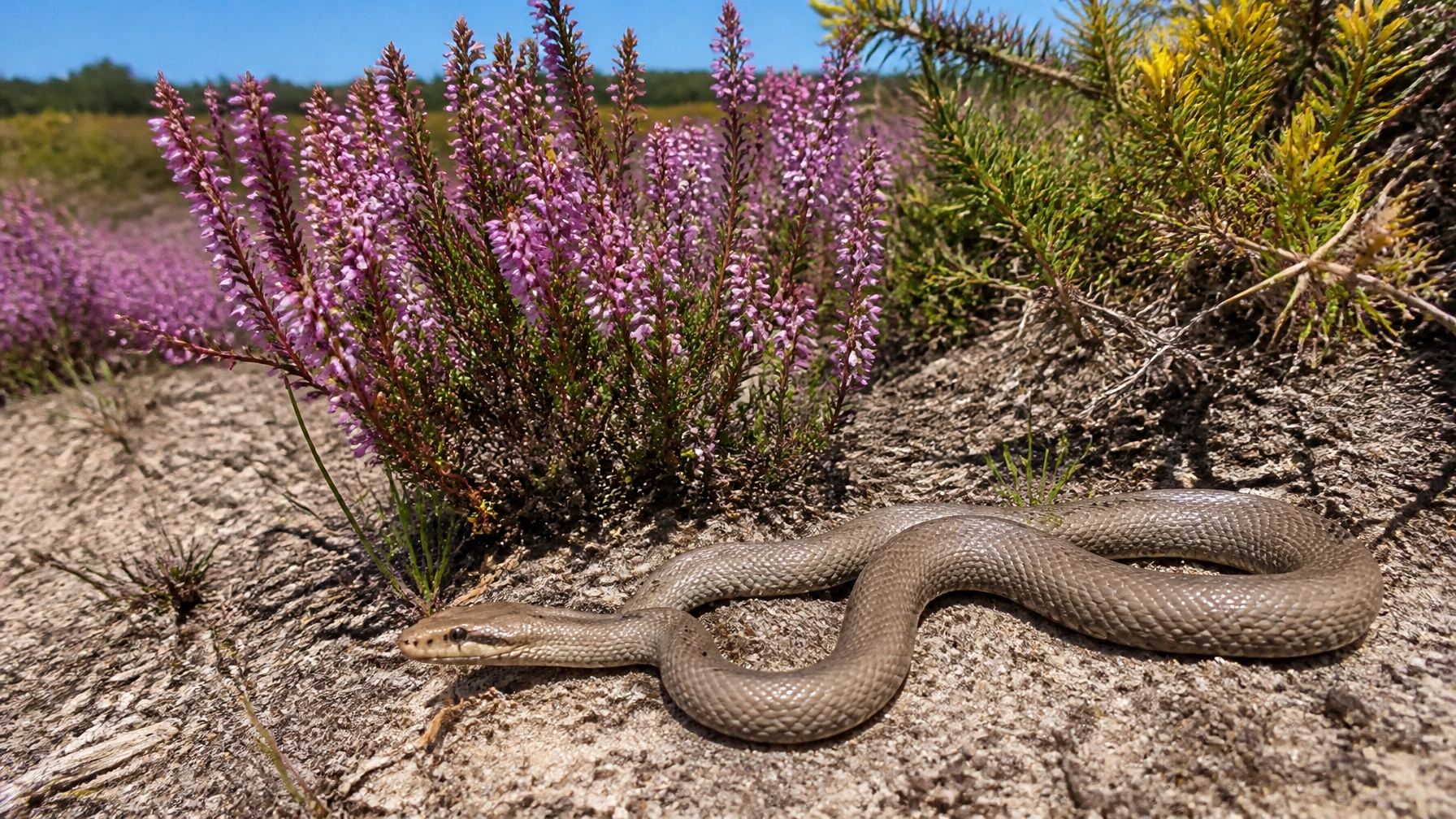
Britain’s rarest native reptile is making a significant comeback on the Pebblebed Heaths in East Devon, proving that long-term conservation efforts are finally yielding remarkable results. Recent surveys conducted across the National Nature Reserve have revealed that the population of smooth snakes has grown by approximately 25 per cent in just one year. This surge in numbers is a testament to the dedicated restoration work that has been underway for over fifteen years, transforming what was once a precarious reintroduction project into a thriving, self-sustaining community of these elusive creatures.
The smooth snake, scientifically known as Coronella austriaca, is a non-venomous species that often goes unnoticed due to its secretive nature and preference for thick cover. Unlike the more common grass snake or the venomous adder, the smooth snake is a specialist of the lowland heathland habitat, a landscape that has become increasingly rare across the United Kingdom. In 2009, a group of seventeen snakes was translocated from Dorset and Hampshire to the Pebblebed Heaths in an ambitious attempt to restore the species to its former range in Devon. For many years, sightings were few and far between, leaving conservationists wondering if the population would ever truly take hold.
The latest figures are a cause for genuine celebration among the local wildlife community. Surveyors recorded thirty-nine individual snakes during the most recent monitoring period, up from thirty-one the previous year. Perhaps most importantly, the team discovered several juveniles, which provides concrete evidence that the snakes are breeding successfully in the wild. Finding young snakes is the ultimate indicator of success for any reintroduction programme, as it shows the habitat can support the full life cycle of the species without further human intervention.
A delicate balance for the heathland
Maintaining the perfect environment for a smooth snake is no simple task, as these reptiles require a very specific mosaic of habitats to thrive. The Pebblebed Heaths National Nature Reserve, managed by the RSPB, the Pebblebed Heaths Conservation Trust, and Clinton Devon Estates, has undergone intensive restoration to ensure the landscape remains suitable. Smooth snakes need a mixture of mature, leggy heather for protection from predators and open, sandy patches where they can bask in the sun to regulate their body temperature. Without careful management, heathlands can quickly become overgrown with invasive scrub, gorse, and birch trees, which shade out the ground and make it impossible for reptiles to survive.
The recovery effort has involved a massive programme of scrub clearance and controlled management to prevent the heath from turning into woodland. This work is often a delicate balancing act, as conservationists must also consider the needs of other rare species, such as the nightjar and the Dartford warbler. By creating a diverse structural mix within the vegetation, the management teams have successfully created a "Goldilocks" environment: not too open, not too thick, but just right for a variety of specialist wildlife. The presence of the smooth snake is often seen as a flagship indicator of the overall health of the heathland ecosystem, as their survival depends on the presence of a healthy population of prey, including lizards and other small snakes.
The success in East Devon mirrors similar positive trends seen at sites like RSPB Arne in Dorset, where intensive habitat management has also helped to stabilize and grow smooth snake populations. It highlights the importance of consistency in conservation; habitat restoration is not a one-time event but a continuous process of monitoring and intervention. The fact that the Pebblebed Heaths can now boast a breeding population of Britain's rarest reptile is a clear signal that the decades of hard work by land managers and ecologists are paying dividends.
Connecting habitats across the landscape
One of the biggest challenges facing British wildlife today is habitat fragmentation. For a species as small and slow-moving as the smooth snake, a busy road or a large patch of unsuitable farmland can act as an impenetrable barrier, isolating populations and leading to genetic bottlenecks. In East Devon, a key focus of the conservation strategy has been to improve connectivity across the landscape, ensuring that snakes can move between different patches of heathland to find mates and colonise new areas. This "landscape-scale" approach is vital for the long-term resilience of the species, especially as the climate continues to change and habitats shift.
The work carried out by the Amphibian and Reptile Conservation (ARC) trust has been instrumental in identifying these vital corridors. By working with local landowners and the Clinton Devon Estate, they have been able to bridge the gaps between isolated pockets of habitat. This joined-up thinking allows the smooth snake population to function as a single, large community rather than several small, vulnerable ones. When populations are connected, they are far better equipped to recover from localized disasters, such as heathland fires or particularly harsh winters, because individuals from neighbouring areas can move in to repopulate the affected sites.
This focus on connectivity also benefits a host of other species that share the heathland. Rare insects, such as the heath potter wasp and various specialist butterflies, also rely on these corridors to move through the landscape. The restoration of the Pebblebed Heaths is part of a wider national effort to create a "Nature Recovery Network," where protected sites are no longer islands of biodiversity in a sea of intensive land use, but part of a living, breathing map of interconnected habitats. The success of the smooth snake in Devon is a shining example of how this philosophy can be put into practice with tangible, measurable results.
Citizens and science working together
The monitoring of smooth snakes is a painstaking process that relies heavily on the dedication of a small army of volunteers. Because the snakes are so well-camouflaged and spend much of their time hidden beneath the vegetation or underground, finding them requires more than just a keen eye. Surveyors use a technique involving "refugia": large squares of heavy roofing felt or corrugated metal laid out across the heath. These materials absorb the heat of the sun, and the snakes often crawl underneath them to warm up. Volunteers regularly check hundreds of these tins throughout the spring and summer, recording the details of every snake they find.
This citizen science approach has contributed thousands of hours of data that would be impossible for professional ecologists to gather alone. Each smooth snake has a unique pattern of scales on its head, similar to a human fingerprint, which allows researchers to identify individuals and track their progress over many years. This level of detail provides invaluable insights into the lifespan, growth rates, and movement patterns of the snakes. It is this combination of professional ecological expertise and passionate community involvement that has underpinned the success of the project in East Devon.
Looking ahead, the future for the smooth snake in the South West looks brighter than it has for decades. While the species remains vulnerable and still faces threats from human disturbance and habitat loss elsewhere in the country, the Pebblebed Heaths stand as a beacon of hope. The project demonstrates that with the right level of investment, scientific knowledge, and community support, it is possible to reverse the decline of even our most sensitive and rare species. The quiet triumph of the smooth snake is a reminder that conservation is often a slow game, but when played with patience and dedication, it can lead to a spectacular victory for the natural world.