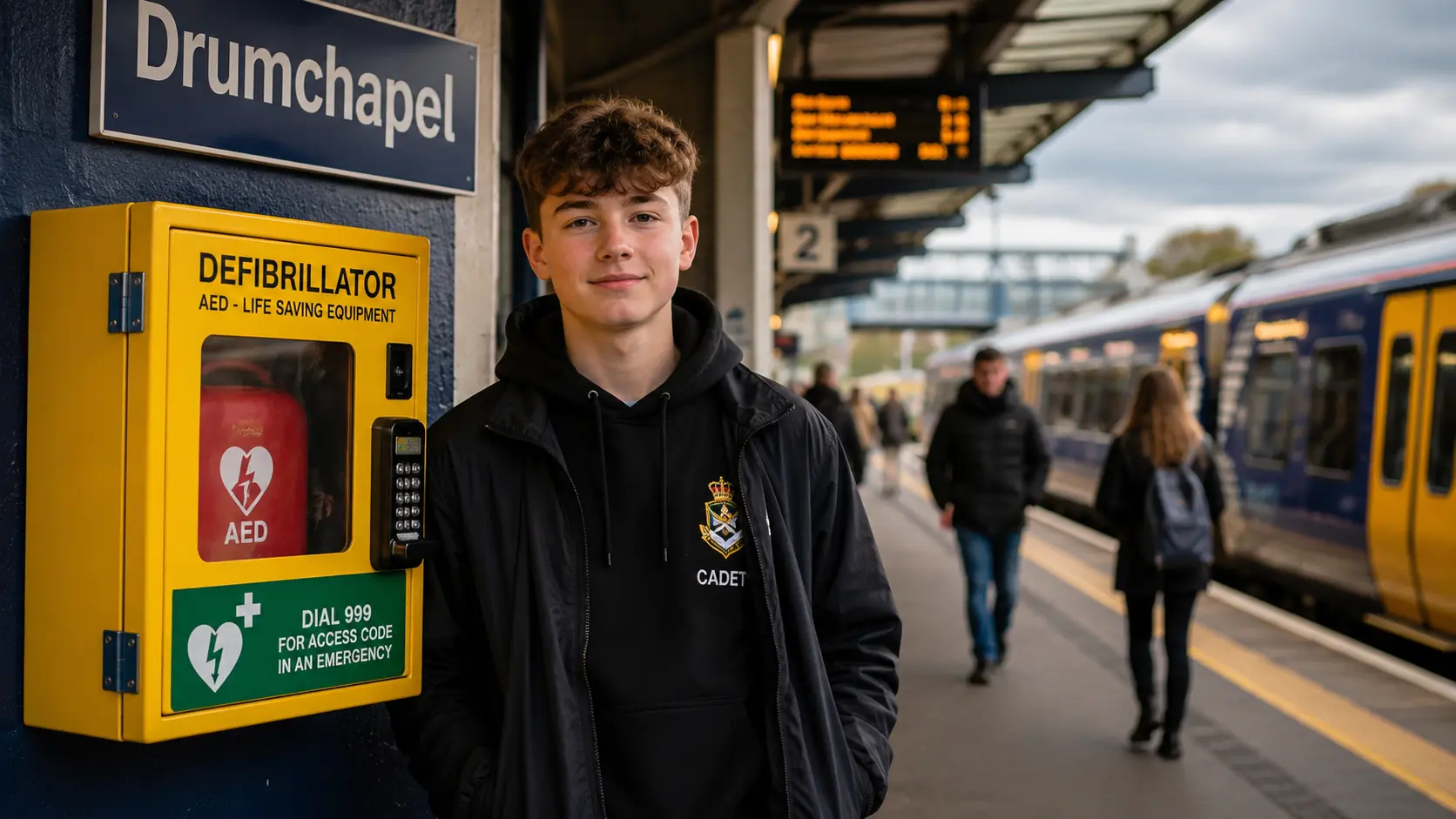
Jordan Kerr was just an ordinary fifteen-year-old on his way home from an Army Cadet training session in Glasgow when his Tuesday evening took a turn that would change his life and the safety of his local community forever.
Standing on the platform at Drumchapel station, the air was filled with the usual rush of commuters and the hum of arriving trains. It was a scene played out thousands of times across the city, yet in a split second, the mundane atmosphere shattered. Jordan heard shouting: not the usual boisterous noise of a busy station, but a sound of genuine, bone-chilling panic.
Following the noise, Jordan discovered a young boy who had collapsed suddenly. The child was unresponsive, and as Jordan moved closer, it became clear that this was a life-or-death situation. While others might have stood frozen in shock, Jordan’s training as an Army Cadet kicked in instantly. He checked for a pulse and found none. The boy had stopped breathing. Without a moment's hesitation, the teenager knelt down on the cold platform and began the rhythmic, exhausting work of cardiopulmonary resuscitation.
Quick Thinking on the Glasgow Platform
The transition from a regular teenager to a first responder is something many spend years preparing for, but for Jordan, the moment arrived before he had even finished school. His cadet training had provided him with the theoretical knowledge of how to handle a cardiac arrest, but applying those skills on a hard concrete floor with a child’s life on the line is a different world entirely. The pressure was immense. As the boy’s family watched in desperation, Jordan remained focused on the task at hand, performing chest compressions and rescue breaths with a level of composure that would have been impressive in a veteran paramedic.
In those first few minutes, the station seemed to fall silent around the small circle of people on the platform. Jordan’s hands never stopped. He knew that the window for survival in these cases is incredibly narrow, and every second without oxygen was a second closer to a tragic outcome. His cadets’ instructor had often spoken about the importance of remaining calm under pressure, and as he counted out the compressions, that discipline became his greatest asset. He was a fifteen-year-old boy in a hoodie, but in that moment, he was the only thing standing between a young child and a different ending.
The physical toll of performing CPR is often underestimated. It is a gruelling, sweat-inducing process that requires significant strength and stamina. Jordan kept the rhythm going for what felt like an eternity, his muscles burning as he maintained the necessary depth and speed for the compressions to be effective. He wasn't just waiting for help; he was fighting for every beat of the boy's heart.
The Long Minutes That Changed Everything
Time stretches in an emergency. For Jordan, the ten to twelve minutes he spent performing CPR felt like hours. He was aware of the sirens in the distance, but his focus never wavered from the boy beneath his hands. Bystanders called for emergency services, but there was a glaring problem: there was no automated external defibrillator (AED) on-site. If Jordan’s physical effort wasn’t enough, there was no mechanical backup to help jump-start the boy's heart before the ambulance arrived.
When the paramedics finally scrambled onto the platform, they found a teenager who refused to give up. They took over the scene, but the foundation laid by Jordan’s immediate action was what gave them a fighting chance. Shortly after the professional medical team arrived, they managed to detect a pulse. The boy was stabilised and rushed to the hospital. Jordan stood back, the adrenaline finally starting to ebb away, leaving him with the heavy realization of what had just occurred. He had literally pulled a life back from the brink.
In the days that followed, news of Jordan’s heroism spread through Drumchapel and across Glasgow. He was hailed as a local hero, a title he accepted with a characteristic level of humility. However, rather than simply moving on and returning to his studies, Jordan was struck by the reality of those ten minutes. He knew that if he hadn’t been there, or if his training hadn’t been as fresh, the story could have been very different. He began to think about why a busy transport hub like Drumchapel station didn’t have the basic equipment needed to save a life in such a common medical emergency.
From Life-Saving Action to Lasting Legacy
Jordan decided that his work wasn't finished on the platform. He launched a campaign to ensure that what happened to that young boy wouldn’t be a matter of luck for the next person. He argued that every major public space, especially train stations where thousands of people pass through daily, should be equipped with a public-access defibrillator. He started a petition and worked with local representatives to put pressure on transport authorities. His message was simple: first aid training is vital, but having the right tools on hand can be the difference between a recovery and a tragedy.
The community rallied behind him. The residents of Drumchapel, moved by his bravery and his dedication to their safety, added their voices to his cause. It didn't take long for the campaign to catch the attention of ScotRail. Recognising the validity of Jordan's argument and the extraordinary circumstances that prompted it, the rail operator agreed to install a permanent, public-access defibrillator at Drumchapel station. It was a massive win for local safety, spearheaded by a teenager who refused to let a near-miss go unnoticed.
Today, if you walk through Drumchapel station, you will see a bright yellow cabinet mounted on the wall. It is a functional piece of medical equipment, but to the people of the area, it is a symbol of Jordan Kerr’s resolve. Its presence means that the next time someone collapses on that platform, help is only seconds away, regardless of whether a trained cadet happens to be catching the next train.
Jordan’s story serves as a powerful reminder of the impact one person can have when they choose to act. His journey from a cadet trainee to a life-saver, and finally to a successful campaigner, has sparked a wider conversation about the necessity of heart-start equipment in public spaces. While he may have started out as just another passenger, his quick thinking and subsequent persistence have left a legacy that will protect his community for years to come. In an era where many feel powerless to change their surroundings, a fifteen-year-old from Drumchapel proved that leadership and courage have no age limit.