Local councils across the United Kingdom recorded over one million incidents of fly-tipping in the last financial year, with urban alleyways frequently bearing the brunt of illegal waste disposal. In many northern cities, these narrow passages between terraced houses have historically become hotspots for discarded furniture, household rubbish, and antisocial behaviour. However, a new wave of community-led intervention is beginning to reverse this trend. Fuelled by the government’s £88 million Building Creative Futures package announced in August 2025, young people are taking the lead in reclaiming these neglected spaces. These initiatives are not merely about cleaning up litter; they represent a fundamental shift in how urban youth engage with their local environment and take ownership of the streets they inhabit.
In Manchester and Liverpool, pilot schemes have shown that when young residents are given the resources and agency to redesign their surroundings, the results are both immediate and long-lasting. By converting fly-tipped corridors into vibrant community hubs, these projects are tackling environmental degradation while simultaneously providing a creative outlet for a generation often sidelined in urban planning discussions. The transformation of a single alleyway can reduce local crime rates and foster a renewed sense of pride among residents who have spent years overlooking derelict spaces.
From Neglect to Neighbourhood Pride
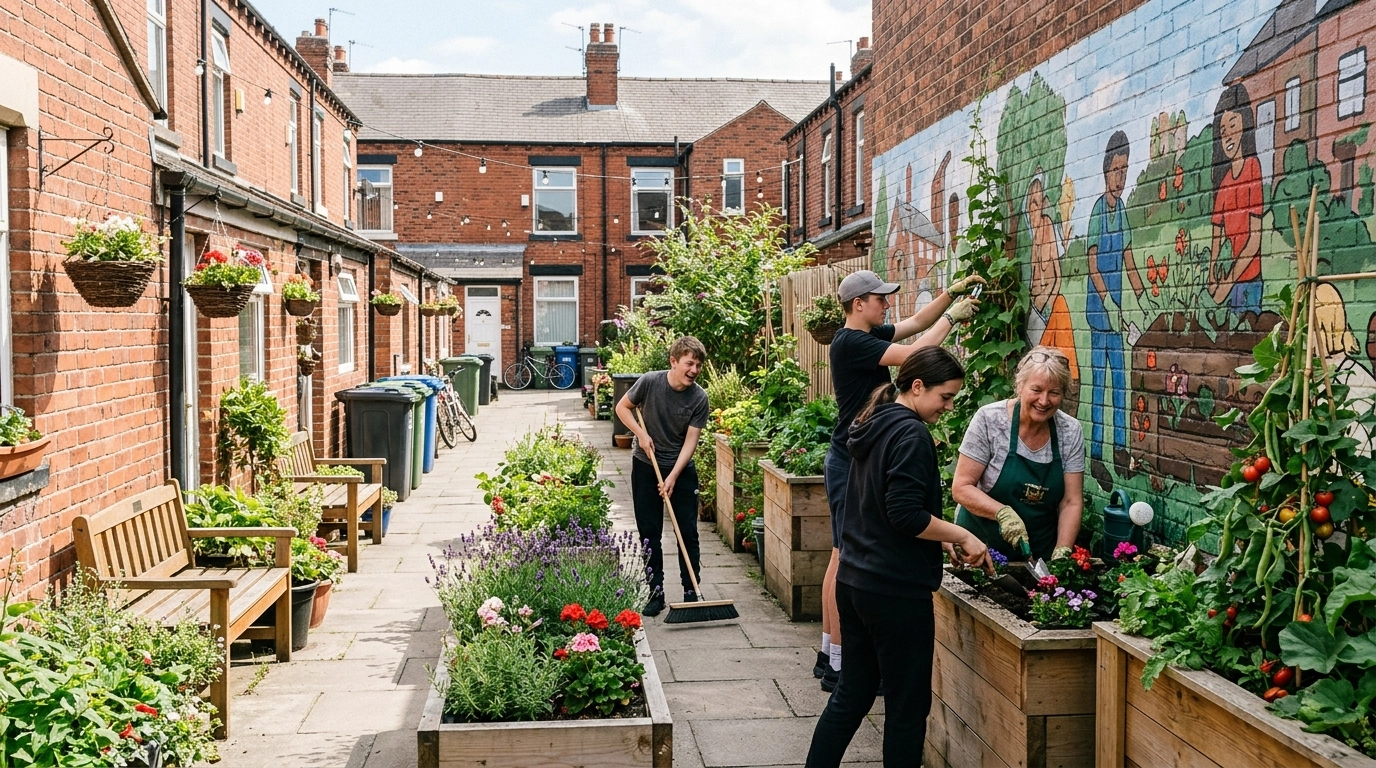
The process of turning a derelict alleyway into a communal garden begins with the arduous task of waste removal. In a recent project in a South Manchester suburb, a group of local teenagers teamed up with community organisers to clear more than three tonnes of rubbish from a 50-metre stretch of pavement. This initial phase, supported by the Pride in Place strategy and its £319 million regeneration fund, serves as a catalyst for broader community involvement. When residents see young people taking an active interest in the cleanliness of their shared spaces, it often prompts a ripple effect of cooperation. Older neighbours who had previously given up on the upkeep of the alleyway began contributing by providing water for plants and donating old gardening tools.
This shift in perception is a crucial element of the “Junk to Joy” movement. It moves the conversation away from punishing those who fly-tip and focuses instead on creating a space that is too well-loved to be treated as a dumping ground. The physical change is striking, but the psychological impact on the neighbourhood is even more significant. Streets that were once avoided after dark are now illuminated by solar-powered festoon lighting and decorated with murals that reflect the heritage and diversity of the local population. For the young organisers, the project provides tangible proof that they can influence the world around them, building confidence and vocational skills in gardening, carpentry, and project management.
The Creative Spark Behind the Change
What sets these youth-led projects apart from standard council-led maintenance is the level of creative freedom involved. Under the Building Creative Futures programme, funding is specifically earmarked for projects that integrate art and culture into community life. In practice, this means that the transformed alleyways are often gallery spaces in their own right. Murals painted by local youth collectives depict scenes of local history, botanical illustrations, and abstract designs that brighten the grey brickwork typical of British terraced housing. These artistic interventions serve a dual purpose: they beautify the area and act as a deterrent to graffiti and vandalism, as there is a documented respect for community-created artwork.
Beyond the paint, the structural changes are equally innovative. Many youth groups have utilised recycled materials to build tiered planters, benches, and even small “libraries” where neighbours can swap books. Using discarded wooden pallets to create vertical gardens allows for a high density of greenery in narrow spaces, improving local air quality and providing habitats for urban pollinators. The selection of plants is often a collaborative effort, with many groups choosing hardy perennials and herbs like rosemary and lavender that can withstand the British climate while providing a sensory experience for passers-by. This hands-on approach to urban design ensures that the spaces are not just functional, but genuinely reflective of the people who use them every day.
Building a Sustainable Urban Future
The longevity of these revived streets depends on a sustainable model of maintenance and continued youth engagement. Unlike traditional top-down urban improvements that can fall into disrepair once the initial funding dries up, these youth-led initiatives are built on a foundation of local stewardship. Many of the young people involved in the initial clean-up operations have gone on to form “alleyway committees,” responsible for the ongoing care of the plants and the organisation of community events, such as street parties and plant sales. This ongoing commitment is being bolstered by the New Youth Strategy, which has allocated an additional £185 million from the Dormant Assets Scheme to support long-term youth services and community infrastructure.
Looking ahead, the success of these projects suggests a new blueprint for urban regeneration across the UK. By focusing on small-scale, high-impact transformations, cities can improve the quality of life for residents without the need for massive, disruptive infrastructure projects. The “Junk to Joy” philosophy demonstrates that even the most neglected corners of our cities have the potential to become assets when the community: and particularly its younger members: is empowered to lead. As more local authorities look to replicate these models, the emphasis remains on ensuring that young people are not just consulted but are the primary drivers of change. This approach ensures that the revival of our streets is not a temporary fix, but a lasting transformation rooted in community pride and environmental responsibility.
Official statistics suggest that communities with active green spaces and communal areas report higher levels of social cohesion and lower instances of antisocial behaviour. As the £8 million Local Youth Transformation Pilot expands to 12 more local authorities across England, the focus on reclaiming urban spaces is expected to intensify. These projects serve as a reminder that the solution to urban decay often lies in the hands of the people who live there, provided they are given the tools and the trust to make a difference. The move from junk to joy is a collective journey, one that starts with a single bin bag and ends with a thriving, green heart for the neighbourhood.