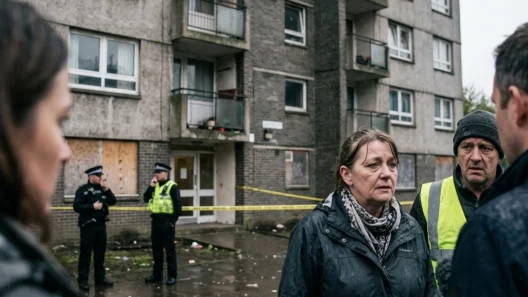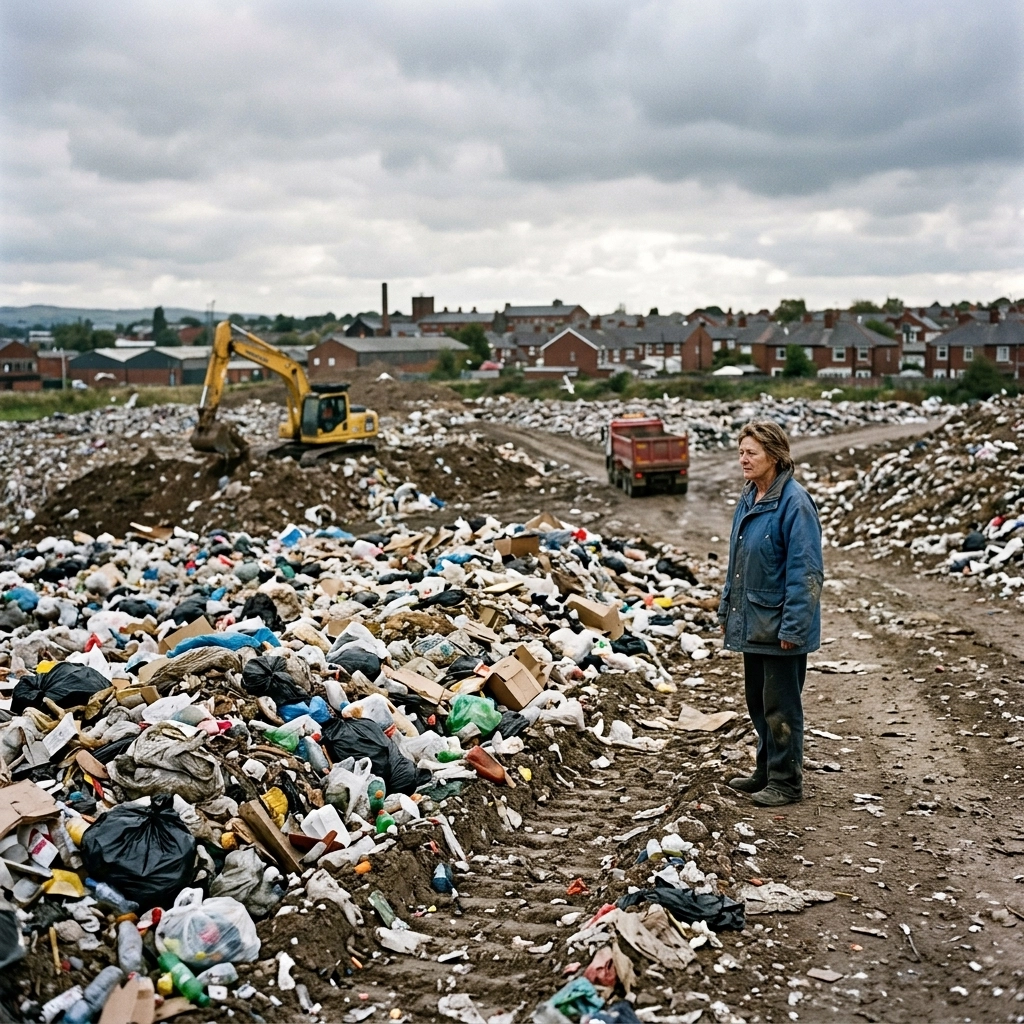
Imagine waking up, opening your curtains, and instead of seeing the local park or a quiet street, you’re staring at a mountain of rotting rubbish that towers five stories high. For the people living on Bolton House Road in Bickershaw, Wigan, this isn't a bad dream: it is a daily reality that has stretched on for well over a year. As part of our commitment to independent news UK, we are diving into the untold stories of those living in the shadow of one of the country's most egregious examples of waste crime.
The scale of the problem is hard to wrap your head around unless you see it. There are roughly 25,000 tonnes of illegal waste sitting on a two-acre site. To put that in perspective, waste crime across the country is now estimated to be equivalent to filling 35 Wembley stadiums every single year. But for the Wigan community, this isn't a statistic about national infrastructure; it’s about the rats in their kitchens, the flies in their children’s bedrooms, and a stench that never seems to leave their clothes.
The Grim Reality of a Local Environmental Crisis
The nightmare began back in October 2024. What started as a few suspicious loads quickly escalated into a full-scale illegal operation. By early 2025, residents reported seeing as many as 20 heavy wagons a day dumping waste at the site. Within just three months, the pile had grown to a staggering height, looming over nearby houses, a playing field, and a primary school.
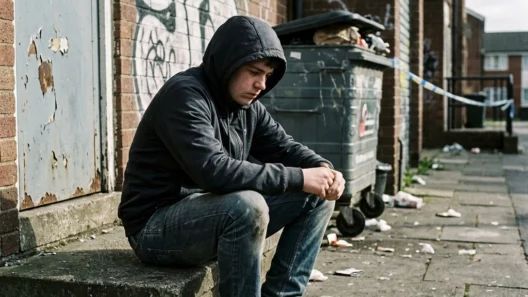
Living next to 25,000 tonnes of household and industrial waste isn't just an eyesore; it’s a direct assault on the senses and health of the local population. Residents have described a life dominated by pests. It’s not uncommon to hear stories of rats nesting in car engines, chewing through wires, and scuttling across kitchen counters. The infestation is so severe that some locals feel like prisoners in their own homes, unable to open windows even in the height of summer because of the clouds of flies and the crawling maggots that appear on their doorsteps.
Beyond the pests, there is the physical toll. Since the site became a permanent fixture of the landscape, many residents have reported persistent chest infections and respiratory issues. Some have even had to resort to steroid treatments just to keep their lungs clear. For parents with children at the nearby primary school, the anxiety is constant. How can you feel safe letting your kids play outside when the air they breathe is thick with the dust and decay of a massive, unregulated dump? It is a heartbreaking situation for a community that feels abandoned by the systems meant to protect them.
The Complex Web of Responsibility and Inaction
One of the most frustrating aspects for the people of Wigan has been the "pass the buck" attitude from various authorities. When a crisis of this magnitude occurs, you would expect an immediate, heavy-handed response. Instead, the situation became a legal and bureaucratic quagmire. The site is a patchwork of ownership, with about 30% of the land belonging to the Duchy of Lancaster: the King’s private estate.
The land ended up with the Duchy through an ancient, 750-year-old legal process called "escheat." This happens when a company that owned the land is dissolved, and the property is essentially left in limbo. Because of this archaic framework, the Duchy has been exempt from the standard cleaning regulations that apply to almost everyone else. They have argued that they aren't responsible for the cleanup, while Wigan Council has countered that the landowner should be held accountable if the original fly-tippers can't be forced to pay.
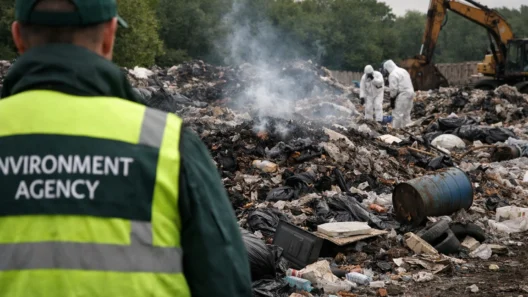
This legal stalemate reached a boiling point in July 2025. A massive fire broke out at the site, sending plumes of acrid smoke across the region. The blaze burned for nine days and was declared a major incident. It took an incredible amount of resources from the fire service to bring it under control, and even after the flames were out, the heat and smell lingered for weeks. This was the moment many hoped would finally trigger a total clearance of the site. However, as we move through 2026, the progress has been painfully slow. While a criminal investigation was launched, the residents are less interested in the courtroom drama and more interested in when the mountains of trash will finally disappear from their doorsteps.
Fighting for a Future Free of Filth
There is, finally, a glimmer of hope on the horizon. Recent reports suggest that a £9 million tender has been issued to clear the site. For the Wigan community, this is news they have been waiting to hear for nearly two years. Clearing 25,000 tonnes of waste is a massive logistical undertaking. It’s not just about moving the rubbish; it’s about managing the hazardous materials that may have seeped into the ground and ensuring that the removal process doesn't cause another spike in pest activity or health issues for the neighbours.
The cost of the cleanup is a stark reminder of why waste crime is such a serious issue. When criminals decide to dump waste illegally to avoid landfill taxes and disposal fees, the taxpayer is almost always the one left picking up the bill. The £9 million required to fix the Bickershaw site is money that could have been spent on schools, healthcare, or local infrastructure. Instead, it’s being used to rectify the actions of a few who put profit above the wellbeing of an entire neighbourhood.
As the clearance work begins to take shape, the focus must remain on the people who have lived through this ordeal. This story is a testament to the resilience of the local community, who refused to stay silent while their environment was destroyed. They have protested, lobbied their MPs, and shared their stories with anyone who would listen. Their fight is a reminder that everyone deserves to live in a clean, safe environment, regardless of where they live or the legal complexities of the land beneath their feet.
The situation in Wigan serves as a loud wake-up call for the entire UK. It highlights the desperate need for reform in how we handle land ownership disputes and how we crack down on industrial-scale fly-tipping. Until the penalties for waste crime truly outweigh the potential profits, and until the legal loopholes like those found in ancient land laws are closed, other communities could find themselves facing the same 25,000-tonne nightmare.
For now, the residents of Bolton House Road are waiting for the first trucks to arrive to take the mountain away. They are looking forward to a summer where they can open their windows, let their children play in the garden, and finally breathe air that doesn't smell of decay. It has been a long, difficult road, but the end of Wigan’s trash nightmare may finally be in sight.
The illegal dump at Bickershaw remains one of the most significant environmental challenges in the region. The collaboration between local authorities and national agencies will be crucial in the coming months to ensure the site is cleared safely and that such a catastrophic failure of waste management never happens in this community again.