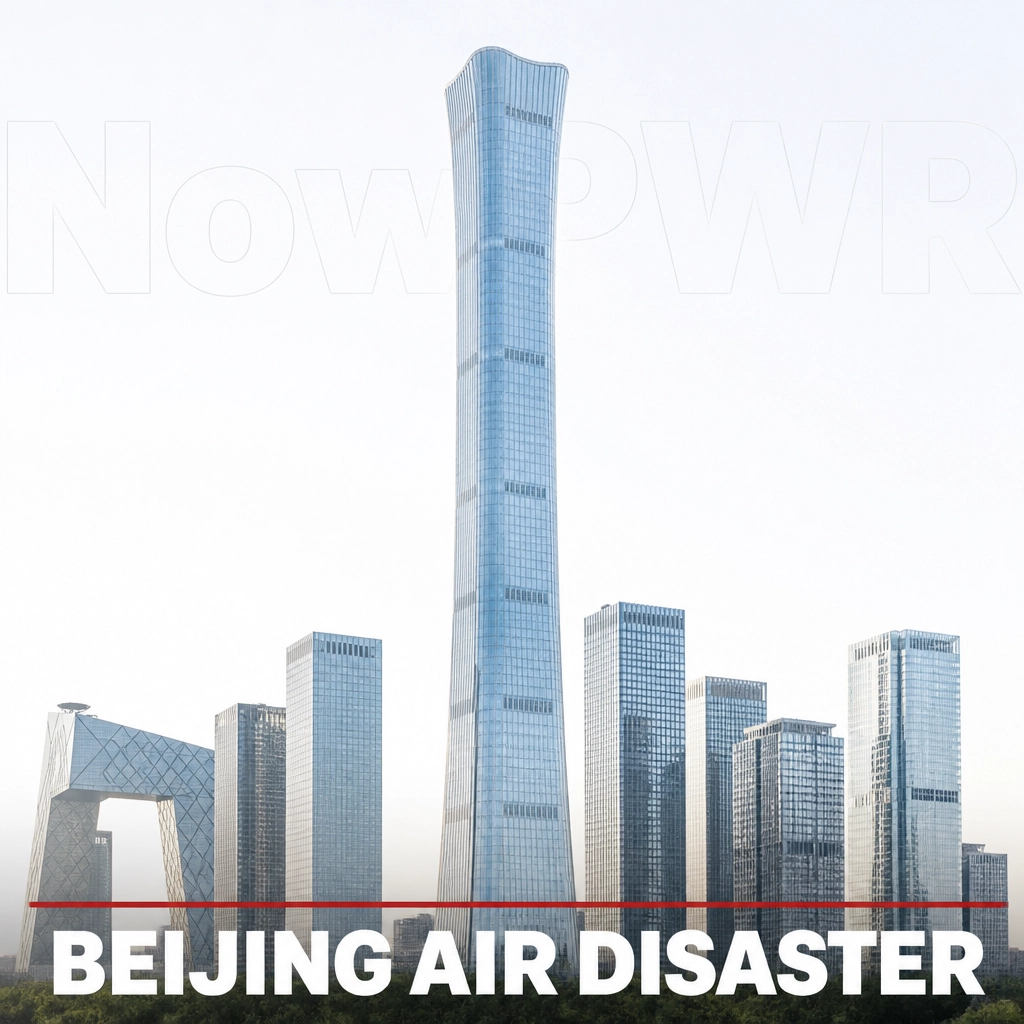
A small aircraft has crashed into the side of the CITIC Tower in Beijing, leaving the pilot dead and thirteen people on the ground and inside the building injured. The incident occurred during the busy morning hours in the heart of the capital’s central business district, sending shockwaves through one of the most heavily monitored areas in the country. The aircraft, which witnesses described as being roughly the size of a standard family car, struck one of the upper floors of the 109-storey skyscraper before spinning out of control and plummeting to the pavement below.
The CITIC Tower, more commonly known as China Zun due to its distinctive shape inspired by an ancient ceremonial vessel, stands as Beijing’s tallest landmark. Reaching a staggering height of 528 metres, it serves as the headquarters for the state-owned CITIC Group and houses thousands of employees across its vast vertical expanse. On this occasion, the height and prominence of the structure became the site of a tragic aviation accident that has raised immediate concerns regarding air traffic control and flight path restrictions over major metropolitan hubs.
Emergency services were on the scene within minutes, with dozens of fire engines and police vehicles cordoning off the area around the base of the tower. Video footage captured by bystanders and shared across social media platforms showed a visible hole in the glass curtain wall of the skyscraper, with smoke drifting from the impact point before the wreckage hit the ground. The pilot, who was the sole occupant of the light aircraft, was pronounced dead at the scene by first responders. Those injured were struck by falling glass and debris as the plane disintegrated upon impact, with several individuals being treated for serious but non-life-threatening conditions in local hospitals.
Impact on the Capital’s Tallest Landmark
The structural integrity of the CITIC Tower appears to have held firm despite the high-altitude impact. Engineers and safety inspectors were quickly deployed to assess the damage to the upper storeys, where the plane first made contact. The tower is designed to withstand extreme weather conditions and seismic activity, yet the concentrated force of a kinetic impact from an aircraft is a scenario that urban planners and architects are increasingly forced to consider in the modern age. Workers inside the building reported feeling a massive shudder that many initially mistook for a minor earthquake or a construction mishap on a lower level.
The debris field extended for several hundred metres around the entrance of the tower, forcing the closure of several major thoroughfares in the central business district. For a city that prides itself on order and precision, the sight of a shattered aircraft in the middle of a financial hub was a jarring contrast to the usual daily routine. The "Zun" shape of the building, which tapers in the middle and flares at the top and bottom, may have played a role in how the debris scattered, with the outward-curving base potentially catching some of the initial fallout before it reached the crowded pedestrian walkways.
While the physical damage to the skyscraper can be repaired, the psychological impact on the residents and workers of Beijing is likely to be more enduring. The CITIC Tower is not just an office building; it is a symbol of the city's economic ambition and a central fixture of the skyline. Seeing such a prominent icon scarred by an accident has prompted a wide-ranging conversation about the proximity of light aircraft flight paths to the world’s most densely populated urban centres. For hours after the crash, crowds gathered at the edge of the police cordons, staring up at the jagged gap in the glass that marked the site of the tragedy.
Chaos at the Heart of the Business District
The immediate aftermath of the crash was defined by a mixture of confusion and rapid mobilisation. In the moments following the impact, the sound was described by local residents as being far louder than the fireworks typically heard during festival seasons. People working in neighbouring towers, such as the China World Trade Center, watched from their windows as the small plane struggled to maintain altitude before clipping the side of the China Zun. The response from the Beijing authorities was swift, reflecting the high-security nature of the district, which is home to numerous international corporations and diplomatic outposts.
Thirteen people were caught in the path of the falling wreckage, a number that many believe could have been much higher had the incident occurred closer to the lunch hour when the plazas are filled with thousands of office workers. Paramedics worked through the morning to stabilise those hit by falling glass, which rained down like shards of ice from the upper storeys. The injured included a mix of commuters, delivery drivers, and building security personnel who were stationed near the main entrance when the plane hit the ground. The pilot’s identity has not yet been officially released, though it is understood he was an experienced aviator operating a privately owned light aircraft.
The logistical challenge of clearing the area was immense. With the skyscraper being the centrepiece of the CBD, any disruption to the surrounding transport links causes a ripple effect across the entire city. Subways were bypassed, and bus routes were diverted as the police established a secure perimeter to allow for a forensic investigation of the aircraft’s remains. The wreckage was eventually shrouded in large tarpaulins and moved to a secure facility for further analysis, while cleaners began the arduous task of removing the thousands of pieces of glass that had turned the surrounding streets into a hazard zone.
Safety Questions and Ongoing Investigations
As the initial shock subsides, the focus has shifted toward how such an incident was allowed to happen in one of the most restricted airspaces in the world. Beijing maintains strict controls over its skies, particularly around the central business district and government quarters. Light aircraft, drones, and even balloons are typically subject to rigorous permit systems. Investigators are currently looking into whether the crash was the result of a sudden mechanical failure, a medical emergency involving the pilot, or a navigational error that led the aircraft into the forbidden zone of the skyscraper cluster.
Aviation experts have pointed out that light aircraft often lack the sophisticated collision avoidance systems found in larger commercial jets. In an urban environment dominated by glass and steel towers, even a minor lapse in concentration or a sudden gust of wind can prove fatal. The investigation will involve a thorough review of the flight’s radar track and any communication between the pilot and air traffic control in the minutes leading up to the collision. There is also the question of whether the aircraft had been modified or if there were any pre-existing maintenance issues that could have contributed to the pilot losing control.
The incident has also sparked a debate regarding the future of general aviation in proximity to mega-skyscrapers. As cities continue to build upwards, the vertical risks associated with small-scale flight are becoming more pronounced. Local authorities have already hinted at a further tightening of flight restrictions across the capital, with some suggesting a total ban on private light aircraft within the fifth ring road. For now, the people of Beijing are left to reflect on a morning that saw their tallest tower become the scene of a tragic and unlikely disaster, reminding everyone of the fragile balance between the heights of human engineering and the unpredictable nature of the world around us.