The Lake District is often defined by its jagged peaks, deep blue waters, and the iconic dry stone walls that lace the landscape together. But there is another vital feature of the Cumbrian countryside that has been quietly making a massive comeback this year. In a significant win for local biodiversity, the “Hedges and Edges” project has just wrapped up a record-breaking winter season, seeing thousands of trees planted across the county to create what experts call “nature’s motorways.”
It is easy to look at the rolling fells and think of the environment as static, a postcard frozen in time. However, the reality of the British countryside is one of constant evolution. Over the last century, the UK lost about half of its hedgerows due to changing agricultural practices and urban expansion. In the Lake District, where the weather can be as harsh as the terrain is beautiful, these green corridors are more than just boundary markers. They are life-saving shelters, carbon sinks, and essential paths for creatures that would otherwise be stranded in isolated pockets of woodland.
This most recent push, led by the Friends of the Lake District and supported by the CPRE’s Hedgerow Heroes initiative, has seen over 17,800 trees find a permanent home in the Cumbrian soil. Between November 2025 and March 2026, the project successfully established two kilometres of brand-new hedgerow and restored a further three kilometres of existing, neglected boundaries. It is a massive undertaking that proves how much can be achieved when local passion meets environmental necessity.
Building bridges for Cumbrian wildlife
The primary goal of this massive planting effort is to reconnect a fragmented landscape. For many of the Lake District’s most beloved species, a wide-open field is a dangerous no-man’s-land. Hedgehogs, dormice, and various rare birds rely on the thick cover of a well-maintained hedge to move between habitats safely. By planting nearly 18,000 saplings, the project is effectively building bridges across the countryside, allowing wildlife to hunt, mate, and migrate without the risk of being caught in the open.
These aren’t just any trees, either. The project focuses on a diverse mix of native species, including hawthorn, hazel, blackthorn, and holly. This variety ensures that there is a constant supply of food and shelter throughout the seasons. In the spring, the blossom provides a vital source of nectar for early-emerging bees and insects. By autumn, the berries and nuts offer a high-energy feast for birds and small mammals preparing for the lean winter months.
Beyond the immediate benefit to animals, these hedgerows are working hard for the climate. Every metre of new hedge helps to suck carbon dioxide out of the atmosphere, locking it away in the wood and the roots. In a region increasingly prone to heavy rainfall and flash flooding, these green barriers also play a crucial role in natural flood management. The deep root systems help the soil soak up water more effectively, while the physical structure of the hedge slows down the flow of runoff across the fields, protecting downstream communities from the worst effects of the Cumbrian weather.
The community effort behind the green wall
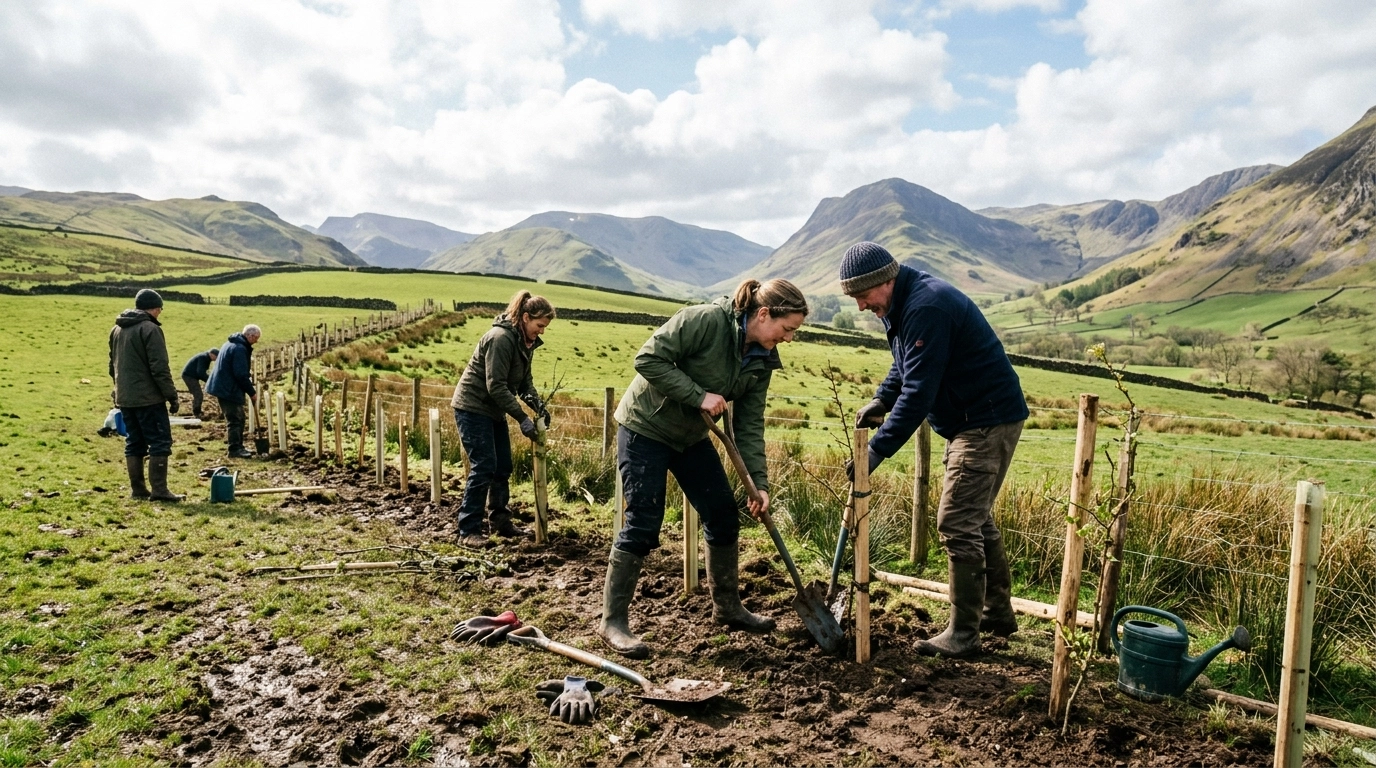
While the numbers are impressive, the real story of the Great Hedgerow Revival lies in the hands that held the spades. More than 100 volunteers and staff braved the often-brutal winter weather to get these saplings into the ground. From local residents who wanted to give something back to their valley to visitors who spent their holidays digging in the dirt, the effort has been truly collaborative.
The project has focused on several key areas across the county, including the Howgills, the River Pettril, and the Ullswater catchment. In these locations, the work involved more than just planting new whips. It also included the traditional and highly skilled craft of hedgelaying. This involves partially cutting through the stems of older bushes and bending them over at an angle to create a thick, living fence that is impenetrable to livestock and perfect for nesting birds.
By teaching these skills to a new generation of volunteers, the Hedges and Edges project is ensuring that the heritage of the Lake District is preserved alongside its ecology. Hedgelaying is a labour-intensive process that requires patience and a deep understanding of how different trees grow. Seeing young people and retirees working side-by-side to lay a hedge in the traditional Cumbrian style is a powerful reminder that conservation is as much about people as it is about the land. It fosters a sense of stewardship that goes far beyond a single season of work, creating a community of people who are personally invested in the future of their local environment.
Securing the landscape for generations to come
As we move into the warmer months of 2026, the focus of the project is shifting from planting to monitoring. The summer will be spent surveying the new and restored hedges to see how the saplings are taking and which species are moving in. It is a vital phase of the project, as the first few years of a hedgerow’s life are the most precarious. Ensuring that the young trees are protected from browsing deer and that they aren’t choked by competing weeds is essential for long-term success.
The ambition doesn’t stop here. With the success of this winter season under their belts, the organisers are already looking ahead to the next phase. If funding is secured, there are plans to plant and restore an additional six kilometres of hedgerow starting in November 2026. This would represent a significant expansion of the project and a major step toward the national goal of increasing the UK’s hedgerow network by 40% by 2050.
For the residents of the Lake District, these new hedges are a sign of hope. They represent a move away from the intensive, stripped-back landscapes of the past towards a more integrated, nature-friendly way of managing the land. It shows that even small-scale interventions, when multiplied by thousands of trees and hundreds of volunteer hours, can have a profound impact on the health of our environment. The Great Hedgerow Revival is a testament to the fact that we can repair the damage done to our natural world, one sapling at a time.
The fells may remain the stars of the show in Cumbria, but it is the humble hedgerow that is doing the heavy lifting in the background. As these new plants grow taller and thicker over the coming years, they will become a permanent part of the tapestry of the Lakes, providing a legacy of green that will benefit both people and wildlife for generations to come. It is a quiet revolution, rooted in the soil, and it is exactly the kind of story that reminds us that the future of our countryside is in good hands.