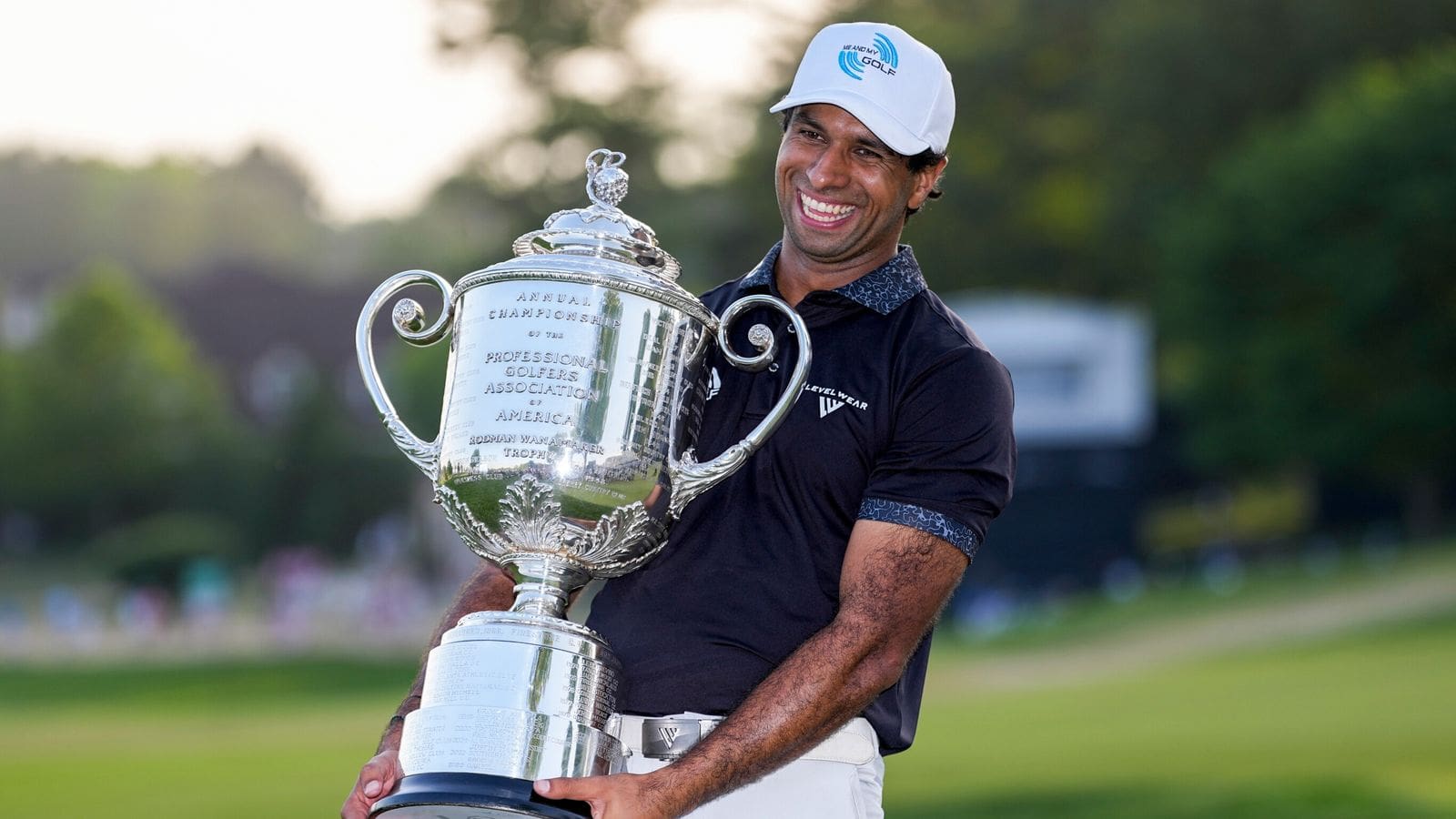
England's Aaron Rai has secured a place in the history books of world sport after a commanding performance at the 108th PGA Championship, held at the historic Aronimink Golf Club. The 31-year-old from Wolverhampton delivered a masterclass in precision and composure, navigating a treacherous final round to claim the Wanamaker Trophy by a three-shot margin. In doing so, Rai has not only secured his first major championship but has also brought an end to one of the longest droughts in professional golf. For the first time since 1919, the trophy will return to English soil, marking a watershed moment for a player whose career has been defined by a quiet, methodical rise to the summit of the game.
The atmosphere at Aronimink was electric as Rai entered the final day with a narrow one-shot lead. Known for his unique style: specifically his use of two gloves for every shot: Rai remained remarkably calm as his competitors faltered under the intense pressure of a major Sunday. While some of the biggest names in the sport struggled with the demanding layout and the thickening rough, Rai stayed true to his reputation as one of the straightest hitters in professional golf. His performance was a testament to the discipline and work ethic that have seen him transition from the developmental tours in Europe to the very peak of the PGA Tour.
The significance of the victory cannot be overstated. Not since Jim Barnes, a native of Cornwall, won his second PGA Championship in 1916 and 1919 has an Englishman held this particular title. Despite decades of success from icons like Sir Nick Faldo, Justin Rose, and Matt Fitzpatrick, the PGA Championship had remained elusive for English golfers for 107 years. Rai’s triumph at Aronimink finally breaks that century-long curse, cementing his status as a national hero and one of the premier ball-strikers of his generation.
A Landmark Achievement on American Soil
The final round at Aronimink provided a stern test for the world’s elite, with swirling winds and firming greens making every decision critical. Rai’s strategy was clear from the outset: find the short grass and avoid the punishing bunkering that lines the fairway of the Pennsylvania course. His iron play, which has long been the cornerstone of his game, was peerless. Time and again, he found the centre of the green while his rivals were forced into desperate par saves from the thick fescue.
The turning point came on the daunting back nine. After a steady front nine that saw him maintain his lead, Rai faced a critical par save on the par-four 11th. After a rare wayward drive, he managed to scramble for a four, a moment that seemed to galvanise his confidence. From that point on, he appeared untouchable. A clinical birdie on the 14th hole followed by another on the 16th pushed him clear of the chasing pack. As he walked down the 18th fairway to a standing ovation, the realisation of what he was about to achieve began to set in.
Rai’s victory was built on a foundation of accuracy that has become his trademark. Throughout the week, he led the field in fairways hit and greens in regulation, a statistically dominant display that left little room for error. His ability to handle the heavy burden of history while playing away from home, against a largely American-leaning gallery, spoke volumes about his mental fortitude. This was not just a win for Aaron Rai; it was a demonstration of how patience and technical precision can overcome the raw power that often dominates the modern professional game.
The Long Shadow of History
To understand the weight of Rai’s accomplishment, one must look back to the early 20th century. Jim Barnes was a pioneer of the professional game, winning the first-ever PGA Championship in 1916 and repeating the feat after the conclusion of the First World War in 1919. Since then, English golfers have enjoyed immense success in the Open Championship and the US Open, and more recently at the Masters. However, the PGA Championship, often seen as the "players' major," had remained a bridge too far.
Over the decades, several English legends came close to ending the wait. In the late 1980s and early 1990s, Nick Faldo was a perennial contender but could never quite find the formula to secure the Wanamaker Trophy. More recently, players like Tommy Fleetwood and Lee Westwood have finished as runners-up, leading many to wonder if the drought would ever be broken. Rai has now answered that question in the most emphatic fashion possible. By joining Barnes as the only English winners in the event’s 108-year history, he has carved out a unique legacy that sets him apart even from some of the greatest names to have ever picked up a club.
This victory also highlights the global nature of modern golf. Rai, who grew up playing on the challenging parkland courses of the English Midlands, has spent years refining his game to compete on the longer, softer layouts found in the United States. His success at Aronimink is the culmination of a journey that began on the EuroPro Tour and saw him climb through the Challenge Tour and the DP World Tour before eventually making his mark on the PGA Tour. It is a path that required immense self-belief and a refusal to compromise on the unconventional elements of his game, such as his dual-glove approach, which he adopted as a junior for better feel and control.
Precision and Persistence Rewarded
Beyond the historical records, Rai’s triumph is a deeply personal victory for a man known for his humility and family values. His background is one of hard work and dedication; his father was his first coach and has been a constant presence throughout his career. Rai has often spoken about the sacrifices his family made to support his dreams, including his mother, whose Kenyan heritage has always been a source of pride for the Wolverhampton native. Seeing Rai lift the Wanamaker Trophy was a emotional moment for those who have followed his journey from a teenage prodigy to a major champion.
The technical aspects of Rai's game will undoubtedly be analysed by experts for weeks to come. In an era where distance is often prioritised over all else, Rai has proven that there is still a place for the strategist. His swing is a model of repeatability, and his short game, often overshadowed by his ball-striking, was flawless under the heat of the Pennsylvania sun. His victory at Aronimink follows a string of strong performances over the last two seasons, including wins on the DP World Tour and consistent finishes on the PGA Tour, suggesting that this major win is not an outlier but the start of a new chapter in his career.
As the golfing world looks ahead, the focus will inevitably turn to what Rai can achieve next. With his first major now secured, the pressure that often haunts talented players who have yet to win a big one has been lifted. He will arrive at the next three majors of the year as a marked man, but if his performance this week is any indication, he is more than capable of handling the scrutiny. For now, however, Rai can enjoy the satisfaction of knowing that he has ended a 107-year wait for his country and earned himself a permanent place among the greats of the sport. The century-long wait for an English PGA champion is over, and in Aaron Rai, the game has a champion whose character is as impressive as his golf.