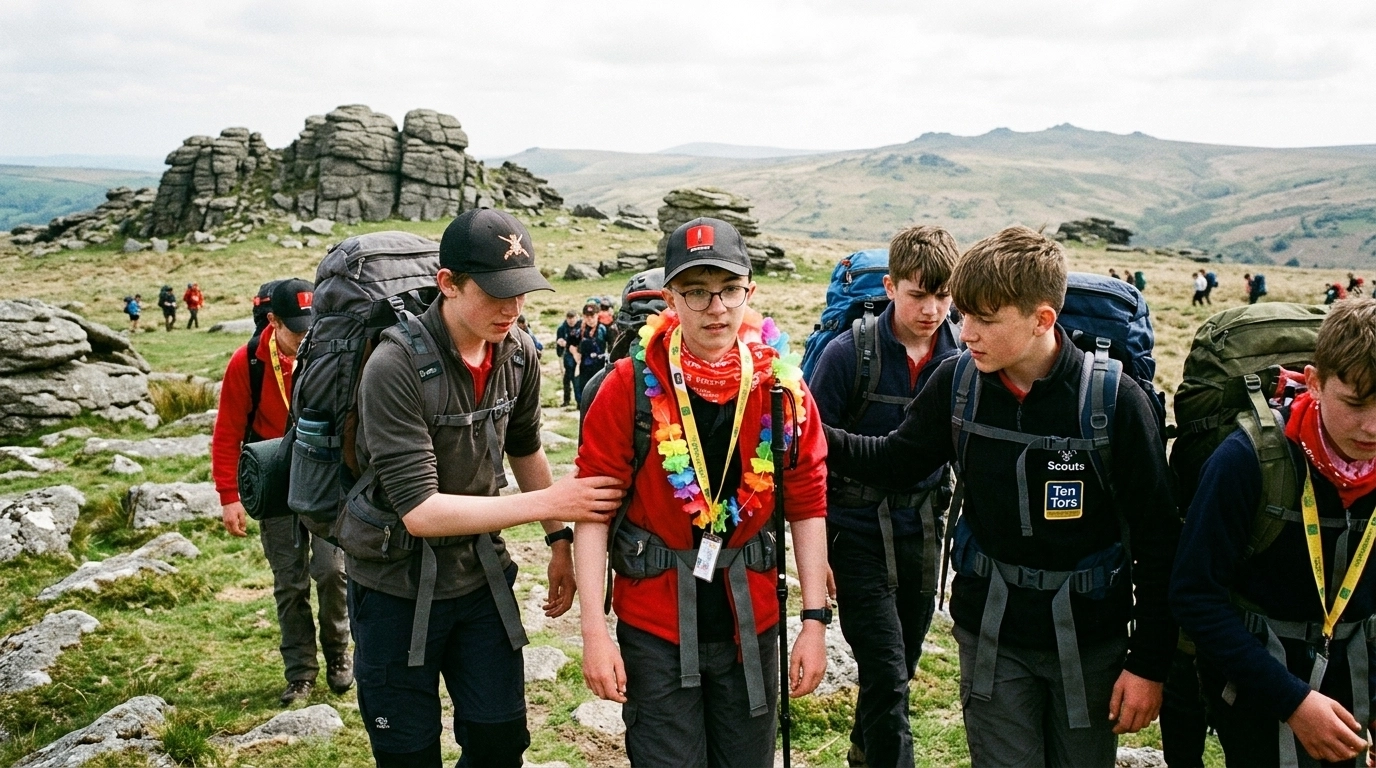
The rugged landscape of Dartmoor is known for its unforgiving weather, steep inclines, and treacherous bogs. It is the setting for one of the most demanding outdoor challenges in the United Kingdom: the Ten Tors. Every year, thousands of young people gather to test their endurance, navigation skills, and mental fortitude against the elements. However, the 64th anniversary of this historic event saw a milestone that few thought possible. Alfie, a thirteen-year-old boy with a significant visual impairment, became the first person in his category to complete the 35-mile route. As part of the Carrick Deg Karn Explorer Scouts team, Alfie did more than just finish a hike; he redefined what is possible for young people living with disabilities in the great outdoors.
Dartmoor National Park covers 368 square miles of wilderness in Devon. The Ten Tors challenge involves teams of six young people trekking between ten specific granite tors over two days. For the 35-mile route, participants must be self-sufficient, carrying all their camping gear, food, and water while navigating the wilderness without adult assistance. The event is famous for its strict rules and the requirement for teams to stay together, ensuring that success is a collective achievement rather than an individual one. For Alfie, this challenge was compounded by the fact that he could only see a fraction of what his teammates could, making every uneven step and every slippery rock a potential hazard.
His journey to the finish line began months before the event took place. Preparing for Ten Tors is not a weekend hobby; it is a rigorous training programme that requires commitment, physical conditioning, and deep trust amongst team members. The Carrick Deg Karn Explorer Scouts, based in Cornwall, are known for their inclusive spirit and dedication to scouting values. When Alfie expressed his desire to take on the 35-mile challenge, the group did not see a limitation. Instead, they saw an opportunity to demonstrate the power of teamwork and adapted their training to ensure everyone could participate safely.
A Historic Achievement on Dartmoor
The history of Ten Tors dates back to 1960, when it was founded by the British Army. Over the decades, it has become a rite of passage for many young people in the South West of England. While there have been participants with various needs over the years, Alfie’s completion of the 35-mile route marks a specific first in the event’s history for a visually impaired teenager. This milestone is significant because the 35-mile route is the standard entry point for younger participants, yet it requires a level of independent navigation and physical resilience that is daunting for any able-bodied teenager.
For Alfie, the achievement is a testament to his personal grit. Visual impairment affects more than just sight; it impacts depth perception, balance, and the ability to anticipate changes in the terrain. On Dartmoor, where the path can vanish into a peat bog or turn into a field of loose boulders in seconds, these challenges are magnified. Alfie worked closely with his teammates to develop a system of communication that allowed him to understand the ground ahead of him. His success has sent a powerful message to the organisers and future participants: that with the right support and determination, the wilderness is accessible to everyone.
The impact of this achievement extends beyond the scouting community. It serves as a beacon for other young people with visual impairments who may feel that high-level physical challenges are out of reach. Alfie’s story is not just about a hike; it is about breaking the glass ceiling of expectations. By crossing the finish line within the allotted time, he proved that disability does not have to be a barrier to excellence. The 64th Ten Tors will be remembered not just for the thousands who took part, but for the one boy who saw the challenge differently and conquered it nonetheless.
Navigating the Toughest Terrain
The 35-mile route is notoriously difficult, even for those with perfect vision. The terrain on Dartmoor is characterised by “clitter” : slopes covered in loose, moss-grown rocks : and vast areas of marshland that can trap a hiker’s boots. For Alfie, navigating this meant relying on his other senses and the constant feedback from his team. He had to learn to “read” the ground through his feet and the vibrations of his walking poles, all while maintaining a pace that would allow the team to reach their checkpoints before the strict cut-off times.
Weather conditions during the event can change in an instant. It is not uncommon for teams to start in bright sunshine and find themselves in a thick “Dartmoor mist” within an hour, reducing visibility to just a few metres. In these conditions, even experienced navigators can become disoriented. Alfie’s training focused heavily on being part of a cohesive unit. His teammates acted as his eyes, describing the landscape and the obstacles ahead, while Alfie provided the endurance and morale that kept the group moving forward through the fatigue.
The physical toll of carrying a full expedition pack : weighing up to a third of a participant’s body weight : cannot be understated. Over 35 miles, this weight places immense strain on the joints and muscles. Alfie had to build incredible core strength and stamina to ensure that his balance remained steady despite his visual limitations. The mental challenge was equally steep; the “Ten Tors blues” often set in during the second day when legs are heavy and the finish line still feels miles away. Alfie’s ability to maintain focus and push through the pain was a key factor in the Carrick Deg Karn team’s success.
The Power of Teamwork and Determination
At its heart, Ten Tors is a team event. No individual can win alone, and no individual is left behind. The Carrick Deg Karn Explorer Scouts exemplified this ethos throughout their journey. The team had to learn how to support Alfie without taking away his independence. This balance is delicate; providing too much help can undermine a participant’s sense of achievement, while too little can lead to safety risks. The scouts developed a seamless way of working together, ensuring that Alfie was a fully contributing member of the team, involved in the decision-making and the heavy lifting of camp life.
The determination Alfie showed is a reflection of his character, but it also highlights the importance of inclusive organisations like the Explorer Scouts. By providing the infrastructure and the encouragement, they allowed a young man to test his limits in a controlled yet challenging environment. This story highlights a broader trend in the UK towards making outdoor spaces more accessible. It challenges the “mainstream” narrative that often excludes people with disabilities from high-adventure activities, proving that with adaptation and a positive mindset, the most iconic challenges in the country are open to all.
As Alfie and his team crossed the finish line at Okehampton Camp, the cheers from the crowd were not just for their speed, but for the barrier they had broken. The success of the Carrick Deg Karn team is a reminder that the greatest obstacles we face are often the ones we place on ourselves or others. Alfie’s 35-mile trek across the tors is now a part of Dartmoor lore, a story of a thirteen-year-old who refused to let his sight define his horizon. His journey from the training hills of Cornwall to the high peaks of the moors stands as an enduring example of what can be achieved when a person has the courage to start and a team that refuses to let them fail.