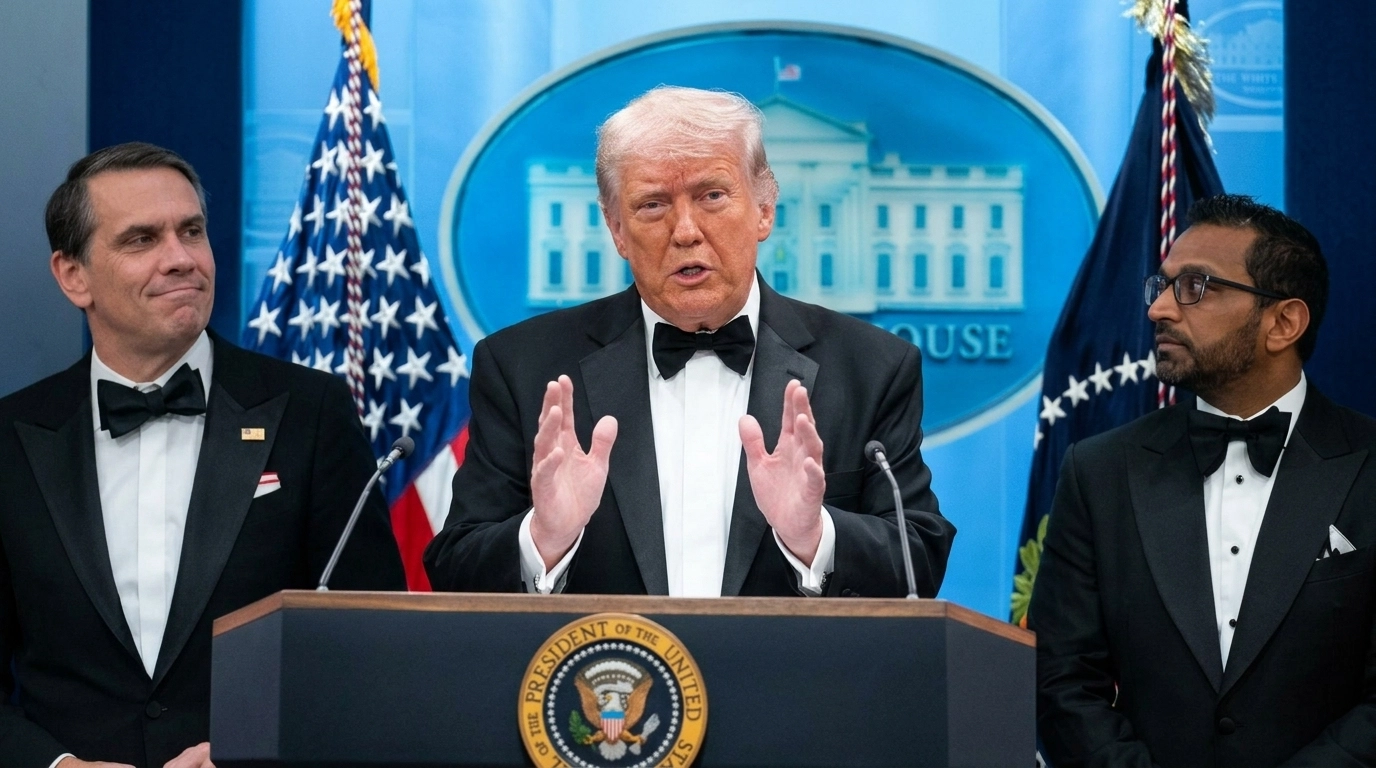
The concept of a shared reality appears to be a relic of a bygone era. In a world where every headline is dissected, doubted, and dismissed before the digital ink has even dried, the latest polling data from the United States offers a sobering look at just how deep the fracture goes. According to a new survey conducted by NewsGuard and YouGov, nearly a quarter of Americans believe that the various attempts on Donald Trump’s life were not desperate acts of lone individuals, but rather meticulously orchestrated pieces of political theatre. This is not just a fringe theory whispered in the dark corners of the internet; it is a mainstream sentiment held by one in four citizens in the world’s most powerful democracy.
The statistics are striking. When asked about the most recent incident at the White House Correspondents’ Dinner in April 2026, where a gunman was apprehended after shots rang out at the Washington Hilton, 24 per cent of respondents claimed the event was staged. This scepticism is not evenly distributed across the political spectrum. Amongst Democrats, the figure rises to a staggering 33 per cent: one in three people who believe the president or his team fabricated a life-threatening situation to garner sympathy or boost falling approval ratings. Conversely, only about one in eight Republicans share this view. What we are witnessing is the total breakdown of trust in official narratives, where the identity of the victim determines the validity of the crime.
At NowPWR, we focus on the untold stories and the real conversations that mainstream outlets often ignore or simplify. The rise of alternative journalism is a direct response to this vacuum of trust. When people feel they are being managed rather than informed, they look for alternative news sites that provide a space for deeper inquiry. The fact that a significant portion of the population looks at a violent event and sees a stunt is a symptom of a much larger malaise in how information is consumed and verified in the modern age.
The Erosion of Public Faith in Mainstream Narratives
The root of this widespread disbelief lies in the long-term erosion of trust in traditional institutions. For decades, the media and government have been the gatekeepers of truth, but that monopoly has vanished. Today, an individual in the UK or the US is just as likely to get their news from an independent news UK platform as they are from a legacy broadcaster. This shift has democratised information, but it has also allowed for the rapid spread of "staged" narratives. When the official story feels too convenient: such as an assassination attempt occurring just as a candidate needs a polling boost: the public's default setting has switched from belief to suspicion.
The April 2026 incident involving Cole Tomas Allen at the Washington Hilton is merely the latest in a series of events that have been met with eye-rolls and hashtags. Allen, a 31-year-old programmer, was indicted for the attempted assassination of the president, yet for millions of Americans, the court proceedings are secondary to their own gut feeling. They see the Secret Service's quick response not as professional excellence, but as part of a rehearsed script. This cynicism is particularly prevalent among younger people, aged 19 to 29, who have grown up in an era of deepfakes and algorithmic manipulation. To them, everything is potentially a construct.
This isn't a phenomenon confined to the latest headlines. The July 2024 shooting in Butler, Pennsylvania, where a bullet famously clipped Trump’s ear, is viewed with similar doubt. Despite the tragic death of a rally-goer and the clear physical evidence of injury, 24 per cent of the population still maintains that the episode was a fabrication. Even the West Palm Beach golf club incident in September 2024, where a rifle barrel was spotted in the bushes before a shot could even be fired, is considered staged by 16 per cent of those surveyed. The "theatre of politics" has become literal in the minds of the public, and once that line is crossed, it is incredibly difficult to return to a state of consensus.
Partisanship and the Weaponisation of Skepticism
The partisan split in these survey results highlights how skepticism has been weaponised as a political tool. When a narrative benefits a political opponent, the easiest way to neutralise its impact is to deny its reality. By claiming an assassination attempt is fake, critics can bypass the need to feel empathy or address the underlying security failures. It is a psychological defence mechanism that allows people to maintain their existing worldview without being challenged by inconvenient facts. For many Democrats, the idea that Trump is a victim is so at odds with their perception of him that the only logical conclusion is that the victimhood must be a lie.
This trend is not one-sided, though the current data focuses on Trump. We have seen similar patterns in the UK and around the world, where political supporters and detractors live in entirely different information silos. Independent news UK providers often find themselves reporting on the space between these silos, trying to understand why two groups of people can look at the same video footage and see two different realities. The survey shows that 21 per cent of Democrats believe all three major incidents involving Trump were staged, compared to just 3 per cent of conservatives. This gap is not just a difference of opinion; it is a difference of world.
The role of social media in this cannot be overstated. Within minutes of the shots being fired at the Washington Hilton, the hashtag "staged" was trending globally. The speed at which these theories move means they often outpace the official facts. By the time a government spokesperson or a news anchor provides a verified update, the "staged" narrative has already taken hold and become part of the audience's identity. Alternative journalism has a responsibility here to navigate these waters carefully: not by blindly accepting every conspiracy, but by acknowledging the legitimate reasons why people are so distrustful in the first place.
Seeking Truth in the Age of Alternative Journalism
As we move forward, the challenge for the news industry is to find a way to bridge this divide. The rise of alternative news sites is proof that the public is hungry for something different, something that doesn't feel like a prepared press release. People are turning to independent journalism because they want the "untold stories" and they want to see the workings of how a story is put together. They are tired of being told what to think and instead want the evidence laid out so they can decide for themselves.
However, the "staged" phenomenon suggests that providing evidence is no longer enough. We are in a post-truth era where evidence is viewed as just another piece of the script. To rebuild trust, journalists must be more transparent about their sources, their biases, and the limits of their knowledge. NowPWR aims to provide that space for real conversations where skepticism is not dismissed as "moronic," as the White House spokesman put it, but is instead examined as a valid reflection of the public's relationship with power.
Ultimately, the fact that one in four Americans doesn't buy the official story of three separate assassination attempts should be a wake-up call for everyone in the business of communication. It is a sign that the social contract between the state, the media, and the people is under severe strain. Whether the events were staged or sincere is almost secondary to the fact that so many people believe they could be. Until we address the underlying reasons for this massive breakdown in trust, we will continue to live in a world where the truth is whatever you want it to be.