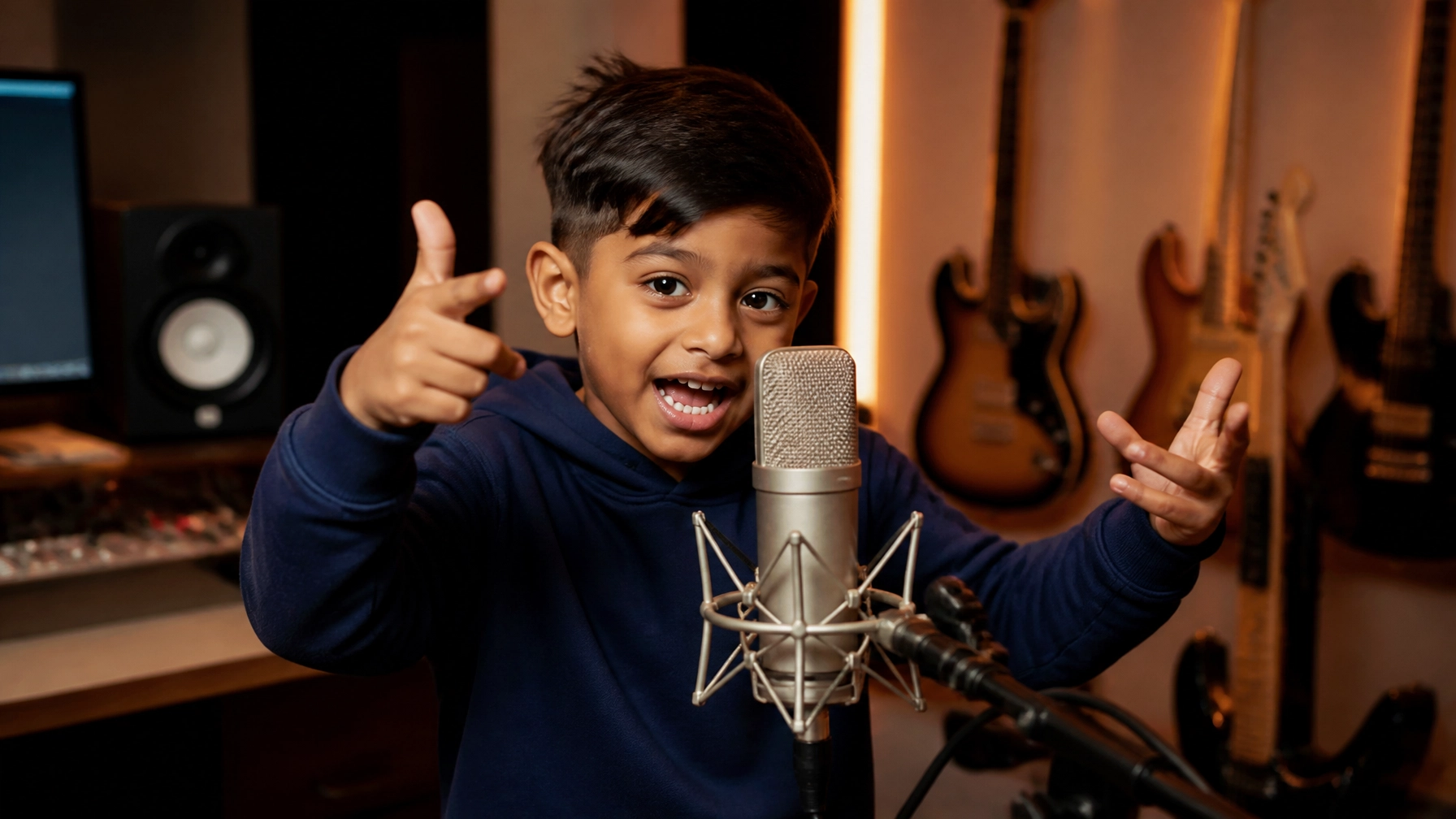
Five-year-old Aryan stood in the middle of his living room, a pair of oversized headphones slipping slightly over his ears. For most of his early life, the world had been a place of quiet frustration. While other children his age were beginning to piece together complex sentences about their day at school or the games they played, Aryan struggled to find the words to ask for a simple glass of water. His parents watched as his eyes filled with a mix of longing and irritation, a bright young mind trapped behind a wall of silence. However, everything changed when a rhythmic beat filled the room. It was not a nursery rhyme or a lullaby that broke through the barrier, but the driving, percussive energy of rap music.
The journey from silence to self-expression for Aryan is one that reflects a growing trend in the United Kingdom, where speech and language delays among primary school children have reached record levels. Recent data suggests that as many as one in five children are now starting school without the expected level of communication skills. For Aryan, the challenge was compounded by the isolation of the lockdown years, a period that deprived millions of infants of the crucial social interactions needed to develop language. But where traditional methods had seen slow progress, music provided a bypass. By mimicking the cadences of his favourite artists, Aryan began to find a rhythm to his own thoughts, turning the staccato struggle of speech into a flow of confidence.
The challenge of silence
For the parents of children with speech delays, the experience is often defined by a sense of profound helplessness. In Aryan’s case, the delay was not just a matter of pronunciation but a fundamental difficulty in planning the movements required for speech. Known as speech motor delay or, in more specific cases, childhood apraxia of speech, the condition means the brain struggles to tell the muscles of the mouth how to move in the correct sequence. The result is a child who knows exactly what they want to say but cannot physicalise the sounds. This creates a cycle of frustration; the child stops trying to communicate to avoid the pain of being misunderstood, which in turn further slows their development.
In the UK, the wait for specialist speech and language therapy can often stretch into months, leaving families to find their own ways to bridge the gap. Aryan’s family describe the early days as a series of "silent conversations," where gestures and facial expressions had to do the work of words. The impact on a child's social confidence at this age cannot be overstated. At age five, the playground is a place of negotiation and shared storytelling. To be excluded from that because of a speech barrier is to be sidelined from the most important developmental stage of early childhood. It was this sense of isolation that music finally began to dissolve.
The breakthrough occurred almost by accident. While listening to a track with a strong, repetitive beat, Aryan’s father noticed that his son was nodding in perfect time. More importantly, he was attempting to hum along to the rhythmic patterns. Unlike the fluid, unpredictable nature of everyday conversation, the rap music offered a predictable structure. Every beat was a marker, a place for a sound to land. For a child whose brain was struggling to coordinate speech, these musical markers acted like a map, guiding him through the terrain of language one syllable at a time.
Rhythms and rhymes
The science behind Aryan’s progress is as fascinating as the story itself. Researchers in the field of music therapy and neuroscience have long noted the deep connection between rhythm and language processing. In the brain, the areas responsible for processing musical beats are closely linked to those that manage the timing and flow of speech. For children with developmental language disorders, listening to a regular, predictable rhythm can actually "prime" the brain to better repeat sentences. It is as if the music provides a scaffolding upon which the child can build their words.
In Aryan’s case, rap was the perfect medium. Unlike singing, which requires a mastery of pitch and sustained vowels, rap is fundamentally percussive. It mirrors the natural "prosody" or rhythm of English speech, which is a stress-timed language. By focusing on the "flow": the way words sit on a beat: Aryan was able to practice complex phonemes without the pressure of a formal therapy session. He wasn't "learning to talk"; he was learning to rap. This shift in perspective is crucial for a young child. It turned a source of anxiety into a source of play and performance.
The repetition inherent in music also played a vital role. In traditional speech therapy, a child might be asked to repeat a difficult sound or word multiple times, a process that can quickly become tedious or discouraging. In a song, repetition is expected and enjoyable. Aryan would listen to the same four bars of a track dozens of times, unconsciously practicing the lip and tongue movements required for the lyrics. His parents began to notice that the clarity of his speech was improving not just while he was rapping, but in his everyday requests and comments. The neural pathways being built through music were successfully transferring to his functional language.
A future in harmony
Today, Aryan is a different boy from the one who struggled in silence only a year ago. While he still works with therapists to refine his articulation, the wall of frustration has been knocked down. He no longer shyly retreats from social situations; instead, he is often found at the centre of them, eager to show off his latest "verse." The confidence gained from mastering a difficult skill has permeated every aspect of his life. For Aryan, the microphone is more than a toy; it is the tool that gave him back his identity.
His story serves as a powerful reminder of the importance of creative interventions in early years education and health. As the UK continues to grapple with the long-term effects of the pandemic on children’s communication, the role of the arts as a therapeutic tool is becoming increasingly central. While not every child will find their voice through rap, the underlying principle remains the same: finding a way to make communication enjoyable rather than a chore is often the key to unlocking a child's potential.
For Aryan’s family, the greatest joy is not just hearing him speak, but hearing him express his personality. Speech is more than just the delivery of information; it is the way we share our humour, our dreams, and our connections with others. As Aryan stands in front of his microphone, his voice clear and his rhythm steady, he isn't just reciting lyrics. He is telling the world that he is here, that he has something to say, and that he finally has the words to say it. The silence has been replaced by a soundtrack of success, one beat at a time.