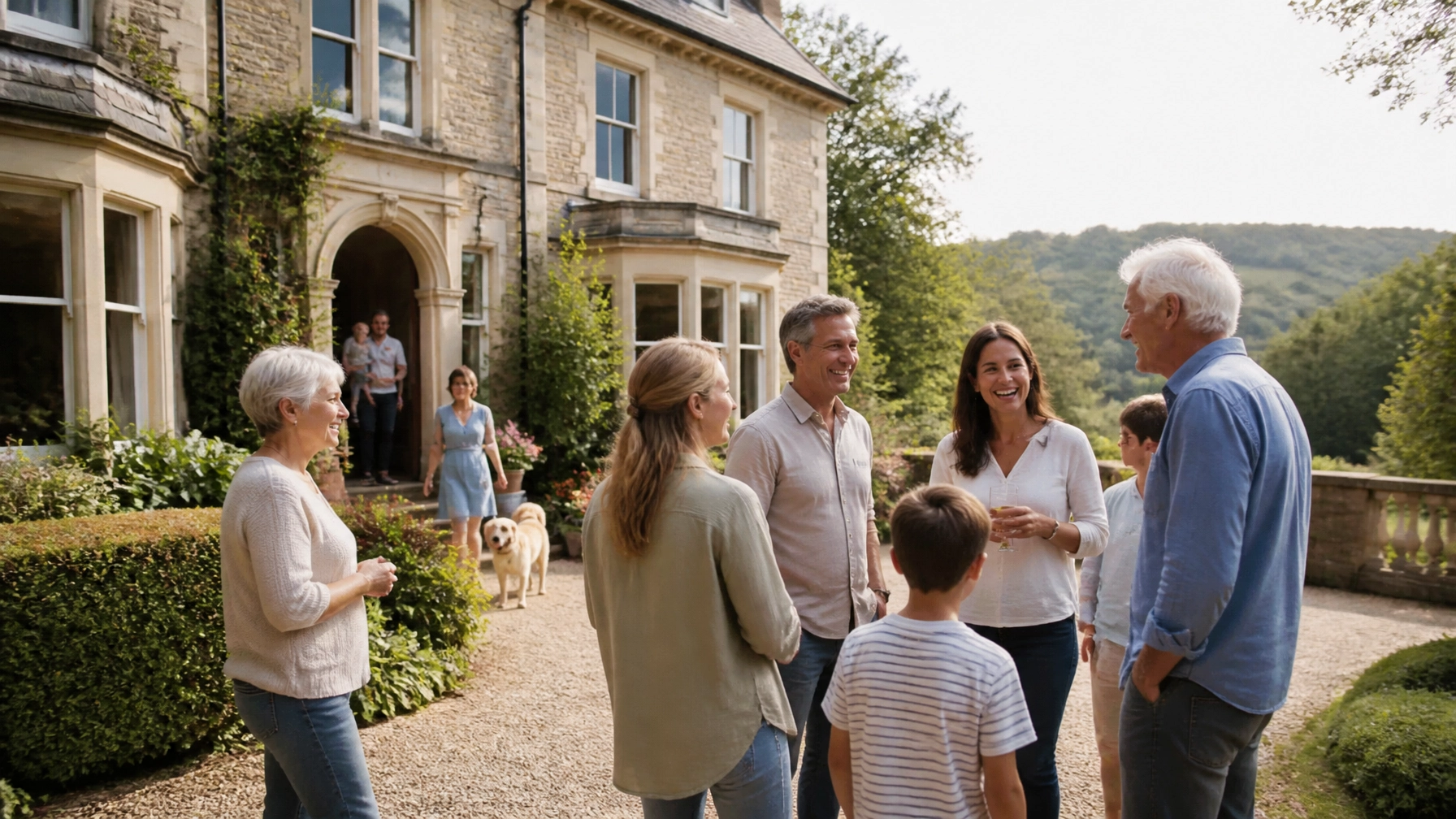
Nestled in the rolling hills of the Devon countryside, a grand Victorian manor that once housed a single aristocratic family has been transformed into a bustling hub of communal life.
Nine separate families, ranging from young couples with toddlers to retirees in their seventies, have moved into the property, sharing not just a roof, but their lives. This radical experiment in co-housing is part of a growing movement across the United Kingdom that seeks to address two of the most pressing issues of modern life: the astronomical cost of housing and a pervasive sense of social isolation. By pooling their resources, these families have been able to afford a quality of life that would have been impossible individually, creating a micro-community that functions as a modern-day village.
The property, located on the outskirts of Totnes, features private living quarters for each family, but the heart of the home lies in its extensive communal spaces. A vast kitchen, a professional-grade laundry room, and a sprawling garden serve as the backdrop for daily interactions. Decisions are made through consensus, and responsibilities: from gardening and maintenance to childcare and cooking: are shared among the residents. This arrangement has turned the traditional concept of the nuclear family on its head, replacing the isolation of suburban living with a constant, supportive presence. For many here, the move was a response to a housing market that has increasingly pushed people out of the communities they grew up in, particularly in rural areas where holiday homes and rising prices have decimated the local rental stock.
The Rise of Shared Living in the West Country
The shift towards co-housing in Devon is no coincidence. The county has long been a focal point for the UK’s housing crisis, with property prices in popular coastal and rural areas often reaching ten or twelve times the average local salary. As traditional routes to homeownership become increasingly blocked, residents are looking for alternative ways to secure a stable future. Shared living offers a middle ground between the insecurity of the private rental sector and the high barrier of entry for individual mortgage applications. In this particular Devon manor, the families have established a legal structure that allows them to share the equity of the property, providing a sense of security that many had previously thought was out of reach.
Economists and housing experts are closely watching these developments. The "sharing economy," which initially took hold in the digital sphere and transportation sectors, is now making significant inroads into the domestic environment. By sharing the costs of heating, council tax, and building insurance, the families in Devon report a significant reduction in their monthly outgoings. However, the benefits are not purely financial. The efficiency of shared resources also extends to environmental impact. One communal heating system, shared bulk-buying of food, and the use of fewer individual appliances mean that the carbon footprint of these nine families is considerably lower than if they were living in nine separate dwellings. This sustainability aspect is a major draw for younger residents who are increasingly conscious of their environmental impact.
The trend also reflects a changing demographic landscape. As the population ages and the traditional support networks of the extended family become more fragmented, the need for new forms of community has never been greater. In Devon, where many villages have become quiet during the winter months due to the prevalence of second homes, co-housing projects provide a year-round vibrancy. They bring children back to local schools and customers to local shops, helping to sustain the social fabric of rural life. The success of this project suggests that the model could be replicated elsewhere, offering a blueprint for how under-utilised large properties can be repurposed to serve a social good.
Combating the Growing Crisis of Social Isolation
Beyond the financial and environmental advantages, the primary driver for many of the residents was a desire to escape the "loneliness epidemic." Research has consistently shown that social isolation can have a devastating impact on physical and mental health, with some studies suggesting it is as damaging as smoking fifteen cigarettes a day. In the context of a modern, fast-paced society, the casual interactions that once occurred over a garden fence or at a local shop have become increasingly rare. For the families in Devon, sharing a home means that a conversation is never more than a few steps away. The intergenerational nature of the group is particularly significant; older residents provide a wealth of experience and a "grandparent" figure for the children, while the younger families offer energy and assistance with more physically demanding tasks.
One resident, who moved from a solitary flat in Exeter, described the transition as life-changing. The simple act of eating together at the end of the day has replaced the habit of eating in front of a television. This sense of belonging is a powerful antidote to the anxiety and depression that often accompany isolation. For the children in the house, the environment is one of constant stimulation and safety. They grow up with a diverse range of role models and a ready-made group of playmates, fostering social skills and a sense of collective responsibility from an early age. The "village" that many modern parents strive to find is, in this case, built into the very structure of their home.
However, the psychological benefits of co-housing require a shift in mindset. It demands a move away from the hyper-individualism that has characterised Western society for decades. Residents must be willing to compromise, to listen, and to engage in the sometimes-difficult work of conflict resolution. The manor operates on a principle of radical transparency, with regular meetings held to discuss everything from the communal budget to the frequency of shared meals. This level of engagement can be exhausting, but those involved argue that it is precisely this effort that builds the bonds of community. The result is a profound sense of psychological security: knowing that if you fall ill, or if you are simply having a difficult day, there is a network of people ready to support you.
Navigating the Practical Realities of Co-Housing
While the romantic image of communal living is appealing, the practical realities are complex and require careful management. Successfully housing nine families under one roof involves more than just a shared ideology; it requires robust legal and financial frameworks. The Devon project is governed by a detailed "living agreement" that outlines the rights and responsibilities of each member. This includes everything from noise levels and visitor policies to the process for when a family decides to leave the community. Managing the expectations of thirty people with different backgrounds and habits is a constant balancing act, and the group often employs external facilitators to help navigate particularly challenging decisions.
The architectural layout of the house is also a critical factor in its success. Striking the right balance between "private" and "communal" is essential for long-term harmony. Each family has their own self-contained living area, including a small kitchenette and bathroom, which allows them to retreat and have their own space when needed. The communal areas are treated as a shared "living room" for the entire group. This "privacy-first" approach ensures that residents do not feel overwhelmed by the presence of others, preventing the friction that often arises in more traditional house-sharing arrangements. It is a design philosophy that recognises the human need for both solitude and socialisation.
Looking ahead, the families are aware that they are pioneers in a housing model that still faces significant hurdles. Traditional mortgage lenders and local planning departments are often ill-equipped to deal with the complexities of co-housing. Securing funding for a project that does not fit into standard "single-family dwelling" categories can be a bureaucratic nightmare. Furthermore, the legal status of such communities can be murky, leading to potential issues with inheritance and property rights. Despite these challenges, the residents in Devon remain optimistic. They see their home not just as a place to live, but as a statement about how society can be organised differently. As the housing crisis continues to bite and the social costs of isolation mount, the example set by these nine families may well become a more common feature of the British landscape.
The success of the Devon manor suggests that the future of housing may not lie in the construction of more isolated units, but in the imaginative reuse of existing spaces to foster connection. By prioritising community over individual ownership, these families have found a way to thrive in an increasingly uncertain world. Their story is a reminder that, while the challenges of the 21st century are significant, the solutions may often be found in the oldest of human traditions: coming together to share the burdens and the joys of daily life. In the quiet corners of the West Country, a new way of living is taking root, one that offers a glimpse of a more connected and sustainable future for all.