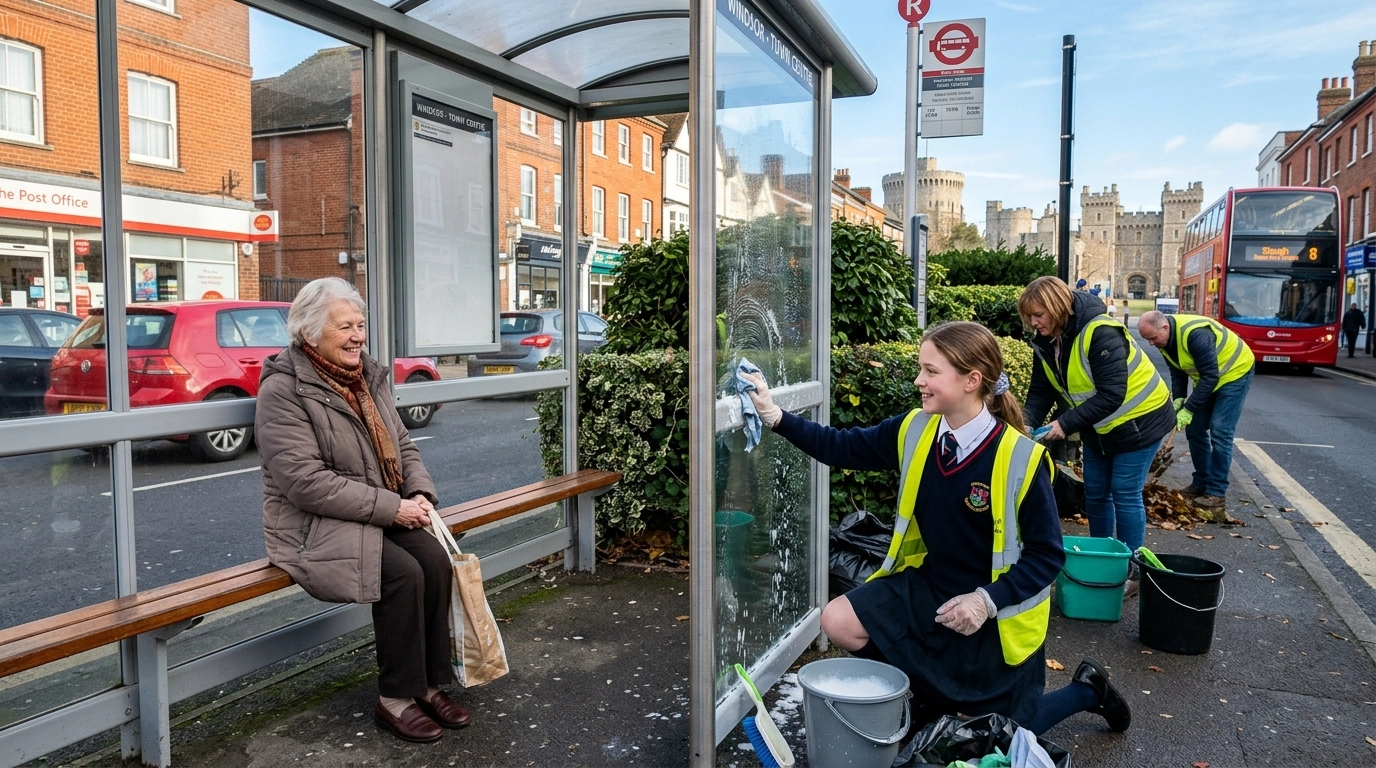
In the historic town of Windsor, known globally for its royal residence and picturesque streets, a small but significant revolution has been taking place at a local bus stop. This is not the work of the local council or a professional maintenance crew, but rather the initiative of a 12-year-old schoolgirl named Poppy Perry. Her story is a powerful reminder of how one individual, regardless of age, can identify a problem and take direct action to improve the lives of those around them.
The project began when Poppy noticed that one of her elderly neighbours, Margaret, was struggling with a recurring and frustrating problem. Margaret, like many residents in the area, relies on the local bus service to get to appointments and run errands. However, the bus stop she used had fallen into a state of neglect. Overgrown bushes, accumulated grime, and a general layer of urban decay had made the shelter nearly invisible to passing drivers. On more than one occasion, bus drivers had sailed past the stop, unaware that Margaret was waiting inside, hidden by the shadows and the mess.
Poppy decided that a simple complaint to the authorities was not enough. Seeing the distress this caused her neighbour, she took it upon herself to lead a team to clean up the shelter. This was not a quick dusting; it was a thorough, dedicated effort to restore a piece of community infrastructure to its intended state. Armed with cleaning supplies and supported by a small group of volunteers, Poppy set out to transform the neglected space.
The physical work involved clearing away thick layers of dirt and moss that had built up on the glass panels of the shelter. These panels, which should provide a clear view for both passengers and drivers, had become opaque. Poppy and her team also tackled the vegetation that had begun to encroach on the waiting area. By trimming back the overgrowth, they immediately improved the visibility of the stop from the road. The goal was simple: to ensure that no one else, especially vulnerable members of the community like Margaret, would be left stranded because a driver couldn’t see them.
A Simple Act of Kindness with a Big Impact
The impact of Poppy’s work was felt almost immediately. For Margaret, the transformation was life-changing in a very practical sense. She no longer had to stand on the very edge of the kerb, potentially in the path of traffic, just to catch a driver’s eye. The bus stop was once again a safe, clean, and visible place to wait. But the benefits extended far beyond one person. The entire neighbourhood noticed the difference. A space that had looked forgotten and unloved was now a testament to local pride.
This act of kindness highlights a common issue in many British towns: the gap between official maintenance schedules and the immediate needs of residents. Local councils often face budget constraints and long lists of priorities, meaning that smaller tasks like cleaning a specific bus shelter can fall through the cracks. Poppy’s initiative demonstrated that community-led action can fill these gaps effectively. It wasn’t about waiting for someone else to fix the problem; it was about recognising that as a resident, you have the power to make your own street a better place.
Furthermore, Poppy went a step beyond just cleaning. She identified that the visibility issue was a persistent one, even with a clean shelter. To provide a permanent solution, she came up with a plan to create a clear sign for the bus stop. This sign would serve as a permanent alert to drivers that passengers were waiting, even during the darker winter months or in poor weather conditions. This level of foresight and problem-solving is remarkable for someone of her age and shows a deep understanding of the practical challenges faced by public transport users.
The response from the Windsor community has been overwhelmingly positive. Neighbours have praised Poppy for her hard work and her leadership. It is rare to see a young person taking such an active interest in the maintenance of public spaces, and her efforts have sparked conversations about how others can contribute to their local areas. The success of the clean-up has shown that when one person takes the lead, others are often more than willing to follow and help.
The Importance of Community-Led Initiatives
Poppy’s project serves as an excellent case study for the importance of community-led initiatives. In an era where much of our interaction is digital, physical community spaces like bus stops, parks, and libraries remain the backbone of local social life. When these spaces are neglected, it sends a message that the community itself is being overlooked. By taking ownership of the bus stop, Poppy reclaimed that space for her neighbours.
Community-led initiatives often have a more immediate and tailored impact than top-down government interventions. Residents know exactly where the problems are because they live with them every day. They know which pavement is a trip hazard, which street light is flickering, and which bus stop is too dirty to sit in. When local people are empowered to take action, the solutions are often more practical and cost-effective. Poppy’s toolkit didn’t involve heavy machinery or expensive contracts; it involved soap, water, gardening shears, and a genuine desire to help.
This story also touches on the concept of intergenerational solidarity. In many modern communities, there is a growing disconnect between different age groups. Poppy’s motivation was rooted in her relationship with her elderly neighbour. By stepping in to help Margaret, she bridged that gap, showing that the youth of Windsor are invested in the well-being of their older residents. This kind of social cohesion is vital for a healthy, functioning society. It fosters a sense of security and belonging that is difficult to achieve through official policy alone.
The success of this clean-up has also prompted a wider discussion about the role of local councils. While Poppy’s work is commendable, it does raise questions about why such a basic service as bus stop maintenance was allowed to lapse. However, instead of focusing on the negative, the Windsor community has chosen to celebrate the positive. They have used this as an opportunity to advocate for better local services while simultaneously showing that they are not afraid to get their hands dirty when needed.
Inspiring the Next Generation of Local Heroes
Perhaps the most significant outcome of Poppy Perry’s initiative is the inspiration it provides to other young people. In schools across the UK, students are taught about global issues like climate change and social justice. While these are important, it can sometimes feel difficult for a child to know how to make a tangible difference. Poppy has shown that you don’t have to look far to find a cause worth fighting for. The most effective change often starts right on your own doorstep.
By leading a team, Poppy also developed valuable leadership and organisational skills. She had to coordinate volunteers, gather supplies, and communicate her vision to others. These are life skills that will serve her well in the future. More importantly, she has learned that her voice and her actions have weight. When young people see one of their peers taking charge and receiving praise for it, it breaks down the barrier of apathy. It proves that you are never too young to be a leader or a “local hero.”
The Windsor schoolgirl has essentially created a blueprint for local activism. It starts with observation: noticing a problem that affects others. It moves to empathy: understanding how that problem impacts someone’s life. Then it requires planning: deciding what steps are needed to fix it. Finally, it demands action: doing the work and seeing it through to the end. If more young people followed this model, our towns and cities would be cleaner, safer, and more connected.
As Poppy continues her studies and her involvement in the Windsor community, her bus stop stands as a shining example of what can be achieved with a little bit of effort and a lot of heart. It is no longer just a place to wait for a bus; it is a symbol of community spirit and a reminder that we all have a responsibility to look out for one another. The next time a bus pulls up and the driver sees a passenger clearly waiting behind the sparkling glass, they might not know Poppy’s name, but they will certainly see the results of her hard work. This simple act of cleaning up a community, one bus stop at a time, has left a lasting legacy that Windsor will not soon forget.