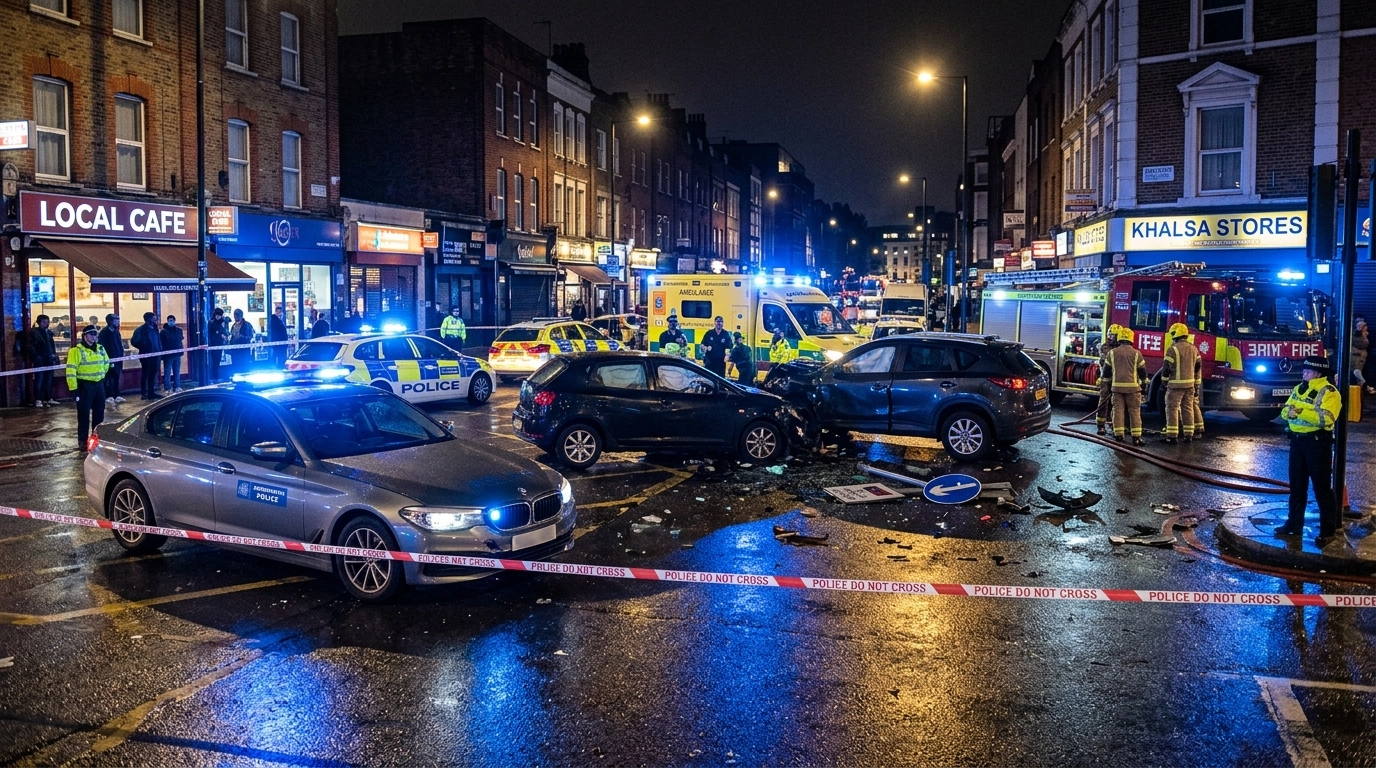
The quiet of an East London evening was shattered this weekend when a high-speed police pursuit culminated in a devastating collision, leaving five people with life-changing injuries and a community demanding answers.
The incident, which unfolded in the late hours of Saturday, has once again brought the complexities and dangers of urban police chases into sharp focus. As emergency services worked through the night to clear the wreckage and treat the wounded, the gravity of the situation became clear: nine people in total were hurt, with five currently fighting for their recovery in various London trauma centres.
The sequence of events began when officers identified a vehicle suspected of being stolen. In a city where vehicle crime remains a persistent challenge, the decision to engage is often made in seconds. However, the transformation of a routine patrol into a high-stakes pursuit through residential streets is a scenario that carries inherent risks: risks that were tragically realised on this occasion. The pursuit, which spanned several blocks of the densely populated East London area, ended abruptly when the suspect vehicle collided with another car, causing a chain reaction that drew in bystanders and other road users.
Witnesses at the scene described a scene of “pure carnage,” with the sound of the impact echoing through the surrounding streets. The mechanical violence of the crash was enough to alert residents blocks away, many of whom rushed to their windows or onto the pavement to find a landscape of twisted metal and flashing blue lights. For the five individuals seriously injured, the path to recovery will be long and arduous. Their lives were altered in an instant, caught in the crossfire of a pursuit that underscores the thin line between law enforcement and public safety.
The Circumstances Surrounding the Collision
The technical details of the pursuit are now the subject of an intensive investigation. Preliminary reports suggest that the suspect vehicle, a car flagged by automated number plate recognition systems as stolen, failed to stop when signaled by a marked police unit. This defiance triggered a pursuit that wound through several arterial roads in East London. The geography of the area, characterized by a mix of narrow side streets and busy junctions, makes any high-speed movement exceptionally hazardous.
As the suspect vehicle attempted to evade the trailing police units, it reportedly reached speeds that were entirely inappropriate for the urban environment. The pursuit came to its violent conclusion at a major junction, where the suspect car struck another vehicle broadside. The force of the impact was so significant that both vehicles were propelled into stationary objects, including street furniture and a parked car. The driver of the suspect vehicle was apprehended at the site of the crash, but the focus quickly shifted from the arrest to the immediate medical needs of those trapped in the wreckage.
In the aftermath of such a collision, the focus is often on the split-second decisions made by the officers involved. National guidelines for police pursuits are stringent, requiring a constant re-evaluation of risk versus reward. Officers must weigh the necessity of apprehending a suspect against the potential danger to the public. When a pursuit enters a residential zone or approaches a busy intersection, the threshold for continuing that pursuit becomes significantly higher. Investigators will be looking closely at whether the pursuit was terminated or if it was still active at the exact moment of the impact.
Emergency Response and Public Safety Concerns
The scale of the emergency response was a testament to the severity of the incident. Within minutes of the crash, the area was flooded with resources from the London Ambulance Service, including advanced trauma teams and the Air Ambulance. Fire crews were also dispatched to the scene to assist with the extraction of victims who were pinned inside the crumpled remains of the vehicles. The logistical challenge of managing nine casualties in a confined urban space required seamless coordination between the various branches of the emergency services.
For the five people identified as seriously injured, every second was critical. Advanced medical interventions were performed on the roadside before they were stabilized enough for transport to major trauma centres. The nature of the injuries: described by officials as “serious and life-changing”: suggests a combination of blunt force trauma, internal injuries, and fractures. While the other four individuals involved in the crash sustained less severe wounds, the psychological impact of being involved in such a violent event cannot be overstated.
Public safety remains the paramount concern for both the community and the authorities. This incident highlights the recurring debate regarding the safety of police pursuits in metropolitan areas. While the police have a duty to recover stolen property and apprehend those who flout the law, the potential for collateral damage is a haunting reality. Residents in East London have expressed growing concern about the frequency of high-speed chases through their neighbourhoods, noting that the density of the population makes the risk of a mass-casualty event like this one unacceptably high. The investigation will not only look at the criminal actions of the driver but will also provide an independent review of the police tactics employed during the chase.
The Broader Impact on East London Communities
Beyond the immediate physical toll, the crash has sent shockwaves through the local community. East London is a region defined by its resilience and its close-knit neighbourhoods, but events of this magnitude leave a lasting scar. In the days following the collision, the junction where the pursuit ended has become a place of reflection, with many locals pausing to contemplate the fragility of safety in the city. The incident serves as a stark reminder of how the actions of a few can have a profound and devastating impact on the lives of many.
The economic and social costs of such accidents are also substantial. Road closures following the crash caused significant disruption to local businesses and public transport, but these inconveniences pale in comparison to the human cost. For the families of those seriously injured, the focus is now on the long-term healthcare and support that will be required. There is also a broader conversation happening about the root causes of the vehicle crime that initiated this pursuit. As long as stolen vehicles remain a tool for criminal activity, the likelihood of police pursuits: and the risks they entail: remains a fixture of urban life.
As the legal proceedings against the driver of the stolen vehicle move forward, the independent oversight body tasked with reviewing police conduct will begin its work. This process is essential for maintaining public trust in the police force. Transparency is key; the community needs to know that the protocols designed to keep them safe were followed, and if they weren’t, that accountability will follow. For now, East London waits for news on the condition of the five victims, hoping that their recovery is swift, while grappling with the reality of a Saturday night that ended in a tragedy that could have been avoided. The conversation regarding how we police our streets and at what cost is far from over.