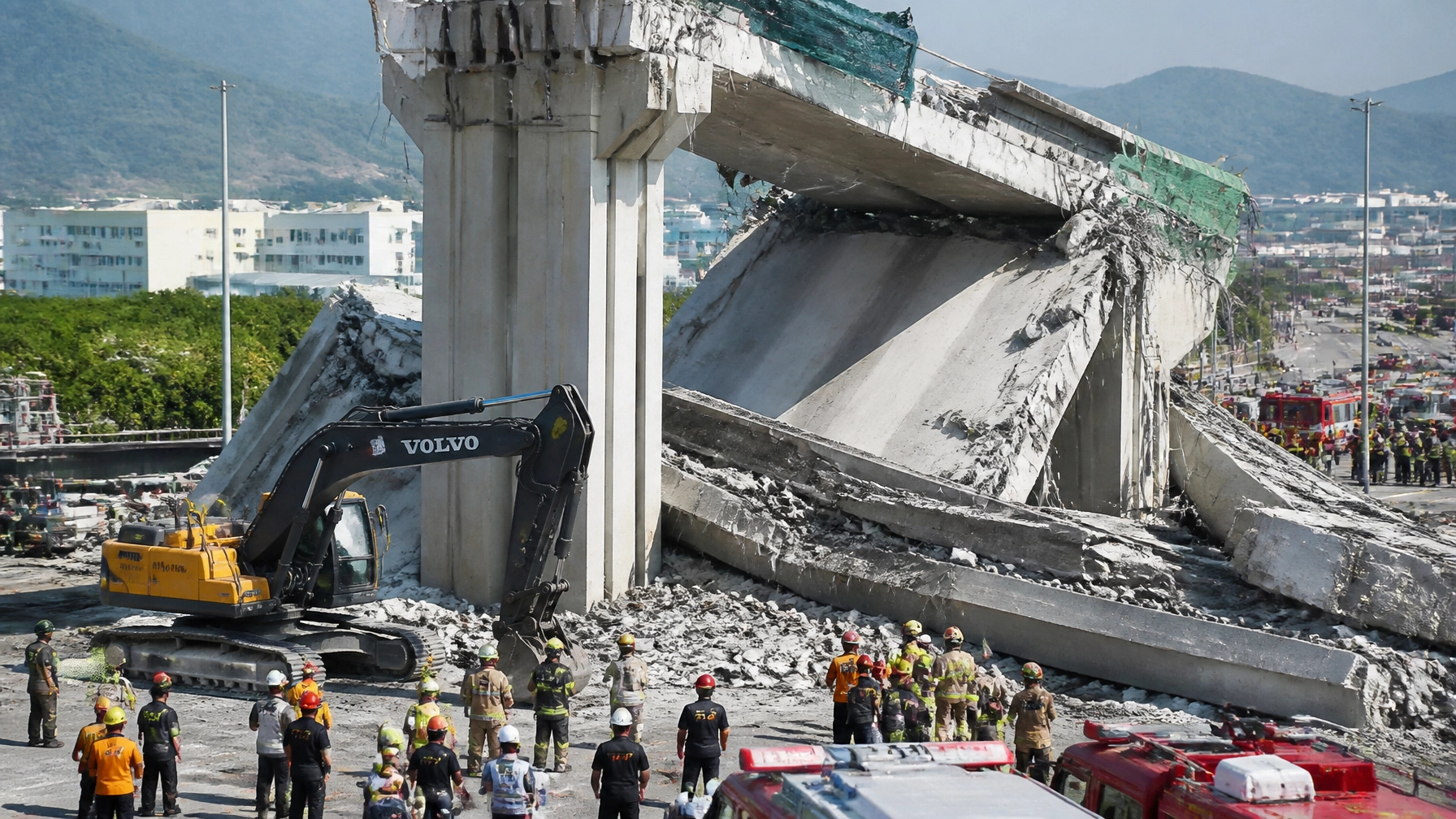
A catastrophic structural failure in central Seoul has claimed the lives of three workers and left several others injured, sending shockwaves through a city already grappling with the complexities of managing its aging urban infrastructure. The incident, which occurred during a planned demolition of a vintage overpass, has reignited fierce debates regarding safety protocols and the pressures of rapid urban renewal. As rescue teams sift through the twisted metal and shattered concrete, the tragedy serves as a grim reminder of the inherent dangers that linger within the bones of a city built during a period of unprecedented economic expansion.
The overpass, a concrete relic dating back to 1966, was in the process of being dismantled to make way for modern developments when a section of the upper deck gave way without warning. According to eyewitness accounts and preliminary reports from site supervisors, the collapse happened with terrifying speed, trapping those beneath the falling slabs before they had any chance to evacuate. What was intended to be a controlled engineering operation transformed in seconds into a scene of industrial carnage, highlighting the precarious nature of handling structures that have reached the end of their design life.
This particular structure had been under demolition since August 2025, a project initiated after routine inspections identified significant structural fatigue and safety concerns. It was a well-known landmark in central Seoul, representing the post-war industrial boom that transformed South Korea into a global economic powerhouse. However, as the city continues to reinvent itself, these older arteries of transport are increasingly being seen as liabilities. The collapse during the decommissioning phase suggests that the risks associated with removing these giants may be just as high as those involved in maintaining them.
The Moment of Structural Failure
The collapse occurred at approximately 2:33 p.m. local time, a period when the site was active with workers and heavy machinery. Demolition work had actually been paused shortly before the disaster after sharp-eyed workers noticed an alarming 2.9cm subsidence gap in the structure while concrete slabs were being cut. In a display of caution that ultimately could not prevent the tragedy, the main demolition activities were halted to allow for a "precise safety inspection" of the anomaly. It was during this very inspection, as experts were assessing the stability of the bridge deck, that the section gave way.
The failure was not gradual. Engineering experts suggest that the removal of certain supporting elements, combined with the pre-existing fatigue of the 60-year-old concrete, created a critical point of failure. When the upper deck collapsed, it brought down massive slabs of concrete and steel reinforcement bars, crushing vehicles and equipment positioned below. Of the twelve people present at the immediate site, six managed to evacuate in the moments leading up to the structural snap, having sensed the shifting weight of the overpass. For the remaining six, the outcome was far more dire.
Initial reports from the scene described a deafening roar followed by a cloud of thick grey dust that choked the surrounding streets. Two men, aged in their 50s and 60s, were killed instantly, buried deep beneath the primary impact zone. A third victim, also in his 50s, was initially pulled from the wreckage of a crushed vehicle and rushed to a nearby hospital, but succumbed to internal injuries shortly after arrival. The three survivors currently in hospital are being treated for serious injuries to their backs, heads, and ribs, with medical staff describing their condition as stable but critical.
Emergency Response and Recovery Efforts
The response from Seoul’s emergency services was immediate and massive. Within minutes of the first distress calls, dozens of fire engines, ambulances, and heavy rescue units converged on the site. Search and rescue dogs were deployed to ensure no other workers or passersby were trapped beneath the smaller fragments of debris. The complexity of the scene presented a significant challenge for first responders; the remaining sections of the overpass were deemed unstable, hanging precariously over the rescue site and threatening a secondary collapse.
Hydraulic cutters and heavy-duty cranes were brought in to stabilise the hanging steel beams while rescuers worked in the shadows of the wreckage. The area, a busy arterial route in central Seoul, was completely cordoned off, causing significant disruption to the city’s transport network. Debris from the fall also struck a nearby railway line, forcing the suspension of services to one of the city's major transport hubs. The logistical scale of the recovery operation highlighted the difficulty of managing a major structural failure in a high-density urban environment where space for heavy machinery is limited and the risk to surrounding buildings is high.
As night fell, floodlights illuminated the site, casting long shadows across the jagged concrete. Forensic engineering teams joined the fire department to begin the painstaking process of documenting the failure. Every piece of twisted rebar and every fractured slab was photographed and catalogued, as investigators sought to understand whether the collapse was the result of an unforeseen structural flaw or a failure in the demolition plan itself. The site has now been declared a crime scene as authorities look into potential negligence or violations of the Occupational Safety and Health Act.
Safety Standards and Urban Risk
The tragedy has sparked an immediate and intense conversation about the safety of South Korea’s aging infrastructure. The overpass was built during a decade when speed of construction often took precedence over long-term durability, a characteristic of the country's rapid development. While South Korea has made immense strides in engineering and safety standards in the decades since, the legacy of its earlier construction boom remains a persistent challenge. This incident is being viewed through the lens of historical disasters, such as the 1994 Seongsu Bridge collapse, which remains a deep scar on the national psyche.
Public anger is already mounting, with many questioning why a structure known to be unstable was not secured more rigorously during the demolition phase. The fact that the collapse occurred during a safety inspection is particularly galling for the families of the victims. It suggests that even when risks are identified, the protocols in place to manage those risks may be insufficient for the volatile nature of decommissioning heavy infrastructure. Government officials have promised a "thorough and uncompromising" investigation, with the Mayor of Seoul vowing to review all ongoing demolition projects across the capital.
Beyond the immediate legal and safety investigations, there is a broader concern regarding the thousands of similar structures across the country. As the "Miracle on the Han River" generation of infrastructure reaches the end of its lifespan, South Korea faces a massive wave of decommissioning and replacement projects. If the demolition of a single overpass can result in such a loss of life, the scale of the challenge ahead is daunting. Industry experts are calling for a fundamental shift in how these projects are approached, advocating for more advanced robotic demolition techniques that remove the human element from the most dangerous zones of a structural failure. For now, however, the focus remains on the grieving families and the search for answers in the rubble of central Seoul.