The sirens began their mournful wail across the Ukrainian capital long before the first impacts were felt, but the sheer velocity of the incoming ordinance meant that for many, there was little time to reach the safety of the city’s deep-level underground stations. In what has been described as one of the most sophisticated and violent aerial bombardments since the start of the conflict, a wave of Russian missiles and drones descended upon Kyiv in the early hours of Monday morning, leaving a trail of destruction that has shocked even a population now accustomed to the regular rhythm of air raids. The primary focus of the morning's devastation was the reported use of a hypersonic ballistic missile, a weapon that moves with such speed and force that conventional air defences often struggle to provide a comprehensive shield.
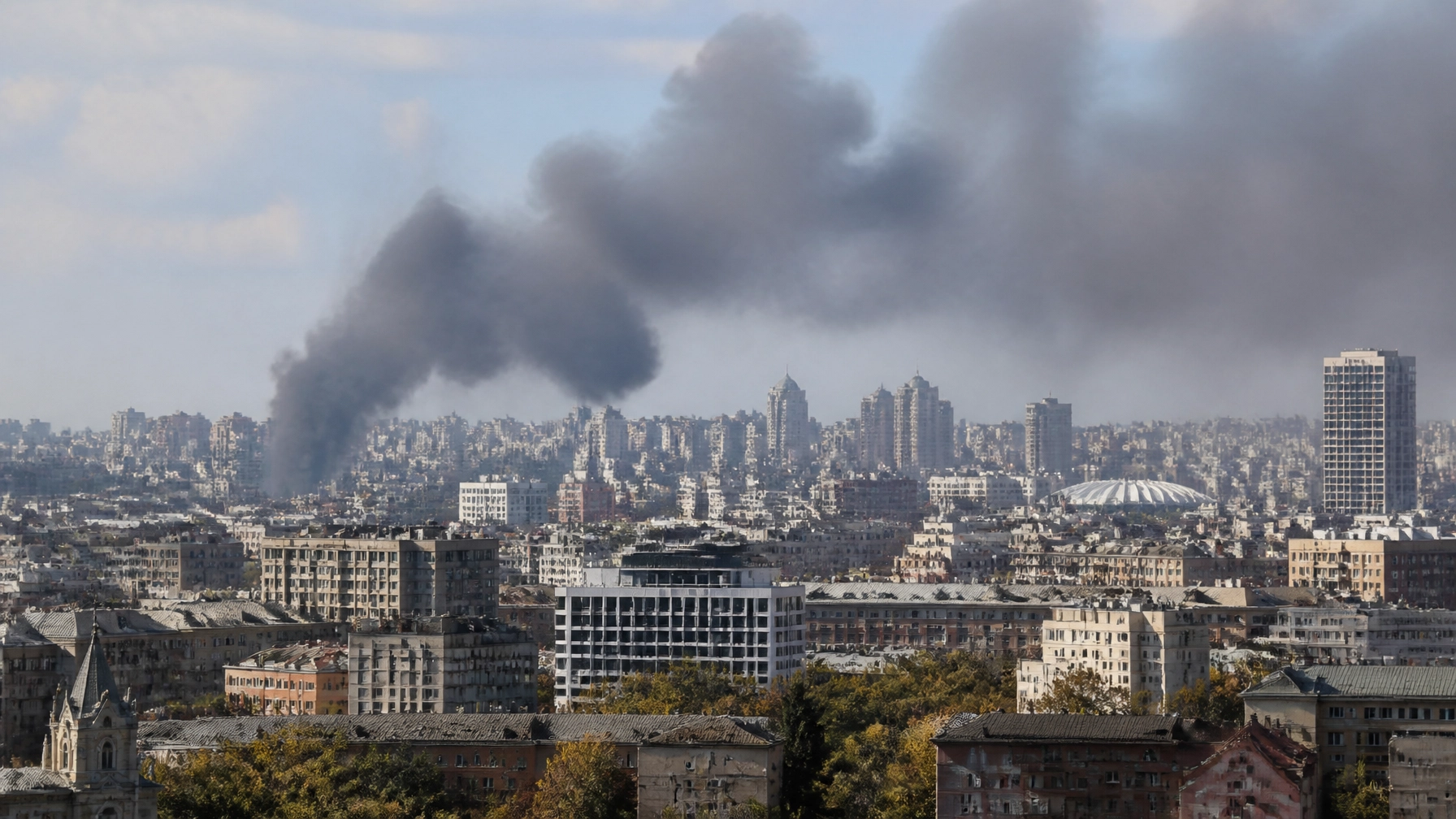
Emergency services were quickly on the scene as the sun rose over a city choked with the thick, acrid smoke of burning commercial and residential buildings. Initial reports from local officials confirmed that at least four people lost their lives in the capital alone, with dozens more treated for injuries ranging from glass lacerations to severe burns and smoke inhalation. The strike on a prominent trade centre, which served as a hub for local businesses and shoppers, became the most visible symbol of the morning’s violence. Firefighters battled for hours to contain the blaze as the skeletal remains of the structure glowed orange against the morning light. The intensity of the heat was so great that nearby vehicles were reduced to charred husks, and the shockwave from the impact shattered windows for several blocks in every direction.
President Volodymyr Zelenskyy addressed the nation shortly after the strikes, confirming the gravity of the situation and the specific nature of the weaponry used. He stated that the Russian military had deployed a hypersonic missile, identifying it as part of the advanced "Oreshnik" system. This revelation has sent shockwaves through the international community, as the use of such technology marks a significant escalation in the capability and lethology of the strikes being directed at civilian population centres. While Ukraine’s air defence systems have become increasingly adept at intercepting cruise missiles and Iranian-made loitering munitions, the arrival of hypersonic ordinance represents a new and terrifying challenge for the men and women tasked with guarding the skies above Kyiv.
The Devastation Across the Capital
The physical landscape of Kyiv has been altered by this latest round of strikes, with the damage extending far beyond the immediate blast zones. In the historic districts, where gold-domed cathedrals stand as symbols of national resilience, the air was filled with the sound of sweeping glass and the frantic calls of emergency workers. The strike on the trade centre was particularly devastating due to the time of the attack; while the building was not at peak capacity, several night-shift workers and security personnel were caught in the initial explosion. The recovery operation has been hampered by the instability of the remaining structure, with specialist teams using heavy machinery to lift concrete slabs in the hope of finding survivors trapped in the basement levels.
Residential areas were not spared. Several multi-storey apartment blocks sustained direct hits or were severely damaged by falling debris from intercepted missiles. In one northern suburb, a primary school suffered extensive damage to its upper floors, though fortunately, the building was empty at the hour of the impact. The humanitarian toll is being felt most acutely by the families of the four confirmed deceased, whose lives were cut short in the sanctuary of their own homes. The psychological impact on the survivors is equally profound, as the arrival of hypersonic weapons removes the relative certainty that sirens provide enough time for evacuation. The "Oreshnik" missile travels at several times the speed of sound, meaning the window between detection and impact is measured in seconds rather than minutes.
The regional military administration has been working tirelessly to restore essential services to the affected districts. Power lines were severed in multiple locations, leaving thousands of residents without electricity or water. Engineers have been deployed to bypass damaged substations, but the scale of the infrastructure damage means that some areas may face prolonged outages. The resilience of the Kyiv population remains a point of international admiration, as locals were seen joining clean-up efforts almost immediately after the "all-clear" signal was given. Despite the smoke still rising from the trade centre, the spirit of the city remains unbroken, even as the threat of further strikes looms over the horizon.
The Arrival of Hypersonic Weaponry
The confirmed use of a hypersonic ballistic missile represents a turning point in the aerial campaign directed against Ukraine. Unlike standard cruise missiles, which follow a predictable path and move at subsonic speeds, hypersonic weapons are designed to fly at extremely high velocities and can manoeuvre mid-flight. This makes them incredibly difficult for even the most advanced Western-supplied air defence systems to track and intercept. The "Oreshnik" system, mentioned by President Zelenskyy, is a relatively new addition to the Russian arsenal, and its deployment in a metropolitan area like Kyiv suggests a willingness to test high-end military technology against civilian infrastructure.
Military analysts suggest that the speed of these missiles allows them to penetrate hardened targets with sheer kinetic energy, often bypassing the need for a massive explosive warhead to cause catastrophic damage. However, in the case of the Kyiv strikes, the combination of speed and explosive power resulted in the total collapse of several reinforced structures. The challenge for Ukrainian forces is now one of detection and reaction time. Radars must be finely tuned to pick up objects moving at such extreme speeds, and the decision-making process for launching interceptor missiles must be near-instantaneous. The Ukrainian Air Force did report the successful downing of several drones and conventional missiles during the same wave of attacks, but they acknowledged that the hypersonic elements of the barrage posed a unique and largely unstopped threat.
The escalation is not merely technical but also political. By using such advanced weaponry, the Kremlin is sending a clear signal of its intent to continue the pressure on the Ukrainian capital regardless of the civilian cost. The deployment of the "Oreshnik" is seen by many as a direct response to recent shifts in the conflict's dynamics and a reminder of the vast military resources still at Russia's disposal. For the residents of Kyiv, the technical specifications of the missile matter less than the reality of its impact. The knowledge that a weapon can arrive with almost no warning has added a new layer of anxiety to daily life, as the traditional safety measures of the city are put to their ultimate test.
Humanitarian Impact and Global Response
The human cost of the morning's strikes extends beyond the casualty figures. Thousands of people have been displaced from their homes, and the destruction of the trade centre has had a significant impact on the local economy, affecting jobs and the supply of essential goods. Local hospitals have been placed on high alert, with medical staff working double shifts to treat the influx of wounded. The injuries seen in the wake of a hypersonic strike are often more severe than those from conventional shelling, with the sheer pressure of the shockwave causing internal injuries that are not immediately visible. Psychologists are also being deployed to help children and the elderly cope with the trauma of the morning's events.
International condemnation was swift, with leaders across Europe and the Western world denouncing the strike as a barbaric act of aggression. The use of hypersonic technology against a civilian population has been described as a further violation of international norms and a sign that the conflict is entering an even more dangerous phase. There are growing calls for the provision of even more advanced air defence systems to Ukraine, capable of countering the specific threat posed by high-speed ballistic missiles. However, the complexity of these systems means that training and deployment can take months, leaving a window of vulnerability that the current barrage has ruthlessly exploited.
As evening falls over Kyiv, the city is a place of contrasts. In some areas, life continues with a defiant sense of normality; cafes are open, and people walk their dogs through the parks. In others, the smell of smoke persists, and the sound of heavy machinery reminds everyone of the tragedy that unfolded just hours ago. The strikes have served to harden the resolve of many Ukrainians, who see the use of such advanced weaponry as a sign of desperation rather than strength. The conversation in the city has shifted from "if" another strike will happen to "when," and how best to prepare for a future where the sky itself holds such unpredictable and devastating power. The global community remains watchful, knowing that the events in Kyiv have implications that stretch far beyond the borders of Ukraine.