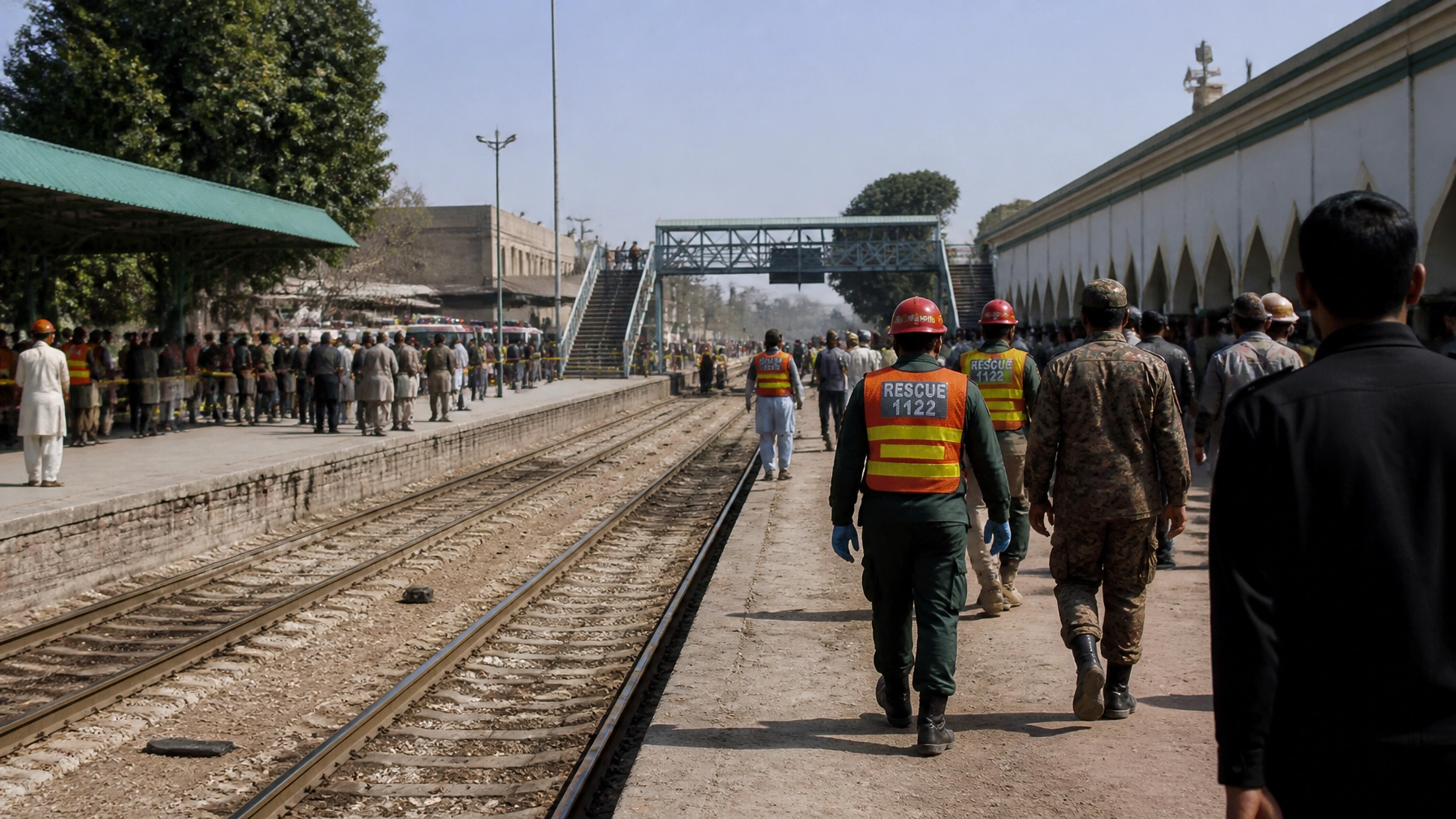
The early morning peace at Quetta’s central railway station was shattered by a devastating explosion that has left at least 24 people dead and dozens more fighting for their lives. At approximately 8:25 am local time, a suicide bomber detonated a powerful explosive device on a crowded platform, targeting passengers as they prepared to board the Jaffar Express. The train, which was scheduled to depart for Rawalpindi, was packed with civilians and military personnel, many of whom were returning home or heading to new assignments. The force of the blast was so immense that it tore through the station's overhead metal roofing and destroyed several stalls along the platform, leaving a scene of absolute carnage in its wake.
Survivors described a sudden, deafening roar followed by a thick cloud of dust and smoke that obscured the platform. Initial reports from the scene indicated that the bomber had managed to bypass security checks to reach the heart of the station where nearly 100 people were congregated near the ticket counter and the boarding area. The casualties include several members of the security forces, as well as women and children who were caught in the crossfire of a conflict that continues to plague the province of Balochistan. Emergency services arrived within minutes, but the scale of the destruction made rescue efforts difficult, with blood-stained luggage and debris scattered across the tracks.
The provincial capital has been placed on high alert as hospitals struggle to cope with the influx of the wounded. Medical professionals at the Civil Hospital and the Combined Military Hospital have declared an emergency, calling for blood donations as the death toll is expected to rise given the critical condition of many survivors. This latest atrocity marks one of the deadliest attacks in the region in recent months, highlighting the persistent and evolving threat posed by separatist movements that have long operated in the restive southwest of Pakistan.
The Immediate Aftermath and Identification of the Fallen
In the hours following the explosion, the true scale of the tragedy began to emerge. Of the 24 confirmed fatalities, a significant number were identified as military personnel from the infantry school, who were the primary target of the attacker. The bomber, believed to be carrying approximately 8 to 10 kilogrammes of explosives, had positioned himself strategically among a group of soldiers waiting to board a specific carriage. The precision of the attack suggests a high level of surveillance and planning, designed to inflict maximum damage on the state's security apparatus while simultaneously striking terror into the civilian population.
Witnesses spoke of the harrowing moments following the detonation. Many of those on the platform were knocked to the ground by the pressure wave, while others were struck by flying shrapnel. Local porters and railway staff were among the first to react, using luggage trolleys to transport the injured to waiting ambulances. The blast not only claimed lives but also caused significant structural damage to the historic station, which serves as a vital transport hub for the region. Steel girders were twisted by the heat and force of the explosion, and the smell of cordite hung heavy in the air for hours after the event.
As the smoke cleared, the grim task of identifying the victims began. Families gathered outside the hospitals, many having travelled from distant parts of the province after hearing news of the blast. The atmosphere was one of profound grief and anger, as the community reckoned with yet another loss of innocent life. Government officials have promised a full investigation into the security breach, questioning how a suicide bomber was able to enter such a high-profile location with a large quantity of explosives. Forensic teams have been working at the site to collect evidence, including the remains of the attacker, in an effort to trace the origins of the device and any potential accomplices.
The Balochistan Liberation Army and the Geography of Insurgency
Responsibility for the attack was swiftly claimed by the Balochistan Liberation Army (BLA), a separatist group that has been fighting a decades-long insurgency against the Pakistani state. Through their media channels, the group stated that their 'Majeed Brigade' had carried out the operation specifically targeting a unit of the Pakistani army. This claim underscores the group's ongoing strategy of targeting security forces and state infrastructure in their quest for greater autonomy or full independence for the province. Balochistan, while rich in natural resources such as gas and minerals, remains one of the country's most impoverished regions, a disparity that separatist groups frequently cite as a justification for their violence.
The BLA has intensified its campaign over the last year, moving away from small-scale ambushes to more sophisticated and large-scale suicide bombings. These attacks are often timed to coincide with major political or military events, aiming to project strength and undermine the authority of the central government. Quetta, as the provincial capital and a major logistics hub, has frequently been at the centre of this violence. The railway station attack is particularly significant as it strikes at the heart of the province's connectivity, sending a clear message that no location: no matter how vital or supposedly secure: is beyond the reach of the insurgents.
The security challenges in Balochistan are compounded by the region's rugged terrain and its proximity to the borders of Afghanistan and Iran. These porous boundaries allow militant groups to find sanctuary and move resources with relative ease. Despite numerous military operations aimed at dismantling the insurgent networks, the cycle of violence continues. The state’s response has historically swung between heavy-handed military crackdowns and attempts at political reconciliation, but the deep-seated grievances of the Baloch people regarding the distribution of wealth and political representation remain unaddressed. This vacuum of stability provides a fertile breeding ground for radicalisation and the continued recruitment of young men into the ranks of the BLA and other militant organisations.
A Nation in Mourning and the Call for Heightened Vigilance
The response from the national leadership has been one of stern condemnation and a renewed pledge to eradicate terrorism. The Prime Minister and the Chief Minister of Balochistan have both issued statements expressing their condolences to the families of the victims and vowing that the blood of the fallen will not have been shed in vain. A three-day period of mourning has been declared across the province, with the national flag flying at half-mast on all government buildings. However, for many residents of Quetta, these gestures offer little comfort in the face of such persistent insecurity. There is a growing sense of frustration with the perceived inability of the intelligence agencies to prevent such high-impact attacks in urban centres.
In the wake of the bombing, security has been significantly bolstered at railway stations, airports, and other public gatherings across the country. The Jaffar Express and other rail services to and from Quetta were temporarily suspended, leaving hundreds of passengers stranded and further disrupting the already fragile transport network. Security experts have warned that the success of the Quetta station bombing may embolden other militant groups to carry out similar attacks in other major cities, necessitating a comprehensive review of urban security protocols. The focus is now on improving intelligence sharing and the technical capabilities of the police to detect explosives before they reach their intended targets.
International reaction has also begun to pour in, with several countries expressing solidarity with Pakistan in its fight against extremism. The tragedy in Quetta serves as a stark reminder of the fragile security situation in the South Asian nation, which continues to grapple with internal dissent and external pressures. As the victims are laid to rest, the conversation in Pakistan is once again turning to the long-term solutions required to bring peace to Balochistan. While military force remains the primary tool for the state, there is an increasing recognition that without genuine political and economic engagement with the local population, the tragedy of Quetta is likely to be repeated. For now, the people of Balochistan are left to pick up the pieces of another broken morning, mourning the 24 lives lost to a conflict that shows no signs of resolution.