North Korea has officially entered a new era of military capability after successfully conducting its first flight tests of missiles equipped with artificial intelligence guidance systems. The launches, which took place under the personal supervision of Kim Jong Un, represent a significant technological leap for the isolated nation and have sparked immediate concern among international defence analysts. According to reports released by state media, these advanced systems are designed to enhance the precision of long-range strikes and bypass existing regional missile defence shields. The move signals a shift from traditional ballistic technology toward more autonomous, adaptive weaponry, raising the stakes in an already volatile geopolitical landscape.
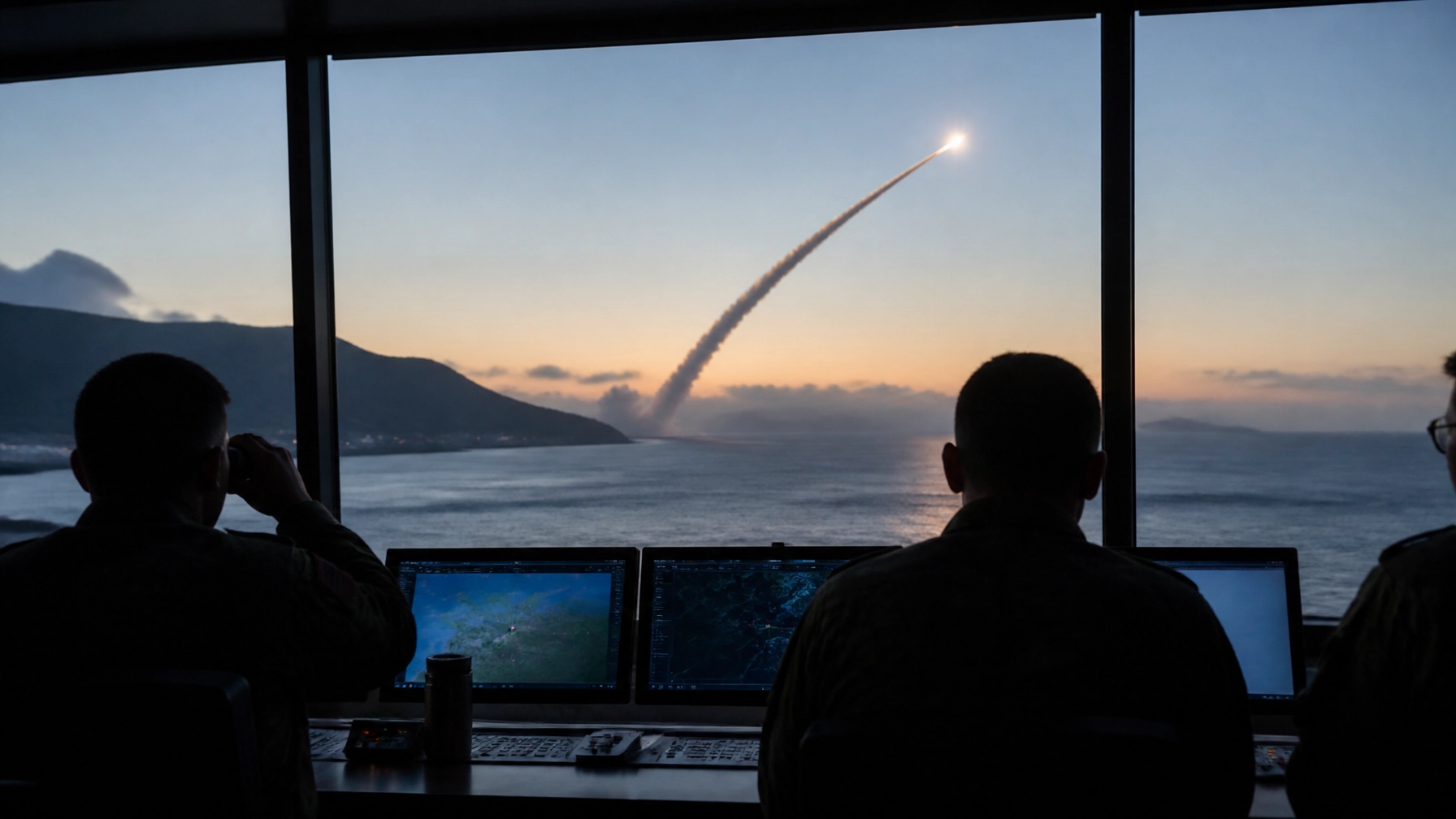
The tests involved a series of short-range and intermediate-range projectiles that utilised onboard AI to make real-time course corrections. Unlike previous iterations that relied on pre-programmed coordinates or basic GPS guidance, these new missiles allegedly possess the ability to identify targets and adjust their flight paths mid-air to avoid interception. Kim Jong Un was reportedly present at a command centre as the projectiles struck their intended maritime targets with what state sources described as "perfect accuracy." This development suggests that Pyongyang is successfully integrating modern computing and machine learning into its domestic weapons manufacturing, despite years of heavy international sanctions aimed at preventing exactly this kind of technological advancement.
Defence experts suggest that the integration of AI into missile systems is not merely a symbolic upgrade but a tactical necessity for North Korea. By automating the terminal phase of a missile’s flight, the weapons become significantly harder to track and destroy. Traditional interceptors rely on predictable parabolic arcs to calculate a kill point; however, an AI-guided missile can move erratically, mimicking the manoeuvres of a cruise missile but with the speed of a ballistic weapon. This hybrid capability complicates the defensive calculations for neighbouring nations and international task forces stationed in the Pacific, creating a new layer of uncertainty regarding the effectiveness of current naval and land-based defence batteries.
The Evolution of Autonomous Warfare in the Pacific
The emergence of AI-guided weaponry in North Korea marks a definitive turning point in the regional arms race. For decades, the focus of the international community has been on the sheer volume and range of Pyongyang’s arsenal. However, the shift toward "smart" weaponry suggests a move toward quality and survivability. These AI systems are believed to be capable of processing vast amounts of sensor data to differentiate between decoys and actual military assets, a development that would give North Korea a sophisticated edge in any potential conflict. The sophistication of the software required for such tasks points to a robust cyber-warfare and domestic tech sector that has managed to thrive in the shadows of the global economy.
Regional powers have long monitored the development of North Korea’s solid-fuel technology, which allows for faster deployment and more difficult detection. The combination of solid-fuel propulsion and AI guidance creates a weapon system that is both rapidly deployable and highly manoeuvrable. This evolution forces a rethink of the deterrent strategies currently employed by Western allies. If a missile can "think" for itself during the final seconds of its flight, the window for a successful interception shrinks from minutes to mere seconds. This technological leap forward is being viewed not as an isolated experiment, but as the beginning of a broader campaign to modernise the entire North Korean strategic force.
The timing of these tests is equally critical. They follow a period of intensified military cooperation between Pyongyang and other global powers, suggesting that the exchange of technical knowledge may be accelerating North Korea's domestic programmes. While the exact origin of the AI algorithms remains a subject of intense scrutiny, the result is undeniable: the nation is no longer just a nuclear threat through raw power, but is becoming a precision threat through digital innovation. This shift toward autonomous warfare signifies that the battlefields of the future in the Pacific will be defined as much by software and processors as they are by explosives and steel.
Strategic Implications and the Failure of International Sanctions
The successful demonstration of AI-guided missiles is perhaps the most glaring evidence to date that international sanctions are failing to keep pace with technological reality. For years, the global community has sought to choke off the supply of advanced electronics and specialised components to North Korea. Yet, the sophistication displayed in these latest tests suggests a sophisticated domestic supply chain or a highly effective illicit procurement network. The ability to develop, test, and deploy AI software within a missile’s guidance package requires high-end semiconductors and advanced computing power: items that are strictly prohibited under current trade embargoes.
This failure of containment has led to calls for a total reassessment of how the international community engages with North Korea. The traditional "maximum pressure" approach appears to have done little to slow the march of progress within the country's military research institutes. Instead, Pyongyang has pivoted toward asymmetrical advantages, using cyber-attacks to fund its research and development while leveraging emerging technologies to bypass the massive conventional military superiority of its rivals. The AI-guided missile programme is the crown jewel of this asymmetrical strategy, providing a low-cost, high-impact deterrent that challenges the status quo of regional security.
Furthermore, the introduction of AI into the nuclear-capable missile fleet introduces new risks regarding miscalculation and accidental escalation. If an AI system malfunctions or misidentifies a target during a period of high tension, the consequences could be catastrophic. The lack of transparency surrounding the logic and safety protocols of these autonomous systems means that the margin for error is dangerously thin. As North Korea continues to refine these technologies, the pressure on international diplomats to find a new path forward increases, as the old methods of containment and isolation seem increasingly detached from the reality on the ground.
A New Front in Global Security and Precision Deterrence
The world is now witnessing a fundamental change in the nature of the threat posed by North Korea. While previous concerns focused on the possibility of a nuclear strike, the current focus must also include the precision with which such a strike could be delivered. The AI-guided missile programme represents a commitment to precision deterrence: the idea that even a small number of missiles can be effective if they are guaranteed to hit their targets. This approach allows North Korea to maintain a credible threat with a smaller, more mobile, and more technologically advanced force, making it significantly harder for any adversary to eliminate the threat in a single pre-emptive action.
As these systems are integrated into the broader military architecture, they will likely be paired with other emerging technologies, such as drone swarms and advanced electronic warfare suites. The goal is to create a multi-layered offensive capability that can overwhelm any single point of failure in an enemy's defence. The international community now faces a challenge that is as much about digital security as it is about physical borders. The code that drives these missiles is just as dangerous as the warheads they carry, and the race to counter this new digital threat has only just begun.
Looking ahead, the international response will likely focus on enhancing cyber-defences and developing new types of kinetic interceptors capable of matching the agility of AI-driven projectiles. However, the true challenge remains political. As North Korea cements its status as a technologically advanced military power, the leverage held by the West continues to erode. The first tests of AI-guided missiles are not just a military milestone; they are a clear message to the world that Pyongyang has adapted to the 21st century and is prepared to compete on the cutting edge of modern warfare. The tension in the Pacific has reached a new height, and the path to de-escalation has never been more complex or more urgent.