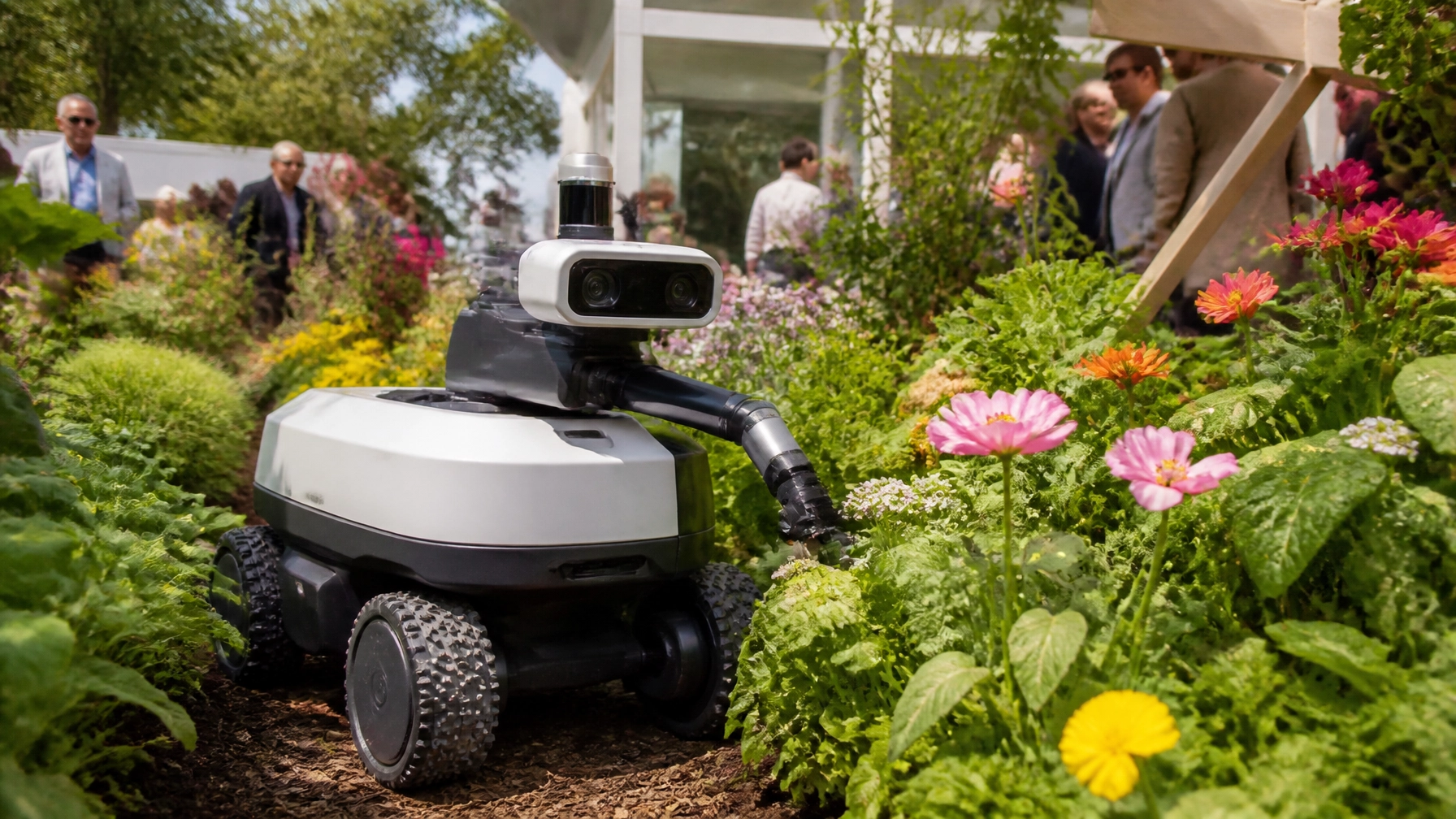
The prestigious grounds of the Chelsea Flower Show have long been the stage for the world’s most breathtaking floral displays and innovative landscape designs. However, this year, the conversation has shifted from the aesthetic beauty of the petals to the invisible processes occurring within them. Amidst the manicured hedges and vibrant blooms, a new kind of visitor has stolen the spotlight: a sleek, sophisticated AI-powered robot designed not just to observe, but to protect the future of global agriculture. This groundbreaking technology, known as the PhenAIx system, represents a significant leap forward in how we understand and manage plant health, offering a proactive solution to some of the most pressing challenges in farming today.
Unveiled as part of the RoboCrops exhibit, the PhenAIx system is the result of years of intensive research and development aimed at bridging the gap between traditional botany and cutting-edge robotics. At first glance, the machine appears as a marvel of modern engineering, navigating the delicate environment of the show’s GreenSTEM zone with remarkable precision. But its true power lies in its ability to see what the human eye cannot. By utilising advanced imaging and machine learning, the robot can identify the earliest markers of plant disease and environmental stress months before any physical symptoms become visible to the naked eye. This "health scan" for the natural world has the potential to revolutionise crop management, shifting the industry from a reactive model of crisis management to one of informed, early intervention.
Predicting Disease Before the Human Eye Can
The fundamental challenge in modern agriculture is that by the time a farmer notices a plant is suffering, the damage is often already irreversible. Fungal infections, viral pathogens, and nutrient deficiencies typically manifest as wilting, discolouration, or stunted growth: all of which are late-stage symptoms. The PhenAIx system changes this narrative entirely. By employing hyperspectral imaging, the robot captures data across a broad range of the electromagnetic spectrum, including wavelengths that are invisible to humans. This allows the AI to detect subtle physiological changes, such as shifts in chlorophyll fluorescence or leaf temperature, which serve as early warning signs of distress.
As the robot traverses a field or a greenhouse, its sensors gather a staggering amount of data on every individual plant. This information is then processed in real-time by sophisticated machine learning algorithms that have been trained on thousands of examples of both healthy and diseased vegetation. The AI can distinguish between different types of stress: identifying whether a plant is thirsty, lacking specific nutrients, or under attack by a particular pathogen. At the Chelsea Flower Show, visitors were able to see this in action as the robot scanned a variety of ornamental and crop species, providing a detailed health report that highlighted potential risks long before a traditional gardener would even suspect a problem.
This level of early detection is particularly crucial for commercial growers and plant breeders. In a large-scale agricultural setting, the ability to isolate a single infected plant before a disease can spread across an entire crop could mean the difference between a successful harvest and a total loss. Furthermore, by providing such precise data, the system allows for targeted treatments. Instead of applying pesticides or fertilisers across an entire field, farmers can address the specific needs of individual plants or small patches, significantly reducing chemical usage and operational costs. It is a more surgical approach to farming that respects the delicate balance of the ecosystem while ensuring the health of the crop.
Transforming Agriculture Through Precision
The introduction of the PhenAIx system at Chelsea is more than just a showcase of a new gadget; it is a demonstration of the power of "high-throughput phenotyping." This process involves the systematic measurement of plant traits to understand how they respond to their environment and their genetic makeup. Traditionally, this was a slow, manual process that required researchers to spend hundreds of hours measuring leaves and monitoring growth by hand. The automation provided by this robotic platform allows for data collection at a scale and speed that was previously unimaginable. This efficiency is vital for the development of new, more resilient crop varieties that are better suited to a changing climate.
As global temperatures rise and weather patterns become increasingly unpredictable, the demand for crops that can withstand drought, heat, and new pests is higher than ever. Plant breeders use systems like PhenAIx to conduct large-scale trials, monitoring thousands of different plant varieties simultaneously to see which ones perform best under specific stress conditions. The AI-driven data provides an objective, highly accurate measure of performance, removing the subjectivity of human observation. This accelerates the breeding cycle, helping to bring more hardy and productive crops to market faster than ever before. It is a perfect marriage of technology and nature, where data serves as the foundation for a more robust agricultural sector.
The robot’s presence at the Chelsea Flower Show also highlights the growing intersection between urban gardening and professional agriculture. While the technology is currently targeted at large-scale producers and researchers, the principles of AI-driven plant care are beginning to trickle down to the domestic level. The same sensors that help a farmer save a wheat crop can also help a gardener maintain a prize-winning orchid or a productive vegetable patch. By demonstrating this technology in such a high-profile, public setting, the creators of the PhenAIx system are inviting a broader conversation about the role of technology in our relationship with the natural world. It encourages a view of AI not as something that replaces human intuition, but as a tool that enhances our ability to care for the environment.
A Sustainable Future for Global Food Security
At its heart, the mission of the PhenAIx system and the RoboCrops exhibit is to address the global challenge of food security. With the world’s population projected to reach nearly ten billion by 2050, the agricultural industry must find ways to produce more food with fewer resources. This requires a significant increase in efficiency and a drastic reduction in waste. Disease remains one of the primary drivers of crop loss worldwide, accounting for billions of pounds in economic damage and threatening the stability of food supplies in vulnerable regions. By providing a tool that can stop these diseases in their tracks, the PhenAIx system offers a powerful weapon in the fight against hunger.
Sustainability is another key pillar of this technological shift. The ability to monitor plant health with such precision directly supports more sustainable farming practices. By reducing the need for broad-spectrum chemical applications, we can protect soil health and prevent harmful runoff into local water systems. Furthermore, the data gathered by the robot helps farmers optimise their water usage, ensuring that every drop is used where it is most needed. This precision agriculture is essential for minimising the environmental footprint of food production, ensuring that we can feed the world without depleting the planet’s natural resources. It is a vision of the future where technology and ecology work in harmony to create a more resilient and sustainable food system.
The recognition the RoboCrops exhibit received at the Chelsea Flower Show, earning a prestigious Silver Gilt medal, is a testament to the importance of this work. It signals a growing awareness within the horticultural and agricultural communities that innovation is necessary to protect the heritage of our landscapes and the security of our food. As the PhenAIx robot moves from the exhibition halls of Chelsea to the working farms of the world, it carries with it the promise of a new era in agriculture. An era where we are no longer at the mercy of hidden diseases, but are instead empowered by data to nurture a healthier, more productive, and more sustainable world. The future of farming has arrived, and it is powered by the intelligent application of technology in service of the earth.